Home Blog Page 15

NHS ECCG OOH Services, 10 Year, Single Supplier Contract ITT Issued – April 2018

0

Issue: 62

This occasional newsletter is researched, written and edited by a group of concerned residents in Ealing, West London who want to preserve our NHS. We view the wholesale engagement of private, for-profit healthcare service suppliers as unnecessary, profligate and dangerous. Increased financial funding is what is needed in our NHS – not financial cuts, closure of vital services or privatisation.


NHS ECCG OOH Services, 10 Year, Single Supplier Contract ITT Issued: Contract Value Between £450 Million and £1.2 Billion

On 22 March 2018 the NHS Ealing Clinical Commissioning Group (ECCG) advertised an Invitation to Tender (ITT) for a 10 year, single supplier Out Of Hospital (OOH) services contract for Ealing The deadline for responding to the ITT is 21 June 2018.


The basic value of the contract is £450.2 million and it will run from 1 April 2019 to 31 March 2029. But that isn’t the end of the potential value of the contract. ‘Transitional’ funding of £47.4 million might be available as might the possibility of adding to ‘the contract scope by annual value of £79.9 million’. Add this lot up for 10 years and we arrive at a potential contract value of some £1.2 billion.


Of note is that Dr Mohini Parmar Chair of ECCG wrote on 8 September 2017 that the 2017/18 OOH services spend in Ealing would be £121.794 million. Over 10 years that would cost (excluding inflation) £1.2794 billion. If the basic cost of the contract (£450.2 million) is all that is spent over 10 years then there would have to be massive reductions in the quantity and quality of OOH services managed and delivered. Maybe if potential bidders think this might be the case, they will not bid.


Why No NELs Reduction Target?

ECCG Managing Director Tessa Sandell recently confirmed in public that no cost reductions would be targeted in the future management and delivery of OOH services in Ealing. The cost reductions would be achieved by reductions in Non-Elective hospital admissions (NELs). So, why one might ask is there no NELs reduction target for Ealing specified in the OOH ITT or in the supporting documents? By 2025/26 and beyond annually for Ealing there should be (pro rata) an annual reduction of 12,375 NELs.


If the NHS SaHF IMBC SOC1 Business Case Continues To Be Rejected, Is This OOH Services Single Supplier Contract a Non-Starter?

In 2012 NHS North West London (NWL) launched its ‘Shaping a Healthier Future’ (SaHF) project. Part of the SaHF plan was the closure of Ealing District General Hospital and the enabling of OOH services via the creation of Ealing community health ‘hubs’ and the expansion of some Ealing GP surgeries. The final SaHF business case for these OOH services changes was published in December 2016. In it (IMBC SOC1) was a request for £513 million for OOH services building work. In September 2017 this business case was rejected by NHSE/NHSI (London). Surely without this £513 million capital grant the OOH services contract is a non-starter?


Where are the OOH Social Care Services and the OOH Integrated Healthcare and Social Care Services in this ITT?

I’ve had a good look at the 36 OOH services listed in the OOH Contract Prospectus, and at all of the ITT supporting documents. The phrase ‘social care’ is hardly mentioned at all. The Government launched the programme to integrate health care services and social care services way back in 2010. We now even have a single Healthcare and Social Care Ministry. The 2014 NHSE Five Year Forward View and the 2016 NHS NWL Sustainability and Transformation Plan (STP) require integrated healthcare and social care services. In the supporting documents we have a paper on Clinical Standards, but no equivalent paper on Social Care Standards. This ECCG OOH services ITT is almost exclusively about NHS healthcare services. As such it’s a complete dinosaur.


Multiple Confusions About Accountable Care/Integrated Care Organisations

The ITT describes the OOH Services contract as’…a building block in the development of integrated care systems for Ealing in the support of the NW London Health and Care Partnership ambition for an integrated care system for NWL’. Now this is all over the place. The October 2016 NHS NWL STP makes no reference to integrated care systems (or their progenitor Accountable Care Partnerships (ACPs)) in Ealing. In fact the only ACP reference in the NHS NWL STP is for Delivery Area DA3 ‘Achieving better outcomes and experiences for older people’.


Where is the Evidence that a Single Supplier OOH Service in Ealing Will Be Any Better Than What We Have Now?

I understand that a business case exists to support this outsourcing move, but this is being kept hidden from the public. Surely the contents can’t be commercially sensitive and anyway public money is involved here and how and why it is planned to be spent should be publicly accountable.


NHS North West London (NWL) 2012 ‘Shaping a Healthier Future’ (SaHF) Still in The Doldrums

It’s now six months since NHS England (London) and NHS Improvement (London) said ‘no’ to the NHS NWL SaHF ImBC SOC1 business case, which asked for £513 million for building work. According to the London North West University Healthcare NHS Trust (LNWUHT) Strategy Committee meeting Minutes, the SaHF Programme Management Office team, the NHSI SOC1 Oversight Group, NWL Trusts and NWL CCGs are all attempting to justify the unjustifiable. SaHF predicts that if we do nothing there will be some 250,000 Non-Elective (NEL) annual NWL hospital admissions annually by 2025/26. ImBC SOC1 requires an annual reduction of 99,000 NELs by 2025/26. NHSE/NHSI state that no evidence has been presented by SaHF which justifies such a massive reduction in annual NELs.


But those pesky NELs keep on rising. LNWUHT Deputy Chief Finance Officer Bimar Patel stated recently that NEL activity rose every month between October 2017 and January 2018. It’s no better with social care and mental health bed blockers either. Delayed Transfers of Care (DTOCs) are not reducing significantly, and in fact beds are being opened rather than closed. In March 2018, LNWUHT Chief Financial Officer Jon Bell confirmed the Trust had planned for 40 (extra) beds for April 2018.


And there was no joy for NHS NWL in the 28 March 2018 Government announcement of NHS capital grants. Out of £760 million awarded nationally, NHS NWL will receive just £4.2 million. You have to ask yourself just how realistic is NHS NWL SaHF’s request for a capital grant of £513 million in the context of these recent awards.


NHS NWL Trusts Fighting Each Other or Working with Each Other to Try to Win the Ealing Out Of Hospital 10 Year, Single Provider Contract

LNWUHT, West London Mental Health NHS Trust (WLMHT) and Hillingdon Hospitals NHS Foundation Trust are all seemingly working on bidding for this contract which was  advertised on 22 March 2018. WLMHT is seemingly pursuing discussions with Central and North West London NHS Foundation Trust and Central London Community Healthcare NHS Trust.


It seems extraordinary that WLMHT, which last year was found wanting by CQC in 9 of its 11 core areas of operation, should be considering taking on running over 30 primarily physical care services in Ealing. This would be on top of improving its mental health services in Ealing, Hounslow, Hammersmith and Fulham, and at Broadmoor.


I can just about remember a time when we had hospitals which just provided care for patients – and that was all they did.


NHSE/NHSI is Making Impossible Demands on Overworked NHS Hospital Doctors

An NHSE/NHSI letter dated 9 March 2018 to NHS hospital doctors instructs that every patient should be medically assessed each morning and evening by a senior doctor. The letter also tells hospitals to ‘boost essential services such as diagnostics and pharmacy at weekends to maximise Non-Elective (NEL) patient flows’. These orders are all about moving patients out of (expensive) hospital beds as soon as possible.


The 2014 NHS Five Year Forward View (FYFV) and all 2016 44 NHS Sustainability and Transformation Plans (STPs) require the NHS in England to collectively improve care services, achieve annual cost savings of £33 billion and a 3% improvement in efficiency – all by 2020/21.


In January 2018 the BMA reported that seven out of ten hospital doctors said there were gaps in the shift rotas in their departments. NHS Providers in March 2018 stated that 9,600 doctor posts in England were vacant. One does wonder whether pressurising and hectoring clinically under resourced NHS hospitals is an effective approach to help the NHS attain its challenging performance, financial and efficiency goals.


A House of Commons Library Paper Attempts to Describe and Explain the Accountable Care Organisation (ACO) Saga

Just as NHS England (NHSE) decides to ‘retire’ the term ‘Accountable Care’ and replace it with ‘Integrated Care’ the House of Commons (HoC) Library issues a paper entitled ‘Accountable Care Organisations’.


This 5 March 2018, CBP 8190, 16 page paper provides an interesting audit trail of decisions, opinions and facts about ACOs in England. However I find it thin on the ground in identifying ACO challenges. It does not get to grips with the enormity of integrating healthcare services with social care services. It does refer to IT, culture and mindset challenges, but it fails to mention the considerable dichotomies of  business models and patient databases in NHS healthcare and Local Authority social care.


ACO Cavalcade Has Been Halted

The whole ACO cavalcade has had to be halted because of Government legislative

‘gaps’ being attacked by Judicial Review (JR) initiatives. On 25 January 2018 we were promised a 12 week public consultation on ACO, but none has been forthcoming. The Government said it wanted to introduce ACO enabling legislation in February 2018 – and this has just not happened. The Department of Health’s (DoH’s) edict that 20% of England’s population should be covered by ACOs/ICOs/MCPs/PACS in 2017/18 has also not been realised. The DoH call for this to be 50% coverage by 2020 is truly risible.


The August 2017 draft ACO contract is alluded to. The contract concepts of ‘full’, ‘partial’, and ‘virtual’ integration are repeated. I can’t help being reminded that it’s hard to be partially or virtually pregnant – and I suggest this also applies to integration.


All the eight grant-aided Accountable Care Systems ACSs (now ICSs) announced in June 2017 have been halted – no reason given, but the two JRs and missing legislation must be clues here. The grant aid for these ACS/ICS experiments is £450 million over four years.


The paper alludes to the riddles of ACSs/ICSs involving CCGs, whilst ACOs/ICOs do not; and ACSs/ICSs broadly relating to STP areas and ACOs/ICOs relating to (smaller) CCG areas.   


Will ACOs Be the Death-knell for CCGs?

In ‘2. Role of CCGs’ we enter a surreal world of ‘children’ supposedly supervising their ‘parents’. If an ACO is awarded a 10/15 year, fixed price contract to provide integrated healthcare and social care to a defined population then, for this to make any sense at all, this ACO must be the commissioning body for all the care services. The CCGs and Local Authorities – sitting ‘below’ the ACO – cannot themselves commission these services as well. You can only have one ‘big boss’ and that clearly will be the ACO.


Jeremy Hunt MP is quoted as saying in 2014 that the 211 CCGs would be turned into ACOs. I see this as highly unlikely and what is more likely is that ACOs will make CCGs irrelevant and they will atrophy.


In ‘3. Legal Challenges’ the 999callforNHS JR will be in court on 24 April 2018 and the JR4NHS JR will be in court on 23 and 24 May 2018.


In ‘4.2 Role of GPs’ both ‘GP Online’ and the BMA are quoted raising concerns about the future role and status of GPs. Both worry about GPs losing their independent contractor status. NHSE envisions ‘multiple models of GP participation’ including partial and virtual integration. This sounds like twaddle to me.


‘4.3 Rationing of Service’ gets to the heart of the ACO raison d’etre – cutting costs. From my 21 years of running my own business I have never experienced a cost cutting initiative resulting in improved quality or quantity of service.


Plans to Transform NHS North West London’s Care Services Still in Disarray – March 2018

0

Issue: 61

Plans to Transform NHS North West London’s Care Services Still in Disarray

NHS North West London (NWL) is possibly unique in England in having not one, but two major different care transformation programmes in play at the same time. The 2012 ‘Shaping a Healthier Future’ (SaHF) project is still attempting to implement ‘changes that will improve (health) care both in hospitals and the community and save many lives each year’. The 2016 NHS NWL Sustainability and Transformation Plan (STP) attempts to improve health and wellbeing, improve (and integrate) healthcare services and social care services, improve productivity and close the financial gap. Both the SaHF and the STP postulate major financial saving accruing for massively reducing annual Non-Elective hospital admissions (NELs). The ‘replacement’ for NELs will be treatment at home, in community healthcare day centres (‘hubs’) and in some expanded GP services. This latter treatment modality is often called Out Of Hospital (OOH) services


NHS NWL SaHF and the STP were effectively halted in November 2017 when the SaHF business case (IMBC SOC1) was rejected by NHS England (London) and NHS Improvement (London). The rejection was on the basis of lack of evidence to support an annual reduction of Non-Elective hospital admissions (NELs) by 99,000 by 2025/26. On 9 February 2018 NHS NWL bosses were scheduled to meet with NHSI/NHSE (London) at which they hoped to supply the missing evidence. On 13 March 2018 we discovered that the 9 February 2018  meeting had been cancelled by NHSE/NHSI.


The IMBC SOC1 business case asks for £513 million for building work. However waiting in the wings is IMBC SOC2 which will ask for another £314 million for building work in ‘inner’ NWL. If this amount of cash for the builders in NWL is typical, then in London the cash for builders for NHS STPs will be £4.1 billion and nationally it would be £36.3 billion. Surely this is all pie in the sky?


The Curious Case of MCAP, Finnamore, NHS Bosses, Freedom of Information and The Truth

In 2012 NHS North West London (NWL) launched its ‘Shaping a Healthier Future’ (SaHF) project. Central to this project was improving healthcare services and reducing health care costs. The project mandated reducing the number of hospital admissions, District General Hospitals, hospital A&E units and hospital beds. Many more patients would be treated in their own homes, in community healthcare day centres (‘hubs’), and in some expanded GP surgeries. Our health would also be improved and cost savings achieved by measures which would somehow persuade us all to live healthier lives. These out of hospital services are variously referred to within the NHS as Community Services, Intermediate Services and Out of Hospital (OOH) Services.


A core component of this project was the theory, promulgated by American management consultants McKinsey & Co in 2009 and 2012, that 40% of patients in Acute care in hospitals should not be there. These 40% of patients should be successfully and less expensively treated using OOH services. In NHS NWL’s SaHF project there was clearly an aspiration to provide a proof of this theory.  On 7 March 2013, an Invitation To Tender (ITT) was created by NHS NWL to find an organisation who could provide this ‘proof’ . It’s not clear how many suppliers responded to this ITT, but one supplier who did respond was Finnamore/Oak. Finnamore/Oak’s ITT response was reviewed and accepted – seemingly within just eight days. The Finnamore/Oak vehicle for providing this proof was called ‘Making Care Appropriate for Patients’ – MCAP. A one year contract to implement MCAP for £249,000 was signed on 12 April 2013. Surprisingly the project appears to have been curtailed in September 2013 after four months. Even more surprising was that Finnamore/Oak was paid even more money (£95,200) for ‘MCAP Implementation support – Extension’ in December 2013.


In November  2017 medical researcher Colin Standfield issued a Freedom of Information (FOI) request to NHS  NWL about MCAP. After receiving no content bearing response, he issued a number of FOI requests about MCAP to NHS NWL. But no-one wanted to talk about MCAP. Why/how were Finnamore/ Oak chosen so quickly and were they the only ITT responder? What value for money was achieved in spending £344,200 on MCAP? What were the results/output from the four months of operating the Finnamore/ Oak  MCAP programme? Does the abandonment of the MCAP project represent a failure to ‘prove’ that 40% of so called Non-Elective hospital admissions (NELs) can be ‘replaced’ by OOH services?


Seven senior NHS NWL executives chose MCAP in 2013. Three of them have left NHS NWL. One of those three – Kevin Atkins – left to join Finnamore/ Oak, then called GE Healthcare Finnamore  In 2014, GE Healthcare Finnamore ‘sold’ him back to NHS NWL for a year at a cost of £98,000. One of the MCAP decision makers still in post at NHS NWL is Dr Mohini Parmar, who is the NHS NWL lead for its 2016 Sustainability and Transformation Plan (STP), as well as being the Chair of the Ealing Clinical Commissioning Group (ECCG). Her silence on the matter of MCAP is particularly deafening.


NHS Failings Caused 271 Deaths of Mental Health Patients 2011 to 2017

An investigation by ‘The Guardian’ has revealed these shocking statistics. Factors attributable to these deaths include:

+ Not following protocols

+ Treatment delays

+ Medication mistakes

+ Insufficient risk assessments.

Avon and Wiltshire Mental Health Partnership NHS Trust and Camden and Islington NHS Foundation Trust recorded the most deaths attributable to NHS failings.


Ealing Clinical Commissioning Group ECCG) Wants Ealing Residents to Help in Shaping Local Healthcare Services

Please tell ECCG what you want and what you don’t want at:

www.surveymonkey.co.uk/r/VC5DTTV


Is Parliament Fit for Purpose in Determining Healthcare and Social Care Policy and Legislation?

On 27 February 2018 a House of Commons Select Committee on Health and Social Care questioned three groups of expert witnesses on the subject of ‘Integrated Care: organisations, partnerships and systems, HC 650’. .


The first group of expert witnesses were impressive as they have between them over 100 years of NHS management, clinical and analytical experience. They were Professor Allyson Pollock, a renowned public health expert, Tony O’Sullivan, a retired Paediatrician and Co-Chair of ‘Keep Our NHS Publi’, Dr Graham Winyard, ex-Chief Medical Officer, NHSE and Dr Colin Hutchinson, Chair of ‘Doctors for the NHS’.


The MPs revealed a shocking level of ignorance, arrogance and disingenuousness. The Chair made repeated attempts to tease out of the experts answers that she clearly wanted. She went on and on about how difficult it is to get new legislation enacted through a hung parliament and described Integrated Care Partnerships as a ‘workaround’ existing legislation. I could hardly believe my ears!


One MP suggested that the leading ACOs/ICSs had been halted, so why all the fuss. The experts quoted Simon Stephens/NHSE statements (which strongly suggest the ACO/ICS pause was purely tactical). Another MP tried to claim that as private companies only had small percentage of NHS contracts, they then did not pose a threat to the public nature of the NHS. This is breathtakingly irrelevant because private healthcare companies are bidding for contracts all over England. Another waxed on about a trip they had made to Yorkshire where care professionals were all working together. He and other MPs deduced from this one visit that integrated healthcare and social care was alive and well. Pathetic.


All four experts told the MPs that they believed in care integration. However, they said that there is no evidence to support implementing this by creating unaccountable, non-public (ACO/ICS) bodies with 10/15 year, fixed price contracts. It might well be illegal anyway. An MP again suggested one might work around current legislation to make this work. One MP said that legal advice had been obtained to support this workaround. As some of the experts were involved in a Judicial Review which questions the legitimacy of ACO/ICS a meaningful dialogue on this was not possible.


Professor Pollock explained to the MPs about the significant differences in healthcare and social care patient databases. It was unclear whether the MPs actually understood what she was talking about. One MP said again that it would be difficult to get new care legislation through Parliament. Dr Hutchison pointed out that as it would just apply to England the chances of new legislation being introduced were much improved.


The King’s Fund opinions were thrown at the experts. The experts threw them back wrapped up in comments which to this writer at least seemed to imply that what the King’s Fund is proposing is possibly illegal.  


To summarise the contents of this session – what the MPs were saying is that we have a square peg which we want to fit into a round hole. Can you work with us to shave bits off the corners of the peg so that it might fit? The experts, calmly and politely, wiped the floor with these uninformed, ill-equipped MPs who clearly did not want to listen to facts or engage in intelligent debate. It was like men against boys.


The following session of MPs v experts involved the BMA, the Royal College of Nursing (RCN) and Unite. There was more of how can STPs/ACOs/ICSs be ‘bent’ to make them work. Issues raised include balancing the NHS financial books by 2021, nursing standards and workforce engagement. The MPs’ trip to Yorkshire was brought up yet again. The wonderful nurses in Doncaster and that fabulous GP practice in Worksop. However, ‘one swallow does not a summer make’. The BMA made the point that a universal national ‘Worksop GP’ service would take new funding, more staff, improved infrastructure and technology. The BMA and the RCN  were firmly against ACO/ICS and gave their reasons.


Unite’s concerns included cuts in NHS staff and capital spending, lack of information about a future NHS, terms and conditions of employment when working ‘across boundaries’, lack of information about non-clinical staff and repealing the Section 75 regulations enforcing market competition rules.


In the final MPs and ‘experts’ session, Healthwatch England (the largely ineffective State sponsored healthcare watchdog), Ipsos MORI (the polling agency) and two healthcare charities took their seats but did not gain my attention. Surely some of the local and regional healthcare activist groups should have occupied these seats? Ealing Save Our NHS, Defend Our NHS York and Sussex Defend the NHS are just a few of the tens of likely candidates.


View the proceedings at https://goo.gl/dvncKT


The National Audit Office Documents Only Failure in its ‘Reducing Emergency Admissions’ Report: NHS STP/ICS Plans in Tatters

On 1 March 2018, the National Audit Office (NAO) published a damning report on successive failed initiatives to reduce emergency admissions at NHS hospitals in England. The NAO scrutinises public spending and holds Parliament to account and to improve public services.


Apparently the Department of Health (DoH) wants elective and emergency admissions to be reduced to 1.5% (whatever that means). The NHS England (NHSE) mandate is however extremely weak in the admissions arena. – ‘…to achieve a measurable reduction in emergency admissions by 2020’.


Cost is a big issue here and reducing mortality and patient pain and suffering makes no appearance in the 54 page report. The current annual cost of emergency hospital admissions is £13.7 billion. This cost has remained static over recent years. Between 2015/16 and 2016/17 emergency admissions increased by 2.1%. So all attempts over recent years to reduce emergency admissions have failed.


No Proof Yet of the Theory that 40% of Those in Hospital Should Not be There

The elephant in the room here is the oft quoted 2009 McKinsey & Co ‘theory’ that 40% of patients admitted to hospital should not be there. The theory continues with the notion that Out of Hospital (OOH)/community care/intermediate services could ‘replace’ these hospital admissions. NHSE states that currently 24% of emergency admissions could be avoided. No ‘proof’ or evidence seemingly exists to ‘prove’ the 40% theory or even the 24% theory.


79% of the growth in emergency admissions from 2013/14 to 2016/17 was by people who did not stay overnight in hospital. Reducing beds (bed use) is clearly a key factor as staying overnight in hospital is expensive. The emergency admissions’ increase is mostly of older people.


It’s pretty clear that NHSE and partners attempts to reduce the impact of emergency admissions has failed. These funded  reduction programmes include the urgent and emergency care programme, the new care models, the Better Care Fund, RightCare and Getting It Right First Time.


Re-admittance rates rose by 22.8% between 2012/13 and 2016/17. However, NHS Digital is planning to stop collecting, recording and publishing re-admittance rates!


Grant Funded Community Care Services Programmes have ‘Stalled’

In October 2017 the DoH admitted that £10 billion spent on community care ‘could have been better used’ and that ‘programmes to focus on community care had stalled’.


The DoH, NHSE and NHS Improvement (NHSI) all admit that they have no idea why there are local variations in hospital emergency admissions. NHSE is not happy with emergency admission data, and the lack of linked data across healthcare and social care.


On page 10 of the report we find ‘…the challenge of managing emergency admissions is far from being under control’.


There are enormous amounts of data analysis on performance, beds and intermediate care.


The number of days that beds are used by people admitted as emergency admissions has increased from 32.4 million in 2013/14 to 33.59 million in 2016/17 – an increase of 3.6%. The majority of bed days (96% in 2016/17) are used by people who stay for two days or more after being admitted as an emergency admission.


The recommendations in the report are stunning and include:


+ Establish an evidence base


+ Disseminate learning on new care models effectively


+ Link primary, community health and social care data


+ Figure out why there are local variations in emergency admissions


+ Figure out how community services will support reductions in emergency admissions


+ Introduce an Emergency Data Care Set to improve data on daycase emergency care


+ Publish data on re-admissions.


Are STP/ACO/ICS Initiatives Dead in the Water?

All this pours cold water on all 44 Sustainability and Transformation Plans (STPs), Accountable Care Organisations (ACOs) and Integrated Care Systems (ICSs) as they all postulate cost savings based on reduced hospital admissions, leading to closure of District General Hospitals and hospital A&E units. They all also postulate Out of Hospital/Community/Intermediate healthcare services as cost saving ‘replacements’ for Acute hospital care – and this is still an unproven theory. Finally the integration of healthcare services and social care services is talked about, but anecdotally on the ground it has not happened. Under current arrangements the dichotomy of business models, finances, patient databases, service access and cultures makes genuine integration an impossibility. Clearly the STP/ACO/ICS dream of balancing the NHS financial books and cutting NHS annual costs by £22 billion – all by 2021 – is now a nightmare.

The National Audit Office Documents Only Failure in its ‘Reducing Emergency Admissions’ Report

0
statoscope on the brown wooden table background

On 1 March 2018, the National Audit Office (NAO) published a damning report on successive failed initiatives to reduce emergency admissions at NHS hospitals in England. The NAO scrutinises public spending and holds Parliament to account and improve public services.


Apparently the Department of Health (DoH) wants elective and emergency admissions to be reduced to 1.5% (whatever that means). The NHS England (NHSE) mandate is however extremely weak in the admissions arena. – ‘…to achieve a measurable reduction in emergency admissions by 2020’.


Cost is a big issue here and reducing mortality and patient pain and suffering makes no appearance in the 54 page report. The current annual cost of emergency hospital admissions is £13.7 billion. This cost has remained static over recent years. Between 2015/16 and 2016/.17 emergency admissions increased by 2.1 %. So all attempts over recent years to reduce emergency admissions have failed.


The elephant in the room here is the oft quoted 2009 McKinsey & Co theory that 40% of patients admitted to hospital should not be there. The theory continues with the notion that Out of Hospital (OOH)/community care/intermediate services could ‘replace’ these hospital admissions.

NHSE states that currently 24% of emergency admissions could be avoided.


79% of the growth in emergency admissions form 2013/14 to 2016/17 was by people who did not stay overnight in hospital. Reducing beds (bed use) is clearly a key factor as staying overnight in hospital is expensive. The emergency admissions’ increase is mostly of older people.


It’s pretty clear that NHSE and partners attempts to reduce the impact of emergency admissions has failed. These reduction programmes include the urgent and emergency care programme, the new care models, the Better Care Fund, RightCare and Getting It Right First Time.


Re-admittance rates rose by 22.8% between 2012/13 and 2016/17.


In October 2017 the DoH admitted that £10 billion spent on community care ‘could have been better used’ and that ‘programmes to focus on community care had stalled’.


The DoH, NHSE and NHS Improvement (NHSI) all admit that they have no idea why there are local variations in hospital emergency admissions. NHSE is not happy with emergency admission data, and the lack of linked data across healthcare and social care.


On page 10 of the report we find ‘…the challenge of managing emergency admissions is far from being under control’.


There are enormous amounts of data analysis on performance, beds and intermediate care.


The number of days that beds are used by people admitted as emergency admissions has increased form 32.4 million in 2013/14 to 33.59 million in 2016/17 – an increase of 3.6%. The majority of bed days (96% in 2016/17) are used by people who stay for two days or more after being admitted as an emergency admission.


The recommendations in the report are stunning and include:


+ Establish an evidence base


+ Disseminate learning on new care models effectively


+ Link primary, community health and social care data


+ Figure out why there are local variations in emergency admissions


+ Figure out how community services will support reductions in emergency admissions


+ Introduce an Emergency Data Care Set to improve data on daycase emergency care


+ Publish data on re-admissions.


View the NAO report can be found here


Comments of the New Draft London Plan from Ealing Save Our NHS

0

Chapter 5. Social Infrastructure

The prevailing theory underpinning improvements to healthcare services and cost savings in the NHS London STPs is that 40% of those in hospital beds should not be there. The proposed STP ‘replacement’ treatment venues include community health day care centres, enlarged GP surgeries and in bed at home. Proofs to ‘prove’ this theory do not exist.

The number of Emergency admissions to hospital (so called Non-Elective admissions – NELs) continues to rise throughout London. The current programme of planned hospital A&E unit closures and District General Hospital (DGH) closures in London has been delayed. In North West London (NWL), for example, two hospital A&Es were closed in September 2014 and A&E performance throughout the region fell dramatically and has never recovered. Plans to fund the closure of another NWL DGH and its A&E unit were rejected by NHS London regulators in November 2017.

16 November 2017 Mayor Khan announced devolved care in London. He stated that London’s population would rise by 1.3 million by 2024. At 2.1 million the eight London boroughs which make up NWL contain over 20% of London’s population. This suggest a population growth in NWL of over 260,000 by 2024.

In the Mayor’s new draft London Plan, the eight NWL boroughs are expected to build 139,950 new homes between 2019 and 2028. In addition to this the OPDC, situated in Brent, Ealing, Hammersmith and Fulham, is required to build 13,670 new homes during this period. This would give us an increase in population in NWL of 461, 982 people by 2028.

In order to successfully treat all these residents in NWL, NHS DGHs, hospital A&E units, community health day care centres and GP surgeries will have to be retained and expanded. By 2028 it’s likely that a new DGH will need to be established in the region.

S1 E ‘new facilities should be easily accessible by public transport, cycling and walking’.
This statement excludes those who are challenged in an ambulatory fashion who will need easy access by private transport. ‘Private transport’ needs to be added to the list.

5. 1. 1 The social infrastructure listing should include ‘social care provision’

5.1. 7 Add ‘including social housing’ after ‘affordable housing’.

S2 C Add ‘private transport pick-up and drop-off’ to the list

5.2.1 London’s social care population is excluded for this planning guideline. (With 1.5 million social care workers in England as opposed to 1.3 million healthcare workers, London’s social care staff population is almost certainly larger than that of London’s healthcare population).

5.2.2 For ‘healthcare’ replace with ‘care’.

In 5.2 a whole new section is required on social care infrastructure provision which should ‘mirror’ the healthcare infrastructure guidelines at 5.2.3, 5.2. 4 and 5.2.5.

5.2 7 Add ‘social care’ references

2 March 2018

NHSI (London) and NHSE (London) Directors of Finance Write to Ealing Save Our NHS (ESON) – Mar 2018

0

NHSI (London) and NHSE (London) Directors of Finance Write to Ealing Save Our NHS (ESON)

In November 2017 NHS Improvement (London) and NHS England (London) Directors of Finance wrote to NHS North West London (NWL) rejecting the NHS NWL ‘Shaping a Healthier Future’ (SaHF) business case ImBC SOC1. This business case requested £513 million for building work connected with plans to close down Ealing District General Hospital. On 6 February 2018 the ESON Research Team wrote to the NHSI/NHSE Directors expressing concerns about the lack of evidence to support the SaHF changes. Specifically ESON found no proof to support the theory that annual Non-Elective hospital admissions (so called NELs) across the eight boroughs in North West London could be reduced by 40% (i.e. by 99,000) by 2025/26.


On 21 February 2018 the Directors wrote to ESON noting the contents of the ESON letter and stating:


We would like to assure you therefore, that proposals for significant changes to the provision of health services will need to meet a high assurance bar and be deliverable’.


Hammersmith & Fulham GP Federation and Four NHS Trusts on Track for ‘£200 Million to £300 Million’ for an ‘Accountable Care System’ (ACS)

‘Pulse’ has revealed this deal which is shocking in so many ways. Dr John Sanfey, Medical Director of Hammersmith & Fulham GP Federation, is the mouth piece in the article. For starters the federation is not a statutory body. Why the wild variation in the budget? Will the ACS ‘commission’ physical health, mental health and social care for 212,000 residents? Dr Sanfey is aiming for ‘partial integration’ in 2019. What does that mean? Where is the NHS CCG in all this? Where is the London Borough of Hammersmith & Fulham in all this? Where is the public engagement in all this? Dr Sanfey says that an ‘alliance agreement’ will be signed in April 2018.


Dr Sanfey MB BA BAO BCh DCCH FRCGP appears to be a freelance GP. He is a member of Pallant Medical Chambers based in Chichester. Pallant appears to be a GP locum agency. Pallant employs 125 people and has offices in Southampton and Twickenham.


Hammersmith & Fulham GP Federation is a rather secretive, private limited company (H&FGPF Ltd). It does not have a web site. CQC data reveals that it runs the Brook Green Medical Centre. H&FGPF Ltd’s registered address is 20 Dawes Road, Fulham, SW6 7EN. According to Companies House Dr Sanfey is not an Officer of H&FGPF Ltd.


ECCG OOH Services Single Supplier

A prospectus on this has been published.

What the document is not is an Invitation to Tender (ITT). It’s more of an ‘engagement’ document at the formative stage of contract writing. What the prospectus says, in effect, is that the Ealing Clinical Commissioning Group (ECCG) is thinking about outsourcing the delivery and management of 36 care services. However the ECCG reserves the right to vary the range of services and the nature in which it might outsource them. One assumes that the prospectus might stimulate the nine NHS Trusts and the eight private care providers that ECCG variously entertained on 19 September 2017 and 2 October 2017 to some kind of response of continuing interest.


The contract will be for 10 years and will be in excess of £1 billion. The scheduled start date is April 2019. The prospectus was briefly presented in public on 28 February 2018. 24 members of the ECCG Governing Body approved it at this briefing. Public questioning revealed that no cost saving were envisioned. Cost savings would accrue, allegedly, from reduced Emergency hospital admissions (so called Non-Elective admissions or NELs).  


The care flavour of the decade (along with privatisation) is integrated healthcare and social care services delivery. If you are looking for lots of this in the prospectus you will be disappointed. The prospectus is clearly written from a healthcare perspective and its integration with social care is never consistently referenced.

No Simple numeric Performance Metrics

There are no references to any performance metrics. However adhering to the, as yet unapproved, 2012 NHS NWL ‘Shaping a Healthier Future’ (SaHF) business case no doubt the single supplier will have to deliver Ealing’s share of reductions in NELs (Non-Elective admissions to hospitals). Out of the regional total of an annual reduction of 99,000 NELs by 2025/26 Ealing will have to pro rata ‘deliver’ a total of 12,375 of them. On page 41 under ‘Non-Elective Requirements’ we have an ominous phrase ‘Table to be inserted’. At the ECCG meeting in public on 28 February 2018, ECCG said that NELs reduction targets would be inserted on 22 March 2018 in the next public OOH Single Supplier document.


There’s also no reference to how the 10 year contract might relate to the OOH component of the NHS NWL Integrated Care System (ICS) – previously called the Accountable Care System – which no doubt will become a reality before 2029.


No Financial Details

There are no financial details in the prospectus. Trying to find out historic annual OOH service spends in Ealing is far from straightforward. Dr Parmar of ECCG wrote to an Ealing resident on 8 September 2017 and told him that the OOH services spend for Ealing in 2017/18 would be £121.794 million. 10 times that results in a £1.2+ billion contract.


Now some detailed comments:

+ Page 3:

It says the underpinning business case is not for public release. I wonder why that is. It can hardly be commercial in confidence.


It says that OOH services have been fragmented, complex and difficult to navigate for the service user and health and social care staff. (How it would know this about social care services is hard to fathom as they are commissioned by the London Borough of Ealing (LBE)).


Telephone Triage

The triage for all OOH services will be on the phone via the Single Point of Access (now re-named the Community Single Point of Access). The current SPA for mental health service users is not clinically supported 24/7. I know this from direct experience and from other carers. For a Community SPA to operate successfully 24/7 for physical health, mental health, social care and their integration with expert support would be a difficult and expensive service to create and maintain.


The sharing of care plans makes an appearance here as does ‘IT functionality of the Community SPA’. The idea of all 434,000 patients registered at the 76 Ealing GP surgeries all having care plans is hard to imagine. NHS and Local Authorities sharing care plans (the former with healthcare plans, the latter with social care plans) is again quite a leap of faith.  Of course the social care service users are part of a different database of 349,000 Ealing residents. No explanation or even description of the challenges of the dichotomy and legality of the healthcare and social care database sharing is even entered into.


Underestimated Population Growth

+ Page 5:  

There is a description of Ealing’s current and future population. The future population figures are understated. Mayor Khan’s new 2018 draft London Plan requires LBE to build 28,000 new homes in Ealing 2019 to 2029. This will add some 84,000 new residents. So the social care database will rise to 433,000 and the healthcare database to 518,000.


There is a discussion here about nursing homes, but care homes and domiciliary staff are not mentioned. Yet another integrated healthcare and social care omission.


+ Page 9:

SaHF makes an appearance here. Its business case requires the closure of Ealing District General Hospital (EDGH) by 2021. £513 million for building works is requested to create Ealing healthcare hubs and extend Ealing GP surgeries – all to enable Ealing OOH services to ‘replace’ Acute hospital care in Ealing.  But in November 2017, NHS Improvement (London) and NHS England (London) both rejected the SaHF business case.


Although there are explicit sections on ‘Community Care’ and ‘Adult Care’ here, there are no explicit sections on ‘Child Care’, ‘Mental Health’, ‘Social Care’ and ‘Integrated Healthcare and Social Care’. This is worrying.


(Social care is described later in the prospectus under ‘Local Authority’ suggesting that integration of the two care services is not in place).


+ Page 10:

Here we find aspirational stuff including the phrases ‘advance towards’, ‘decisive steps’, and ‘a new deal’. They add little value to the prospectus.


The Manchester and Dudley Vanguard Multispeciality Providers (MCPs) ICSs are mentioned in a positive light. Surprising this, as all three of these grant funded projects have been halted.


‘…(Current) improvements to OOH services throughout the borough’. The only measureable, tangible OOH services’ improvement in Ealing mentioned by Dr Parmar in her letter of  8 September 2017 was ‘(Home Ward) service apparently helping to avoid 1,400 hospital admissions over an eight month period’. This is tiny reduction compared with the hospital admissions reduction goal.


Performance Aspirations

+ Page 12:

A goal for the single supplier approach is ‘increased consistency and reducing variation in quality (of access to) services’. There’s some shallow thinking here, as there’s no guarantee that such benefits accrue for a single supplier. I might get great service from Thames Water, but a chum down the road might get awful service from them.


Waiting times will not magically reduce by hiring a single supplier. Hiring more staff, opening more hospital beds and expanding and opening more treatment centres might just achieve this.


Expecting a single supplier provider to be the key to keeping ‘all parties informed and involved in the tailored care using appropriate clinical IT systems’ is a statement of faith. Notice no mention here of integration with social care IT systems.


How a single supplier per se might reduce hospital bed-blocking (Delayed Transfers of Care – DTOCs) is not explained. Reducing DTOCs on a sustainable basis with a rising and aging population must require more nursing home beds, more care home beds and more mental health beds, along with more staff.


+ Page 14:

‘Vision for OOH care’. This is about healthcare and not integrated healthcare and social care.


‘The aim is for the single supplier to be clinically led and co-ordinated through a single point of contact to oversee, clinically triage and book all services in scope’. This presumably means the use of the Community SLA. 1,000s of people will be calling this telephone number. And where is the reference to social care triage and integrated healthcare and social care triage?


‘High quality care as close to home as possible and where appropriate’. Well, after EDGH closes, none of the 434,000 Ealing residents will find any high quality care in Ealing if they are critically ill or seriously injured.


Unreal Expectations

+ Pages 15/16:

Some of the expectations of what a single supplier must deliver seem almost certainly to be unachievable:


‘Joined up care across a person’s life from child to adult in the community responding to patient need, and delivering care to address the changing needs of an individual’.


Surely the GP has the primary role here – not the OOH service single provider?


‘The provider will deliver seamless proactive planned care’. What? For 518,000 Ealing residents in 2029?


‘Principles underlying the Clinical Model’

What about the integrated healthcare/ social care model?


The six principles are exemplary aspirational ones. Adhering to these principles and cutting costs significantly will take a genius of a single supplier. There’s reference here to Multi-Discipline Teams (MDT). Anecdotally employing MDTs has proved a little value in Ealing or throughout NHS NWL.


The rest of the document covers NHS healthcare service specifications and separate Local Authority social care specifications.


NHS Recruitment Crisis: EU Nurses Registering to Work in the UK Last Year Dropped by 96% – from 1,304 to 46

These July 2016 to April 2017 figures are very worrying. 34,000 vacancies for nurses and midwives were advertised in January 2018. The January 2018 minimum salary to qualify for a Skilled Work Visa was £46,000/year. In the Thames Valley only one nurse was recruited for the 400 posts advertised.


One in 11 NHS posts are unfilled. The 234 NHS Trusts, who employ 1.1 million ‘whole-time-equivalent’ staff, have 100,000 vacancies. 12% of mental health doctor roles are unfilled.


NHS North West London (NWL) Marks its Own Homework – October 2016 to February 2018

In a quite appalling waste of money NHS NWL has produced a coloured 16 pager entitled ‘The North West London health and care partnership – Progress update February 2018’. It pats itself on the back on each page. It’s probable that management consultants wrote this – thereby adding to the £36 million spend by the eight NHS NWL Clinical Commissioning Groups (CCGs) on management consultants since 2013. However you’ve got to give credit to these NHS regional bosses for having the brass neck to churn this stuff out.


Acute care performance is consistently amongst the worst in England. NHS NWL’s attempts to reduce beds and emergency hospital admissions (largely so called Non-Elective admissions – NELs) has been almost totally unsuccessful. Its many and different attempts at providing sustainable and cost effective Out of Hospital (OOH) services are largely unsuccessful. The well publicised dream of reducing annual NELs by 40% (by 99,000) by 2025/26 and ‘replacing’ the Acute functionality with OOH services must look like a nightmare to NHS NWL bosses.


The older peoples’ service suffers from a chronic shortage of geriatricians. On the mental health front from personal and anecdotal experience there is no ‘real time’ clinical support at the Single Point of Access. The service is still just a ‘go to your GP or A&E’ response service – as it has been for years. Chronically understaffed, the NHS West London Mental Health Trust (WLMHT) still bears the Care Quality Commission 2016 label for 9 of its 11 core services as ‘Requires Improvement’. Waiting times for psychological therapy programmes are measured in months and years. Also WLMHT apparently continues to consider bidding to gain other contracts e.g. the 10 year Ealing Out of Hospital services single supplier contract. How adding more /different service responsibilities will help to improve mental health services for our two million residents in quite beyond me.


At last some real data on page 12.’Agency staff bill reduced by £69 million’. It’s still in £millions but this data is not shared. In ‘Resilience’  it’s a bit distasteful to go on about the Westminster Bridge, London Bridge and Grenfell tragedies. In contemporary London there are going to be ‘unprecedented events’. The NHS NWL Grenfell Tower response metric of ‘4,514 contacts with our outreach team’ tells us very little about successful outcomes and treatment programmes for victims.


Quite incredibly there are virtually no references to updates on social care services and integrated health care and social care services. At least the ailing 2012 ‘Shaping a Healthier Future’ (SaHF) project is completely ignored in the glossy brochure. Surprisingly though, there are no ‘updates’ on the NWL Sustainability and Transformation  Plan, the NWL Sustainability and Transformation Partnership, the NWL Accountable Care Systems(s) (now apparently re-named and the NWL Integrated Care System(s)). Work on all of these have consumed lots of public money collectively by the 8 CCGs and individually by the each of the 8 CCGs.


Have a browse yourself, see what success looks like, and make up your own mind:


www.healthiernorthwestlondon.nhs.uk/news/2018/02/15/north-west-health-and-care-partnership-%E2%80%93-progress-update-february-2018


NHS Ealing District General Hospital (EDGH) Closure Plans Come to Light

A Freedom of Information (FOI) reply has revealed plans to create a 50 bed frailty/elderly unit within refurbished parts of a closed down EDGH. The FOI reply document arrived on 21 February 2018. The FOI revealed planning document is dated 16 June 2017. This document has the snappy title of ‘Client section (call-off) of a PSCP from the Procure 22 Framework: Information Pack for SaHF/STP Implementation Programme for London North West Healthcare NHS Trust’. Some eight months later I can’t believe there isn’t a more recent version of the document.


Rather confusingly the frailty/elderly residential unit for 50 people is called ‘Ealing Local Hospital’ (ELH). The 2012 NHS North West London ‘Shaping a Healthier Future’ (SaHF) changes never envisioned a ‘Local Hospital’ offering in-patient beds. Apparently the writing of the detailed/full business case for closing the 327 bedded EDGH and creating the 50 bedded ELH will commence in March 2018. ‘External approval’ of this business case is not expected until December 2019. These dates should be taken with a pinch of salt as they are eight months old, the overall SaHF business case was rejected by NHS Improvement and NHS England in November 2017 and NHS bosses are famous for creating schedule dates that are never met.


What will be housed in this ELH is still not set in stone. However what is clear is that there will be no ‘traditional’ A&E services, no intensive care services, no operating theatres and no ambulances will ever deliver seriously injured or chronically sick Ealing residents to the ELH. One of the two 25 bed ‘Intermediate Care’ wards at Clayponds in South Ealing will close and effectively move to ELH.


Seemingly there will be no new build on the EDGH site. So any grandiose plans that might once have existed for a new ELH are no more. It’s all now about ‘refurbishment’ of the ‘light’, ‘heavy’ or ‘major’ flavour. London Borough of Ealing (LBE) planning permission may not be needed for this re-purposing.


There’s only one explicit mention of demolition on the EDGH site, with no spatial details provided. If it’s going to be all refurbishing and repurposing, this may result in no or limited land release for housing. LBE may be disappointed by this and may lose some interest in the site as it careers headlong into meeting Mayor Khan’s target of 28,000 new homes in Ealing by 2029.


The date for the closure of EDGH is by no means clear. The opening date of the ELH is also far from clear. It’s December 2023 on page 3 and June 2025 on page 9.


21,000 Mentally Ill Prison Inmates Competing for Just 3,600 Mental Health Prison Beds

The Criminal Justice Alliance recently released these shocking figures. The British Medical Association recently stated that the average life expectancy of a prisoner in a gaol in England and Wales was 56 years. Self-harm in prison rose 12% last year (October 2016 to September 2017) and totalled 42,837 incidents. We have the highest imprisonment rate in Western Europe with 84,255 prisoners. In 1993 this figure was 44,552. The frontline prison staff population was reduced by over 7,000 from 2012 to 2016. Plans exist to recruit 2,500 new prison officers. These are clearly big problems for the government to solve and surely the NHS has a key role in diagnosing and treating all these 21,000 mentally ill patients.


 

ESON Presents Written Evidence to NHS NWL Bosses – Feb 2018

0

ESON Presents Written Evidence to NHS NWL Bosses Which Demonstrates that NWL’s SaHF, STP and ACO Ambitions are Unattainable

On 6 and 7 February 2018 a submission, written by the Ealing Save Our NHS (ESON) research team, was delivered by hand to the Directors of Finance at NHSI (London) and NHSE (London). These two people had written to the two NHS North West London (NWL) CCG Accountable Officers on 7 November 2017, rejecting the NHS NWL SaHF business case. This ‘Shaping a Healthier Future’ business case – ImBC SOC1 – was rejected because of the lack of evidence presented to support the assertion that annual emergency (so called  Non-Elective or NEL) admissions could be reduced by 99,000 by 2025/26. The business case asks for £513 million for building work, which would be needed – state NHS NWL – to eliminate Ealing District General Hospital.


The 6 February 2018 ESON letter pulls together evidence to show that this annual NEL reduction of 99,000 is quite simply completely unattainable. View the letter at:

www.ealingsaveournhs.org,uk


Refreshing NHS Plans for 2018/19’- Moving the Goal Posts and Changing the Names Yet Again

This February 2018, 31 page document issued jointly by NHSE and NHSI is another tsunami of confusing jargon. STP became Sustainability and Transformation Partnership in March 2017. Now we are back to STP being Sustainability and Transformation Plan. Two new (new to me) funds have appeared – the Commissioner Sustainability Fund and the Provider Sustainability Fund.  NHS bosses often, apparently, invent these funds to provide grants to organisations in order to help them in saving on costs. Reading ‘Alice in Wonderland’ might help you make sense of this clearly dysfunctional habit.


Our old property friend Naylor appears early on page 7 when we are told that ‘..the STP having a compelling estates and capital plan’. On page 8 we are reminded of a public consultation (closing 20 March 2018) on reducing prescribing of over-the-counter medicines for 33 minor, short-term health conditions as well as vitamins and probiotics.


On page 9 we see’…allow for 2.3% growth in non-elective admissions’. This is yet another nail in the £513 million NHS NWL SaHF ImBC SOC1 coffin.


More pie in the sky is found on page 9. ‘Our expectation is that Government will roll forward the goal of ensuring that aggregate performance against the four-hour A&E standard is above 90% for the month of September 2018, that the majority of providers are achieving the 95% standard for the month of March 2019 and that the NHS returns to 95% overall performance within the course of  2019. Are there any NHS front-line staff who actually believe these goals will be met on these dates?


On page 10 more beds and/or a 3.5% reduction of NHS and social care Delayed Transfer of Care /DTOCs (bed blocking) are sanctioned. Another target also appears for Referral to Treatment Times. The new aim is for the number of those people waiting 52 weeks for treatment to be halved by March 2019.  However no 2018/19 winter weather forecast or predictions of the incidence of new strains of flu are included in the document.


Page 10 again – ‘…need to consider the capacity require to deliver growth in non-elective and elective activity and the impact on the workforce’.


The Re-naming of Parts

On page 12 Integrated Care Systems (ICSs) make their big entrance – explicitly replacing Shadow Accountable Care Systems (ACSs). How renaming makes any difference to a product or service offering is way beyond my understanding. Greater Manchester and Surrey Heartlands ICSs get plugs in here – I really do wonder whether either of them welcomes this spotlight. ICSs will replace STPs. It can’t be a co-incidence that there are two active Judicial Reviews questioning the ‘Accountable Care’ approach. How convenient that NHS bosses should swap out ‘Accountable Care’ and replace it with ‘Integrated Care’ right now.


On page 13 Capitated /Population Budgets seem to have got their marching orders. Could this be anything to do with one of the currently active Judicial Reviews one wonders? It states ‘All ICSs will work within a system control total, the aggregated required income and expenditure position for Trusts and CCGs within the system’. This statement is clearly missing a Local Authority (LA) social care component. But this is but one of many instances where NHS healthcare ‘trumps’ LA social care.


I could go on and on page by page, but I’ve picked out some gems:

+ STPs must be ‘stretching and realistic’. Whatever does ‘stretching’ mean in this context? Scalable or elastic maybe?

+ CCGs will have to submit new plans. Again oddly and worryingly there is no mention of new LA plans. How does/will healthcare and social care integration actually work?

+ Annex 1 contains a shocker. Just 131 new mental health beds will be opened in England April 2017 to March 2018. Parity of esteem anybody?

+ Since 2015 there have been just 770 additional GP trainees.


More at;

www.england.nhs.uk/publication/refreshing-nhs-plans-for-2018-19/


Surprise, Surprise! NHS Staff Retention is a Problem

‘Health Services Journal’ has reported that the NHS regulator NHSI is now working with 70 English NHS Trusts trying to improve staff retention. Is this really the role of a regulator one might ask? No doubt some good work is being done here in trying to make up for national cuts in training and education; ‘enhancing’ retire-and-return –to –work schemes; and promoting flexibility around rotas and career development.


With 11.4% of nurses leaving London NHS Trusts it might be a good idea for an NHS body to research in detail why this is the case. Anecdotally it seems that nurses are leaving because they are unhappy in their jobs. This is not rocket science.


However this initiative, if known by front line staff, might just annoy those overworked, understaffed, stressed-out hospital teams. For many of them time off for training and education is but an ageing dream.


It’s Government/DoH/NHS England policies that are leading to staff leaving the NHS. Quality and quantity of service needs to be designed into policies – it’s not something that can be re-engineered in dysfunctional policies.


This all seems like trying to wipe an elephant’s bottom with a piece of confetti, when what should be going on is trying to figure out why the animal has chronic diarrhoea and treating that condition in a sustainable fashion.


The NHS London North West Healthcare University Trust and the West London Mental Health NHS Trust have both volunteered to receive this NHSI human resource counselling.


DLA, PIP, ESA, AA, CA, UC and WCA – Theory and Practice

In this new, coming golden age of cradle to grave care (integrated healthcare and social care) there is acronym soup served up in care and care related benefits. Crudely below I’ve summarised what they seem to be all about and I’ve collected some data on how it is all working out:


DLA –  Disability Living Allowance.

Introduced in 1992, it’s money for people who have extra care or mobility needs. DLA can be claimed by under 16s and those who were 65 or over on 8 April 2013. It’s means tested and tax free.


PIP – Personal Independence Payment.

Replaced DLA during 2013 -2015 for those 16 to 65.

ESA – Employment and Support Allowance.

For those who can’t work because of illness.


AA – Attendance Allowance.

Money for those people over 65 who have care needs and need help with activities of daily living. Not means tested and tax free.

CA – Carer’s Allowance.

£62.70/week. It’s means tested and taxable. The people you care for must be receiving DLA, PIP or AA and you must be caring for them at least 35 hours/week.


UC – Universal Credit

UC replaces six means-tested benefits and tax credits – Jobseeker’s Allowance, Housing Benefit, Working Tax Credit, Child Tax Credit , ESA and Income Support. Announced in 2010 the phased, national rollout began in 2013 and in Ealing in February 2018.


WCA – Work Capability Assessment.

The Department of Work and Pensions’ (DWP’s) test as to whether welfare claimants are entitled to sickness benefits.


+ The Conservative Government’s austerity is hurting or killing the sick and the disabled according to The Canary web site. Between October 2013 and October 2014, 46% of people who previously had DLA either lost money or had their claims stopped under PIP. 164,000 mentally ill people lost their PIP money in 2017.

+ Over £100 million has been spent on ESA and PIP appeals since October 2015. 87,500 PIP claimants had their decisions changed at mandatory reconsiderations, whilst 91,587 won their appeals at tribunal. In the first half of 2017, 60% of PIP appeals went in the claimant’s favour. In 2017/18, 68% of ESA appeals were won by claimants.

+ Between December 2011 and February 2014 almost 90 people a month were dying after the DWP told them they were fir for work. 590 cases of suicide have been linked to WCAs.

+ We are in the fourth year of UC and we have yet to see a full business case for this huge reform. The original key assertions were that UC would help people back into work and by 2017 save £5.5 billion on annual benefit costs. The original rollout costs were budgeted at £2.2 billion. This has now ballooned to £15.8 billion, the annual cost savings target date moved to 2021, and the UC national coverage will now be completed by late 2022.As with grandiose NHS cost savings programmes, grant funding is always paid out to help with transition. In the case of UC this amounted to £1.5 billion in 2017. However in 2016, the Office of Budget Responsibility forecast that the best annual cost savings by 2021 would only be £1 billion. The notorious six week wait for first payment is soon to be reduced to five weeks. In 2017, 19% of claimants waited longer than six weeks. The Labour Party has made repeated claims that the Government has not provided any evidence to back up its original assertion that UC would help people back into work. However research has shown that UC leaves working families are worse off than under the old system.


Notes from the Trenches and Elsewhere


+ CQC has announced that London North West University Healthcare University NHS Trust has performed ‘worse than expected’ in three core areas of its Maternity services compared to its peers. This is a sad postscript to the closure of the well-performing  Maternity services at Ealing Hospital in 2015.


+ ‘Pulse’ Reports that NHS England admits that the national target of recruiting 600 extra GPs from EU countries by 31March 2018 has been/will be missed by 470


+ NHS London North West University Healthcare Trust only recently adopted ‘University’ into its name. But which University and why? Maybe adding ‘University’ to your name is felt by NHS branding gurus to add an academic ‘gloss’ to the organisation. However perusing the 15 person Board I’ve found a Professor David Taube of Imperial College Academic Health Science Centre (AHSC). Imperial College (IC) seems to have continuing ‘imperial’ ambitions. Some contrast to my 1960s days at London University when IC folks were largely beer swilling, rugby playing engineers! A recent non-exec recruit to the LNWUHT Board is Ruwan Weerasekera – a Managing Director of the Union Bank of Switzerland. How this fits with healthcare is at best puzzling and at worst worrying.


+ Meltdown at the Liverpool Community Health NHS Trust (LCHT) in 2014 provides salutary guidance in spotting dysfunctional healthcare leadership. Analyst Richard Vize has unravelled a litany of fear, intolerance, disbelief and insecurity over a four year period. Dr Bill Kirkup carried out an independent review. He identified an inexperienced and bullying leadership obsessed with achieving Foundation Trust status, irrespective of the effect on patients. Two NHSs CCGs and NHS England pushed LCHT to achieve significant savings. In one year LCHT tried to deliver 15% cuts, apparently oblivious to the risks. Appalling treatment of staff led to a collapse in morale and sickness absence rose. Reporting of serious incidents was discouraged. CQC failed to spot the problems and it was only when staff contacted Labour MP Rosie Cooper that alarm bells were rung in Government. The LCHT Chief Executive resigned but has been employed in the NHS ever since. She’s currently on the Betsi Cadwaladr NHS Board in North Wales. LCHT Chair Ms Frances Molloy also resigned and now runs a Liverpool-based charity that has NHS contracts. It would seem that nothing succeeds quite like failure.  


+ An estimated 60,000 people marched through central London on 3 February 2018 in the ‘NHS in Crisis’ event. It was organised by Health Campaigns Together and The People’s Assembly. British media coverage of the event was poor but Donald Trump publicised it! 54 related events were held on the same day all over England.

A Very Lively Public Meeting in Ealing

0
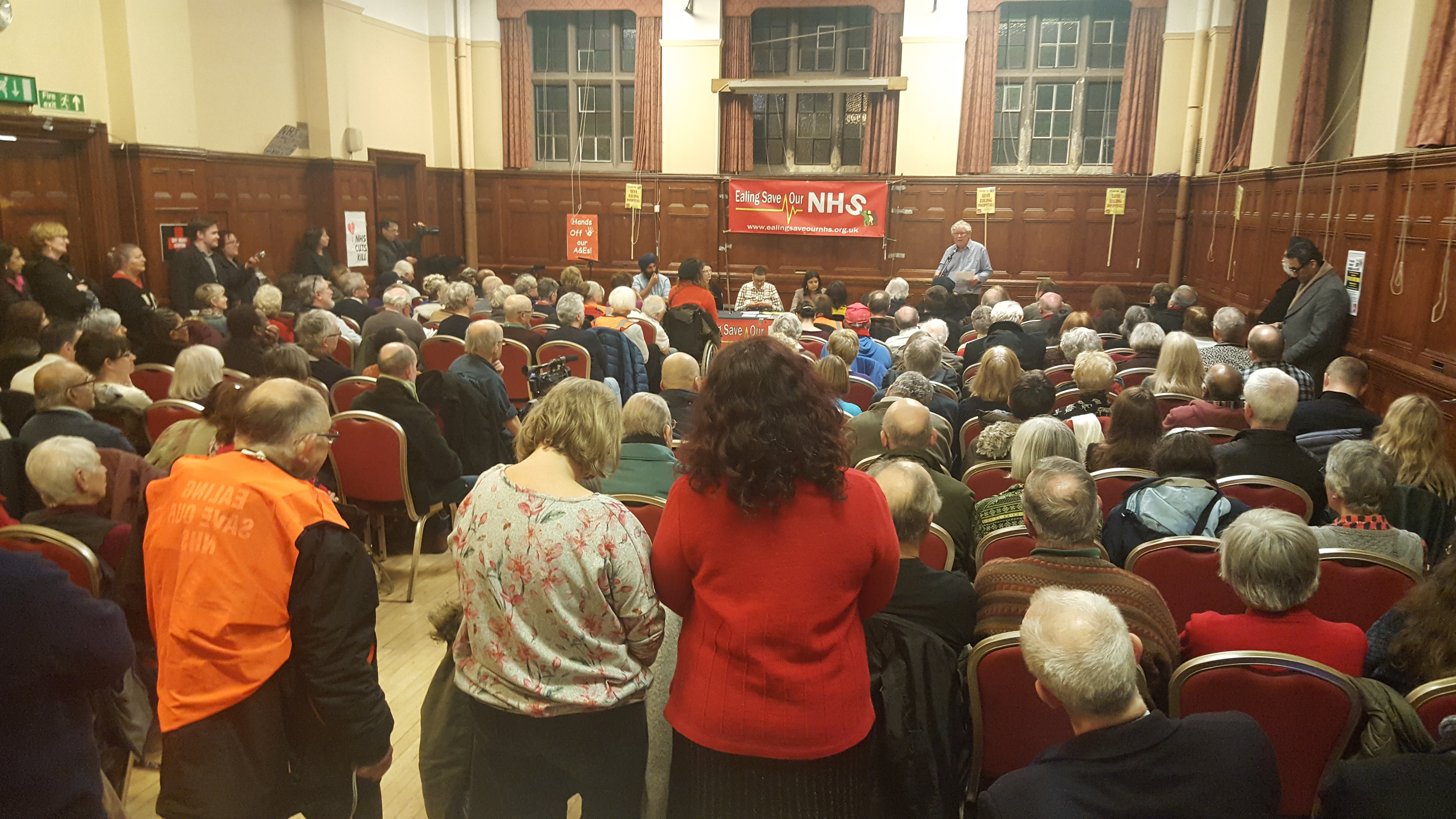
There was anger and cheers at the Ealing Save Our NHS public meeting last Tuesday. The room in Ealing Town only seated 150 – another 50 people had to stand around the sides and at the back.  John Lister set the tone by describing how ridiculous claims were being made to justify bed cuts and A&E closures.
Private management consultants were being paid millions of pounds to write reports that didn’t stand up.  Tens of millions of our NHS money was paid to finance companies for PFI hospitals – huge interest payments that were totally unnecessary.
As well as being a respected researcher on health policy, John is a veteran campaigner and national Secretary of Keep Our NHS Public.   ACPs or Accountable Care Organisations are the latest Government plan for running, commissioning and privatising our NHS. “They are unaccountable” said John, “They don’t care and they don’t organise properly.”
Hospital consultant Gurjinder Sandhu held the room spellbound as he described the pressures faced by staff. He vividly described patients who needed looking after, while staff had to put up with constant undermining by managers in various ways. More ambulances are being diverted to Ealing A&E than any other in London, but staff are told Ealing A&E can be closed under their cuts plans.
The people in the room were loud in their appreciation of Gurjinder and junior hospital Doctor Aislinn Macklin-Doherty as well as all the other NHS staff.  The pressures on hospital staff described by Gurjinder were radicalising junior doctors, Aislinn explained.  Doctors who had once been of a conservative persuasion were demonstrating and even striking.
Local Labour MP Rupa Huq talked about her support for the campaign to save Ealing Hospital and promised that her party would put a moratorium on all NHS cuts.
Eve Turner was an animated chairperson.  She thanked the local council for defying the Government over hospital cuts.  She told the meeting that local Health bosses planned to put Ealing  NHS community services out to tender in a single ten year contract, worth something like a billion pounds of our NHS money.  The contract could be won by a private company, or by a part of the NHS forced to compete with other sections of the NHS. 
There were lively questions from the floor.  At the end of the meeting dozens of us joined together for a photoshoot in support of migrant NHS workers.  We held up posters saying “We’re PROUD of our Migrant NHS workers”. Because we are.  With all the pressures facing the NHS, one of the nastier policies followed by the government is to pretend that the problems are caused by migrants, both patients and staff.  We are in solidarity with all NHS staff and we demand the NHS carries on being for all who need it, not for those with money, or those who are deemed worthy of care.
Our answer to divide and rule is solidarity.

Ealing Save our NHS, Public Meeting,13th February 2018, Excerpts from Ealing Save Our NHS on Vimeo.

[gmedia id=28]

Letter to NHSI London and NHSE London Directors of Finance

0

6 February 2018

We are a group of concerned North West London (NWL) residents, who have invested considerable time and effort in studying regional and local plans for healthcare services in this area. In November 2017 a letter written by NHSI/NHSE London to NHS NWL CCG Accountable Officers came into our possession. The letter asks for further evidence based assurances before committing financial resources to the SaHF ImBC SOC1. At the heart of these concerns is the lack of evidence to support an annual Non–Elective (NEL) admissions reduction of 99,000 by 2025/26.

Read the rest of the letter here and the letter to Colin Stanfield regarding A&E perfomance :


[pdf-embedder url=”https://ealingsaveournhs.org.uk/wp-content/uploads/2018/02/ESON-NHSI-Letter-6-FEB-2018-FINAL.docx.pdf” title=”ESON NHSI Letter 6 FEB 2018 FINAL.docx”]
[pdf-embedder url=”https://ealingsaveournhs.org.uk/wp-content/uploads/2018/02/Letter-to-Colin-Standfield-re-The-Lost-£190-million-and-AE-Performance-2-1.pdf” title=”Letter to Colin Standfield re The Lost £190 million, and A&E Performance (2) (1)”]

ACOs, ACSs, ACPs – Start/Stop – It’s all a Shambles -Feb 2018

0

ACOs, ACSs, ACPs – Start/Stop – It’s all a Shambles


House of Commons STP/ACO Inquiry, House of Commons ACO meeting, two ACO Judicial Reviews, 149 MPs sign up to ACO Early Day Motion, nine Shadow ACSs and goodness knows how many Shadow ACPs ‘paused’- hard to imagine a worse healthcare/social care futures’ shambles.


Hammersmith & Fulham has its own challenges with its GP Federation and five NHS Trusts talking big about a healthcare/social care contract of up to £300 million per year for a population of maybe 212,000. Press publicity reports an ‘alliance agreement’ being signed in April 2018, but the absence of public endorsements by the Local Authority (the social care people) speaks volumes.


Professor Allyson Pollock gave some 85 NHS activist leaders from all over England much food for thought in Laura Pidcock MP’s brilliant ACO meeting in Parliament on 22 January 2018. One of her stunning revelations was about the dichotomy of healthcare and social care patient groups. Sure enough I then did my home-based research on Ealing. 426,000 healthcare patients on 76 GP surgery lists (Ealing CCG 2016) and a 358,445 (social care) population in Ealing (GLA 2017).


Add to this the out of area registration scheme that allows any healthcare patient to register with any GP surgery in any part of the country – assuming the receiving GP surgery will accept them. Then add to this the online Babylon ‘GP Choice’ scheme, which is out of area registration on steroids! Apparently 12,000 patients in less than three months have – via Smartphone app video consultations – left their ‘geographic’ GP surgery and joined Dr Jefferies & Partner’s GP surgery in Fulham, West London. Allegedly this surgery ‘cherry picks’ its new patients – so no-one is accepted with complex mental health problems, frailty, dementia, pregnancy or drug addiction.


So…..integrate that Mr Hunt!


Last week also revealed progress by the #JR4NHS Judicial Review team in winning an important concession from NHS England (NHSE). There will now be a 12 week national, public consultation on ACOs. No ACO contract will be signed until that consultation has taken place. The judge has promised a full hearing ‘as soon as possible after 14 March 2018’. However Secretary of State Hunt still plans to push through new regulations to legitimise ACOs but apparently not now during the next four weeks. Government and NHSE claim that £90,000 has alreadyben incurred in legal costs, which #JR4NHS could have to pay. Advisors to #JR4NHS warn that the £180,000 raised so far needs to grow to £350,000 to £400,000 to cover possible costs. To donate go to:

www.crowdjustice.com/jr4nhs-round3


NHSE has stated that the public consultation will ‘provide further clarity about ACOs’ role and purpose’. I don’t know about ‘further’ but ‘some’ might be good. No doubt the whole thing will be a stitch up just like the 2012 NHS North West London (NWL) ‘Shaping a Healthier Future’ consultation. We won’t be given an opportunity to say if we like or want ACOs. Another bizarre aspect is that NHSE says that an ACO is not a new type of legal entity and that it will not affect the commissioning structure of the NHS. (It doesn’t say whether it will affect the social care commissioning structure of Local Authorities). If all this were ‘true’ why are new regulations being drafted to ‘legitimise’ ACOs?


On 29 January 2016 NHE announced that the ‘second wave’ of ACSs would be delayed and re-named. The phrase ‘integrated care’ gets a mention. So…new dates and new names – but the same old concerns about disintegrated care and degraded health and social care services.


Desperate Attempts at Trying to Justify Closing Down Ealing District General Hospital (DGH) and its A&E Unit


After failing to get £513 million for building work in NHS North West London (NWL) in November 2017, NHS regional bosses appear to have been trying to find some ‘new’ numbers which they might utilise to have another go at getting the cash. These bosses, especially those still wedded to the incomplete and failing 2012 NHS NWL ‘Shaping a Healthier Future’ (SaHF) project, still maintain they need this cash in order to downgrade Ealing DGH and shut down its A&E unit.


The sticking point for these bosses and their army of management consultants is trying to convince the regulator (NHS Improvement – NHSI) that by treating patients at home and at GP surgeries/day care ‘hubs’, 99,000 emergency admissions across NWL can be eliminated annually by 2025/26. This ‘replacement’ approach is so called Out Of Hospital (OOH) services. NHSI wants NHS NWL to supply evidence to support its case.


Let’s examine NHS data to try and discover whether this evidence exists.


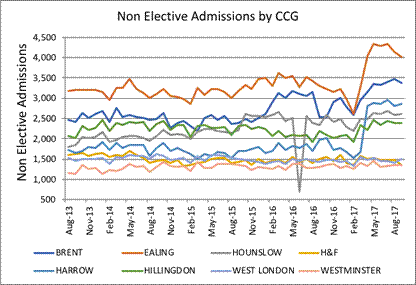
Emergency admissions in NWL (virtually all of which are so called Non Elective Admissions – NELs) are higher now than in 2013. To put the annual NELs reduction aspiration in perspective, here are the NELs totals over recent years –


October to September:

+ 2013/14 – 195,000

+ 2014/15 – 190,000

+ 2015/16 – 200,200

+ 2016/17 – 216,000


There has been no successful reduction in bed numbers since 2011 (when we started collecting the data). In fact in March 2011 there were 3,150 General and Acute beds in use in NHS NWL. In September 2017 that number stood at 3,400. Hospital bed occupancy rates are higher now than they were in 2013.


Hospital bed blocking (so called Delayed Transfer of Care – DTOC) is endemic. In Ealing DTOCs are higher now than they were in 2013. In terms of social care DTOCs in Ealing, they have risen steadily since April 2014 (100 days delay/month) and in July 2017 reached over 900 days delay/month. ‘Get West London’ research reveals that the 75+ population in Ealing has grown by 2,200 since 2012. During that time 50 care home beds and 41 nursing home beds have been lost. Ealing Council’s social care budget has been reduced annually in recent years. In 2013/14 it was £127 million. In the current year it’s £94 million.


Let’s now look at ambulance redirections in NWL – so called Intelligent Conveyance. During the period April 2016 to September 2017, no ambulances were redirected to Northwick Park Hospital. The same was almost true of Hillingdon Hospital except  for 30 times in January 2017 and a handful of times in June 2017. However redirections of ambulances to Ealing Hospital happened every month with 70 in November 2016 and 90 in April 2017. Just where would the sense be to shut down Ealing Hospital A&E?


As for meeting the Type 1 (T-1) 4 hour performance target, no NHS NWL hospital has ever got near to consistently meeting or exceeding the 95% target since Central Middlesex and Hammersmith Hospitals’ A&Es were shut down in September  2014. In January 2017 NHS Northwick Park and Hillingdon’s A&E 4 hour performance slumped to around 50%. By December 2017 neither hospital reached 60%.


Out Of Hospital (OOH) services have been the SaHF ‘replacement’ strategy for removing 40% of patients from hospital Acute beds, for well over four years. SaHF has consistently said that there would be no changes to hospital services until OOH services were in place. OOH services were not in place when the two hospital A&Es were closed in September 2014 – with disastrous, on-going results. And OOH services are scarcely apparent even now. The best NHS NWL bosses can seemingly come up on OOH services amounts to 2,700 hospital admissions prevented in Brent in 2017, and 1,400 hospital ‘admission avoidances’ in Ealing in 2017. Given that NHS NWL SaHF has been trying to develop OOH services and reduce hospital admissions since 2012 it is hardly a recommendation that over five year’s work has resulted in an annual reduction of just 4,100 emergency admissions/NELs.


Apparently NHS Ealing CCG has thrown in the towel in trying to ‘commission’ NHS service suppliers to develop, run and manage OOH services in Ealing. Later this month a business case will probably emerge in an attempt to justify outsourcing Ealing OOH services to a single supplier for 10 years. Apparently this contract value could reach £1 billion. All our attempts to find out the OOH services specification have been frustrated. Apparently Virgin Care is one of the interested parties. No doubt this is all part of the Accountable Care/integrated care bandwagon.


However other rumours swirl around whether ‘austerity’, land values and land sales might be the keys to what happens next. The £513 million request is enshrined in a NHS NWL business case labeled the ImBC SOC1. This bid largely relates to so called outer NWL. There is another NHS NWL business case backed bid, still not submitted, for inner NHS NWL London labeled ImBC SOC2 for £377 million. There are allegations that NWL will only be granted SOC1 or SOC2. In terms of land sell offs clearly inner NWL land will generate far more cash than outer NWL land sales. After all London Mayor Khan’s so called London Care Devolution seems to be mostly about ‘estates’. There clearly is some sensitivity about land values/sales value as Freedom of Information attempts to access this data (so called Naylor 2) are clearly being obstructed.


Nursing Recruitment in NHS North West London is at Crisis Point


NHS Digital’s quarterly recruitment update for North West London (NWL) must ring alarm bells everywhere. In April, May and June 2017, 2,545 nurses and midwives vacancies were advertised. However only 42 new recruits were taken on – that’s just 1.65% of those they were seeking.


Nationally the statistics also make for very depressing reading. One in 10 of all nurses quit each year. The overall number of vacancies for all types of healthcare staff, which hospitals across England advertised to fill in July to September 2017, hit 87,964.

Over 36,000 Hospital Beds in England Closed  Since 2000 – Jan 2018

0

Over 36,000 Hospital Beds in England Closed  Since 2000 : All kinds of Flu Kick In and the NHS is in Meltdown

A&E waiting times have shot up. Patients on trolleys in hospital corridors has become common place. Elective surgery throughout England has been cancelled nationally for a month. Anecdotally I heard that the A&E unit at Ealing Hospital has been under unprecedented pressure. One report also stated that for a recent 21 consecutive day period there were no available beds at Hillingdon Hospital.


Experts are now saying that ‘Australian Flu’ is not the main culprit, but it’s just one of a number of flu types affecting many of us. Shortage of A&E units, doctors, nurses and beds are the main causes of mayhem in NHS hospitals.


The latest NHS Unify 2 data makes for chilling reading. It shows that the number of A&E attendances year on year has remained remarkably stable. For Type 1 A&E attendances at Ealing Hospital and Northwick Park Hospital in November 2017, the number of patients was just 2.81% more than in November 2016.


In NHS North West London the plan for the next three years includes over 25,000 NHS staff being terminated. 600 hospital beds to be closed. By 2025/26 Non-Elective (i.e. emergency) hospital admissions (so called NELS) will, apparently, be reduced annually by 99,000. Ealing District General Hospital (DGH) along with its A&E will closed by 2021. Instead of being treated in residential Acute hospitals the idea is that these seriously ill people will be treated in some expanded GP surgeries, new ‘Hub’ day care centres and/or in their own homes.


However, the plans are in disarray. NHS NWL asked NHS bosses for £513 million for building work and on 7 November 2017 the NHS Regulator – NHS Improvement (NHSI) – said no. NHSI said no compelling evidence had been presented to justify NHS NWL cutting NELS annually by 99,000 beginning in 2025/26.


NWL stated last month that without this cash Ealing Hospital DGH and its A&E would, in effect, continue to exist. The creation of day care ‘Hubs’ and the expansion of some GP surgeries would be abandoned – without this cash. So far we know of no formal attempt by NHS NWL to create a new business case to support another bid for the £513 million. Since 2009 NHS NWL has spent over £89 million on management consultants. No doubt more cash is being thrown again right now at management consultants in order for them to unearth (probably non-existent) ‘evidence’ in an attempt to justify massive cuts in emergency hospital admissions.


Why is NHS Ealing Clinical Commissioning Group (ECCG) Trying to Outsource Out Of Hospital (OOH) Services for 10 years?

Why does ECCG want to outsource OOH services at all? Is it because ECCG, along with the other seven CCGs in NHS North West London, has failed to implement the OOH strategy outlined in the 2012 NHS North West London (NWL) ‘Shaping a Healthier Future’ (SaHF) programme? On page 39 of  SaHF (‘11. Proposals for delivering care outside hospital’) a reduction of 110,000 hospital stays annually is promised along with 48,000 avoided hospital emergency admissions annually. On page 11 SaHF states ‘…it will take at least three years to put…in place’. Now, over five years later, there is still no significant annual reduction in emergency admissions. According to the 2012 SaHF proposal, £120 million was to be invested across NW London to enable this OOH transformation. On 8 September 2017 the ECCG Chair confirmed that OOH NHS NWL spend for 2017/18 is £729,283,000 with OOH NHS Ealing costs at £121,794,000.


The 10 year contract length is interesting. CCGs have three year contracts. Healthwatches normally have three year contracts. NHSE has a five year ‘Five Year Forward View’. So why 10 years? The crunch date is of course 2021 when annual healthcare ‘losses’/’debts’ costs have to be paid off. So no doubt this fixed price ECCG OOH contract will be signed at, let’s say,  20% of current costs i.e. all things being equal at around £100 million per year. Although initial ECCG statements posited a 1April 2018 start date this seems now unlikely to be met.


The estimate in my 15 November 2017 newsletter of the potential size of the ECCG OOH 10 year contract was £1billion. However until (and if) we see the details of the Invitation To Tender it will be difficult to firm up this figure.


On 19 September 2017 and 4 October 2017 ECCG invited interested parties to come to talk to it about an OOH OH contract. A recent Freedom of Information request response has revealed who attended. 25 different organisations attended – 12 of them attended both events! There were nine NHS Trusts and nine private healthcare service suppliers who attended. The private companies were Allied Healthcare, CHS Healthcare, Connect Health, Homelink Healthcare, NRS Healthcare, Philips, Shaw Healthcare, Specsavers and…..

Virgin Care Services   


Jeremy Hunt MP Has His Cabinet Role Increased to Include Social Care

If this was a plot development in a ‘Carry On Caring’ comedy film I might find it far fetched. Presumably no-one else wanted to take the healthcare (or the social care) job on. My take on Mr Hunt is that he is an attention seeker. He’s always smiling when the cameras are on him. In 2017 he sold his Hotcourses business and pocketed £15 million – so he doesn’t really need the work. He’s had a chequered past. An Admiral’s son, he once worked as an English teacher in Japan and allegedly failed in a venture selling marmalade to the Japanese. He has variously been accused of cheating on his Parliamentary expenses and his tax bill, upsetting Junior Doctors which led to strike action, and constantly misleading the public about healthcare reforms.


In theory a single Government department responsible for cradle to grave care is certainly not a bad idea. However new Primary Government legislation and a massive national relocation of resources will be needed to turn the idea into reality. Social care staff in the 326 Council Authorities will now somehow all ultimately report to Jeremy. Exactly how will that work? Of course by 2025/6 all care might well be delivered by Accountable Care Organisations (ACOs) which will, of course, render NHS organisations and Local Authority social care operations powerless. No doubt Mr Hunt will still be with us then with a new job title of ‘Secretary of  State for Accountable Care’.

Accountable Care Is In For a Rocky Ride in 2018

Accountable Care Organisations (ACOs) will at some point in the future, to put it simply, replace NHS organisations and Council Authorities in determining care budgets and managing care service delivery. ACOs will, according to NHSE’s 2014 Five Year Forward View be the STP delivery vehicles to deliver improved care services. ACOs will appear in lots of flavours including ACS, ACP, MCP, PACS and PCH. A single provider (e.g. Virgin Care) might run an ACO, but so could a cabal/consortium of NHS, public, private companies and charities. This could all kick off with some ‘Shadow’ ACOs in April 2018. However the Full Monty 10/15 year £multi-billion ACO contracts will not happen till at least 2019.


ACOs will be ‘command and control’,cost-cutting  vehicles which deliver care at a fixed price over 10 to 15 years.


Fear kicks in when Jeremy Hunt MP tells us all that ACOs are ‘simply about improving the quality of care the NHS offers’. With a First Class Oxford University degree Mr Hunt is clearly not unintelligent. As a founder of a PR agency, he clearly knows how to mislead by not telling anything like the complete truth. (Believe me I’m an expert on this subject having run my own PR agency for 21 years).


ACO Judicial Reviews (JRs)

There are two of these on the go:

+ The JR4NHS ACO JR, filed on 11 December 2017, has attracted £144,000 donated by over 5,000 people. The grounds of the JR are that ACOs have not been subject to any public consultation, and lack Parliamentary scrutiny and legislation.  High profile supporters include Public Health Professor Allyson Pollock and Professor Stephen Hawking. More at:

http://bit.ly/JR4NHS


+ The ‘999 Call for the NHS’ ACO JR questions the legitimacy of replacing payment by results with a Whole Population Budget. (The latter is better known in the founding home of ACOs – USA – as a Capitated Budget). The JR is led by a West Yorkshire health activist Jenny Shepherd, supported by lawyers Leigh Day, and it was filed in November 2017. The first legal hurdle has been cleared as a judge has granted permission for the JR to proceed. The case will be heard in Leeds High Court on 24 April 2018. £12,000 more is needed to fund this JR. Donations can be made at:

www.crowdjustice.com/case/healthcare4all-stage3/


Labour’s Early Day Motion (EDM) on ACOs

Tory plans, apparently, are well advanced to submit new draft legislation soon to legitimise ACOs in February 2018. In response to this, the Labour Party initiated on 6 December 2017 an Early Day Motion (EDM) 660 on these proposed changes – so that the House of Commons can discuss them. The primary sponsor of the EDM is Jeremy Corbyn MP.161 MPs have signed so far. My MP Virendra Sharma has signed, as have Andy Slaughter MP (Hammersmith), Ruth Cadbury MP (Brentford and Isleworth) and Gareth Thomas  MP (Harrow West). Why is it taking so long for all the other North West London Labour MPs to sign?


Dudley ACO Delayed

Hardly a storming start for the flagship pioneer Dudley ACO. Its start date has been put back 12 months! Dudley CCG, in the West Midlands, is attempting a Multi-Speciality Community Provider (MCP) ACO. The contract value is £5 billion. In August 2017, Dudley CCG announced that a hotchpotch consortium of local GPs and four local NHS bodies was the preferred bidder.


Greater Manchester ACOs are Also Delayed

Another of the top ACO pioneers, Greater Manchester – with its delegated care budget – is also failing to meet its ACO plan dates. VAT complications are being touted as the reason the £6 billion MCP contract has not been awarded to the preferred consortium of existing care providers. ACO number two in Stockport aims to ‘create a new care trust capable of holding an MCP contract’. It has been ‘paused’.


And After ACOs……?

One can’t help but speculate what might come next after ACOs. After all recent NHS history is littered with organisations here today and gone tomorrow. Regional Health Boards and PCTs are long gone. If ACOs ever get off the ground and take over nationally then that’s the end of CCGs and possibly the NHS itself. If ACOs never take off or fly and burn – what will come next?


The BMJ Exposes £5+ Million ‘Sponsorships’ of CCGs – Most of It Undeclared Publicly

The British Medical Journal (BMJ) has announced findings, obtained through Freedom of  Information (FOI) requests, that NHS Clinical Commissioning Groups (CCGs) have overtly and covertly received gifts and payments from a range of commercial organisations. Of the total of £5,027, 818 payments uncovered, only £1,283,767 was declared in public registers.  Bath University and Lund University in Sweden carried out this research.


Amongst the undeclared payments was a £24,000 NHS Southwark CCG project funded by drug companies Bayer, Boeringer Ingelheim and Pfizer. Amongst declared payments was a £75 England cricket match ticket given to NHS Medway CCG by AMP Infrastructure, a property investment company.

Thanks for visiting us

Sign up to receive all the latest news from Ealing Save our NHS

We don’t spam! Read our privacy policy for more info.