Home Blog Page 13

Ealing Save our NHS newsletter – 16/08/18

0

Ealing Save Our NHS calls for a halt to outsourcing OOH services & a bit of a protest

August is meant to be a quiet month but obviously not this year. This Friday we have a protest against privateers Virgin Care and have been busy stirring the pot over the risks of the planned outsourcing of most of our Community Health Services to a single provider by our local health bosses. Read more below.
Virgin Care Protest this Friday 17th August 1.00pm -2.00pm
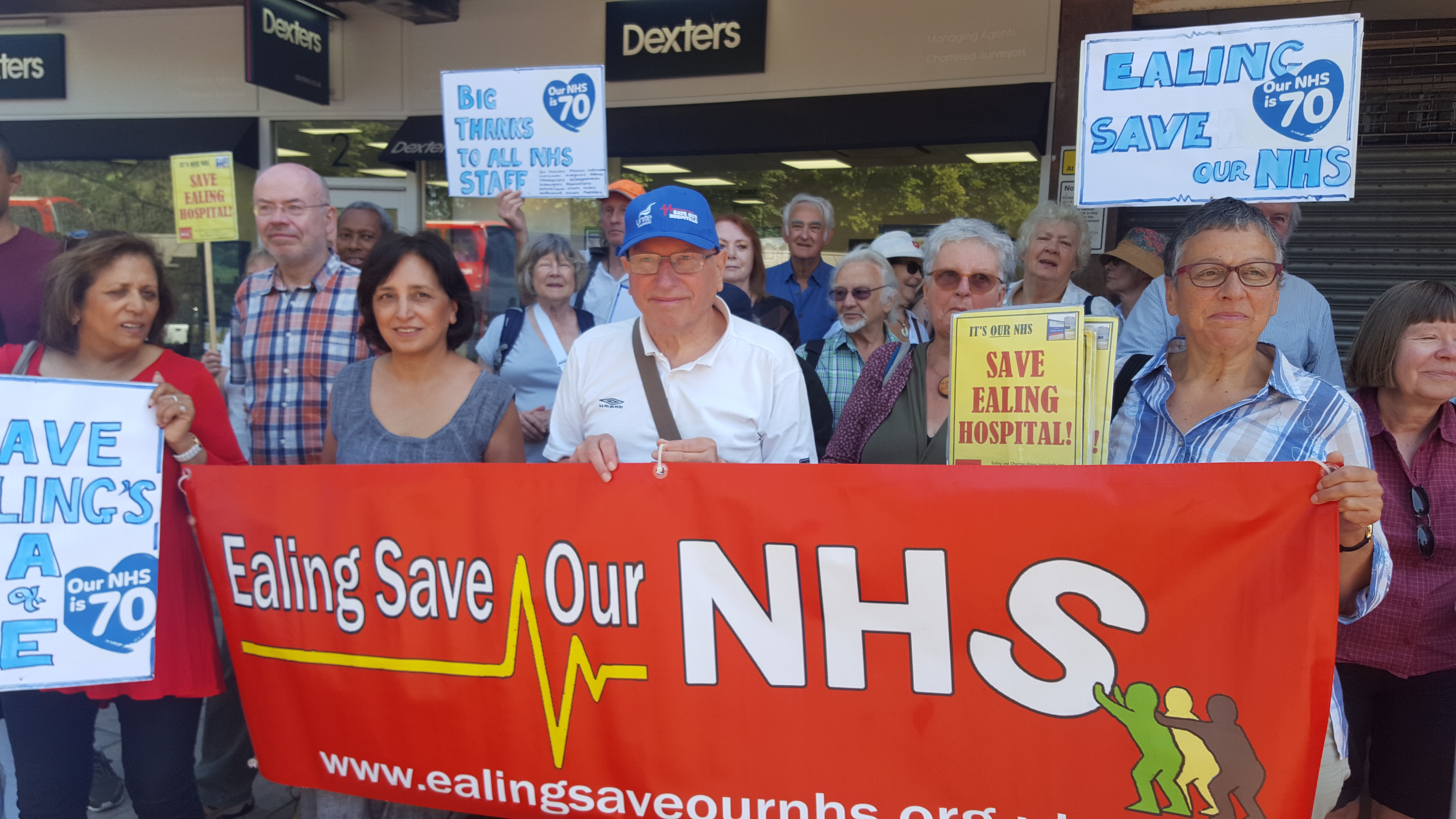
Virgin Care who are now the leading private provider of our NHS services are putting in a bid to run our Community Health Services here in Ealing. As part of their drive to win the Contract they are coming to Ealing Town Hall this Friday to meet the voluntary sector in a ‘community engagement’ event. ESON is totally opposed to private providers running our vital NHS services and we will be outside Ealing Town Hall on Friday at 1.00pm with leaflets and banners to say “Virgin Care are not welcome here” It would be great if you can join us.

ESON letter calls for halt to OOH Tender Process due to risks

Ealing Save Our NHS has sent a detailed letter to Ealing CCG (local NHS bosses), NHS Improvement and NHS England (national NHS bosses) spelling out our concerns about the planned outsourcing of our Community Health Services and the serious risks it poses to the future of Ealing Hospital and our local Trust, which currently runs many of these services. A number of similar contracts have failed but as far as we can see Ealing CCG has taken no account of this at all.
Our letter calls on the process to be halted until such time as these issues are satisfactorily addressed. We have also sent the letter to local MP’s, GLA, the Mayor and to Ealing Council’s Health Committees asking them to act. You can read more about how Ealing Hospital will be affected and the risks of this contract in our letter which is attached here.

Get West London story on Ealing & Charing Cross A&E cuts:

Local reporter Martin Elvery has been chasing up NHS bosses to find out the latest news on A&E cuts. As far as we can see there is no change but good to see our local media keeping up the pressure. Read here

North West London CCGs waste Millions says Guardian

North West London NHS bosses, including Ealing are once again in the news in this damning article on the 100’s millions wasted on management consultants. Read article here

Charing Cross campaigners organise protest against GP at Hand:

Save Our Hospitals (Hammersmith & Charing Cross) have been in the forefront of a campaign to highlight the threat to GP services of private outfit ‘GP at Hand’ (aka Babylon) who offer GP services by an App on your phone and are in effect siphoning money off from normal GP practices. They had a well attended protest last month, which we were pleased to support. You can read more here

Petition to stop Virgin suing when it loses contracts:

Last year Virgin Care have made around 2 million pounds by suing the NHS in Surrey when they failed to win a contract, money which should have been spent on providing front-line NHS services. A 38 degrees supporter wants to stop that happening again – you can sign to support here

Subscribe to our newsletter here

Who Might Have Bid for the Single Supplier Up to £1.2 Billion Ealing Out Of Hospital (OOH) Services Contract?

0

Issue: 69

1 August 2018


Who Might Have Bid for the Single Supplier Up to £1.2 Billion Ealing Out Of Hospital (OOH) Services Contract?

Rumour has it that the bidders will have included:

+ Central London Community NHS Healthcare Trust

+ Hillingdon Hospitals NHS Foundation Trust

+ London North West University Healthcare NHS Trust

+ West London Mental Health NHS Trust

+ Virgin Care


Deadline for submitting an intention to bid was 19 July 2018.


All Attempts to Improve Access to Treatment for the Seriously Ill and Critically Injured (Type 1) in North West London (NWL) Have Failed

In April 2014 healthcare researcher Colin Standfield began collecting and collating A&E performance data at the NWL hospitals. In that month the performance for Type1 A&E patients against the 4 hour target was 88%. Clearly below the 95% target. The latest NWL A&E performance figures (June 2018) are at 80% – so no improvement in over four years. At no time since August 2014 has that figure exceeded 90%. Hillingdon Hospital continues to have the worst performing A&E unit in England at 59%.


In summer 2012, NHS NWL’s ‘Shaping a Healthier Future’ (SaHF) programme promised us ‘improved care, both in hospitals and in the community’. Some six years later this promise to the seriously ill and critically injured has not been kept. The original SaHF Medical Director has been long gone from the project. Of the eight CCG Chairs who signed their name to the SaHF programme, five are still in post. It’s surely time for them to publicly apologise for the failure of SaHF and perhaps consider their positions.


In October 2016, NHS NWL published its Sustainability and Transformation Plan (STP). It promised ‘to improve the health and wellbeing of our residents’. This promise to the seriously ill and critically injured has not been met. Of the five STP sponsors, three have already resigned. Maybe it’s time for the other two to remove themselves as well.


Expansion of ‘GP at Hand’ Online Service Blocked by CCGs

On 17 July 2018, Hammersmith & Fulham Clinical Commissioning Group (CCG) formally objected to the expanded use of the ‘GP at Hand’ Smartphone consultation service. Patient safety was the CCG’s concern. This service, launched in 2017 by Babylon, allows for Smartphone based 24/7 consultation services. One of the conditions to signing up to the services is that you immediately transfer to the GP surgery hosting the service. The launch GP surgery was Dr Jeffries in Fulham. Over 30,000 have signed up for the service which now boasts five London GP surgery sites.


Attempts to expand the service to Birmingham have been thwarted. Birmingham & Solihull CCG has raised concerns about Birmingham GP patients being registered at a GP surgery outside of Birmingham. NHS England (NHSE) also raised concerns in November 2017 when the service expanded to five sites across London. Ipsos Mori is currently conducting an independent evaluation of GP at Hand, which has been commissioned by Hammersmith & Fulham CCG and NHSE.


As ‘Private Eye’ recently pointed out, GP at Hand’s privacy policy clearly states that it may take users’ data to share with third parties. This smacks more of being a transparency policy.


Referral Facilitation Services – the Future for Healthcare ‘Demand Management’?

A member of my family, who has had countless ear infections over many years, recently asked his GP to see a consultant. Weeks later he received a letter from the ‘Ealing Referral Facilitation Service’ (ERFS) granting him an appointment with a consultant on 25 February 2019. This is completely unsatisfactory. The letter itself is a strange beast as it does not bear an NHS logo on it.


Another family member received an ERFS letter telling her that if her referral were to be accepted by West Middlesex Hospital the hospital would contact her. If the hospital did not contact her after a period she should contact them .All attempts to get through on the phone to the hospital have so far failed. Months later she gets a letter from the hospital giving her an appointment date.


My surgery’s Patient Participation Group has attempted to explain how the ERFS works in its current newsletter to patients. The description makes no mention that the ERFS might turn down the GP’s request for a consultant appointment. It also states that a hospital will contact the patient with appointment details. My family knows that this contact might takes weeks or months to be made.


It’s clear from anecdotal evidence that there is no consistency in the way the ERFS works. For some patients, the ERFS does not make it easy for them to exercise ‘patient choice’ as to which hospital they want to be referred.


It almost beggars belief that two GP members of the Ealing CCG Governing Body are also paid Clinical Assessors for the ERFS. So not only do these two receive fees from Ealing CCG as Ealing GPs they also get paid for double guessing their GP peers in Ealing on GP patient referrals to consultants. This is conflict of interest on steroids!


I can find no description of ERFS on any NHS web site. Google can’t find one either. Apparently the ERFS is an outsourced operation run by a private company. Ealing CCG accounts state it cost £849,000 to run ERFS last year.


What’s Happening on the Accountable Care/Integrated Care Front?

When Secretary of State Hunt was confronted with the JR4NHS legal challenge on Accountable Care Organisations in February 2018, he conceded that there had been no public consultation on the issue of Accountable Care Organisations. He said no Accountable Care Systems’ (ICSs’) contracts would be signed until after a 12 week public consultation. Well, the JR4NHS Judicial Review has been and gone but there is no sign of any ACS (now ICS) public consultation. Could it be that as the JR judge found  the Health & Social Care Act 2012 gave very broad discretion to CCGs when commissioning services? Maybe this means no new ACO/ICS Government legislation is needed and perhaps no consultation. It could be that as the other major ACO JR – 999 Call For NHS – is appealing its rejection, the way is still blocked for ICS progress.


It’s clear that ICS contracts for front-runner ICSs in Dudley and Greater Manchester have not been signed. NHS England web pages on ICSs have been unchanged since May 2018.


The High Court Overturns £104 Million Virgin Care Contract for Public Health Services in Lancashire

‘Health Service Journal’ has reported that on 22 June 2018 the High Court found in favour of two NHS Trusts in their action against Lancashire County Council. (LCC). Lancashire Care and Blackpool Teaching Hospital Foundation Trusts took LCC to court after LCC awarded a five year contract for school nursing and health visiting to Virgin Care. The Trusts claimed that LCC’s bid evaluation process was deficient. The judge found LCC’s records of moderation processes fell short of standards required to evidence reasons for the scores awarded to the bidders.


This occasional newsletter is researched, written and edited by a group of concerned residents in Ealing, West London who want to preserve our NHS. We view the wholesale engagement of private, for-profit healthcare service suppliers as unnecessary, profligate and dangerous. Increased financial funding is what is needed in our NHS – not financial cuts, closure of vital services or privatisation.

No Justification for the Latest Cut to Ealing Hospital

0

In this article Professor Clara Lowy considers the changes in the urology service affecting services in Ealing Hospital.   


A recent decision has been made to remove Urological surgery from Ealing Hospital – further undermining the Hospital


In 2012 the ‘Shaping a Healthier Future’ plan was born following a very limited public consultation claiming that care could be carried out better in the community rather tha in hospitals. The plan did include reassurance that provisions would be in the community before hospital bed closures.


The two hospitals marked for major downsizing were Ealing & Charing Cross. By 2014 Hammersmith & Central Middlesex had lost their A&E departments – but the promised alternative community services were not in place.  As a result the A&E departments at Ealing, Northwick Park and elsewhere filled to overflow.


Despite this, the Ealing Clinical Commissioning Group and The London North West University Healthcare NHS Trust set about downsizing Ealing Hospital.  First they closed the Maternity Department, then Urological Cancer Treatment, then closure of in patient Paediatric Care and A&E Paediatric Care and now in 2018 Urological Services. The reason given primarily was staffing recruitment and shortages, leading to possible unsafe practises.


A review of the proposed urological service change was presented to the Ealing Council Health & Adult Social Scrutiny Panel after the changes had been ‘enacted’ in June.


I provide here a summary of the outline of the current urological services presented to the Ealing Scrutiny Panel now available to Ealing residents.


The changes started in 2012/13 when the Urological Cancer Service ceased at Ealing Hospital.  This resulted in reduced volume and diversity procedures so Health England withdrew clinical training posts. The department had a high turnover of staff, relying on temporary staff.


The options were to consolidate services on two rather than three sites, Northwick Park and Central Middlesex Hospital (CMH) were chosen. So why was Central Middlesex chosen as the second site when Ealing Hospital would have been the much more appropriate since it almost still has a full complement of services including an A&E?


8000 new urological patients attend the 3 sites, of this a quarter are Ealing residents (2000) and a fifth of these (400) are emergency admissions.  The number of emergency admissions is rising by 10% per year.


This reflects the aging population in the Borough. This group also have more co morbidities and therefore should have access to an A&E and a hospital where disciplines are well integrated not only for patients with presenting urological problems but also Ealing in-patients who develop urological emergencies.


Questions and problems

As this reorganisation has already taken place Ealing patients are now being triaged in A&E at Ealing Hospital & transferred if needing admission to Northwick Park. It is envisaged that some patients will not be suitable for transfer. An on-call urologist from Northwick Park will travel to Ealing Hospital to perform the necessary operation. He or she will be operating in non-urological equipped theatre and without designated training junior staff.  Is this good practice?


Ealing Hospital will continue to provide Out Patient, a One Stop Clinic and Enhanced Out Patients Procedures but as Ealing Hospital is no longer recognised for training it is not clear who will be qualified to carry out the outpatient procedures?


A statement is made that Outpatient and onsite specialist cover will be maintained.


How can this be true when an on-call Urologist has to be summoned from Northwick Park Hospital to operate on patients that cannot be transferred?


It is claimed that there will be better continuity of care. If so where is the evidence to support this claim?


Is there sufficient capacity on the NWP site to absorb the emergency urological patients arriving from the Ealing A&E?


Unless there are clear answers to these questions, we can be forgiven for concluding that the changes are driven not by clinical reasons but as part of the unsuccessful ‘Shaping a Healthier Future’  plan for North West London.


Clara Lowy is a local resident and Emeritus Professor of Medicine


NHS – 70th Birthday Party Outside Ealing Hospital (VIDEO)

0
Thursday 5 July was seventy years to the day since the introduction of free health care and the founding of the NHS.
ESON organised a lunchtime party outside Ealing Hospital to thank the staff and protest against the undermining of our NHS.
Local people, hospital staff, politicians and campaigners were all there. We had amazing hats, singing, speeches, a huge cake and lots of sun. Passing cars hooted their support.

Ealing Save our NHS – 70th Birthday Party Outside Ealing Hospital, 5/7/18 from Martin Woodford on Vimeo.


[gmedia id=34]

Ealing Save our NHS newsletter – 7/07/2018

0
Up to a 100 people turned up for our NHS 70th Birthday Party at Ealing Hospital including local politicians, two MP’s, campaigners and supporters and lots of hospital staff. 
 
Our lovely cake pictured below was a big hit with hospital staff, who took lots back to the Wards too. Best of all was seeing their smiling faces and to hear how delighted they were to see us all there in support. 
 
Ealing Council has issued a good press release about the Birthday Bash which you can read here:-
 
 
Here are a few fun pictures from Thursday – more on our Facebook Page.

All together now – hospital workers, politicians & campaigners!
And there was 70th hats and singing too!

Who else should cut the beautiful cake!
Our lovely staff, enjoying the cake & lots went back to the Wards too.
 
 
A wonderful uplifting day for all us. As one of our songs says – ‘if we all stand together we can win’!  HAPPY BIRTHDAY NHS.
 
———————————————————————————————————-
 
** Listen to the awesome National Health Singers **
 
The wonderful National Health Singers have just released their incredibly moving new single – ‘Wont Let Go’, funded entirely by Crowd Funding. The Choir are not just your usual choir but are a protest choir made up of a range of NHS staff and allies who sing at protests and demonstration such as the recent NHS demonstration. The song has just been released in celebration of the 70th anniversary of the NHS and it would be great if we can all help to make it go viral!!
 
You can listen here and please share everywhere:

 
————————————————————————————————————
 
On the March in London – 30th June

Up to 50,000 people marched in London on 30th June including many health workers, campaigners, unions and people of all ages. A good crowd joined Ealing Save Our NHS at Ealing Broadway, with placards and our very popular hats!


If you would like to get a bit more involved in our Campaign you will be very welcome to join us at our next Meeting 
 
Tuesday 17th July at 7.30pm in Northfields Community Centre.
 
You will also find us on our Stall at the Norwood Green Village Day on Saturday 14th July from 12.00-5.00pm
 
Thanks to everyone who has supported NHS 70th Birthday events.

 Stop the cuts – we love our NHS 30/06/2018

0
On Saturday dozens of us took the tube from Ealing to join the huge pro-NHS march in celebration of 70 years.
The message from everyone was:
 Stop the cuts – we Love our NHS. We don’t want to lose it or have some sort of insurance based system.
Next up is the Birthday Party on Thursday 5th July  on the grass outside Ealing Hospital. It’s from 12.00 to 2.00 with cake, music, singing, and talking. All welcome.
[gmedia id=32]

Ealing Save our NHS at Hanwell Carnival – PHOTOS!

0
There was amazing support from people at the 2018 Hanwell Carnival. Lots of people wrote birthday messages because the NHS has got  a big birthdays coming up – 70 years young.   
 
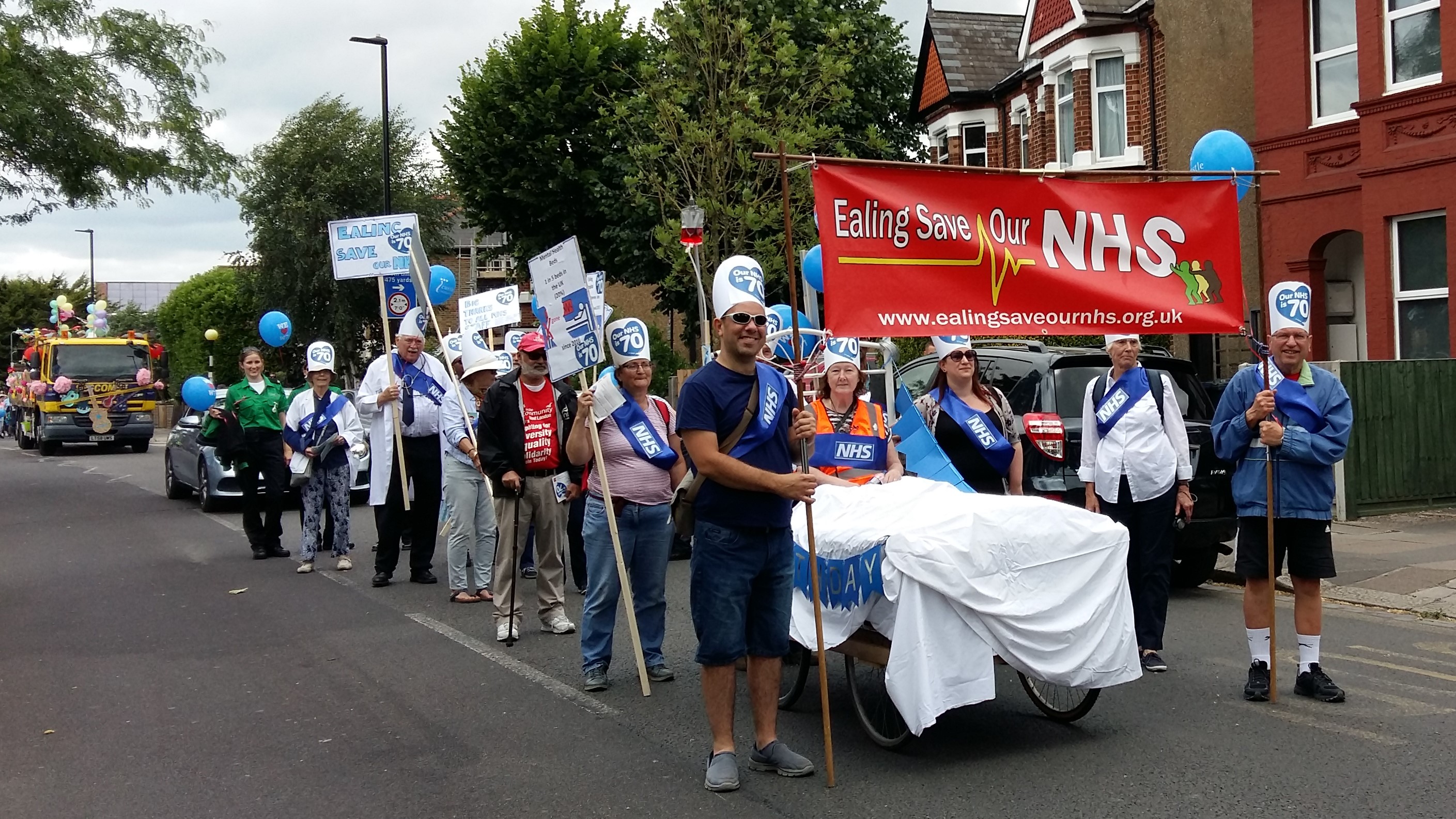
There were no prizes for contingents on the parade this year – but Ealing Save Our NHS would have surely been a contender with our superb ’70’ hats and “hospital bed”on wheels.
 
Thanks to everyone who visited our Stall, talked to us, signed the petition against the big Ealing “sell off”, took leaflets and took an interest. We hope to see some of you again at one of the forthcoming birthday events! 
 
Have a look at the photos here. 


[gmedia id=30]

Ealing Out Of Hospital (OOH) Services Outsourcing Contract

0


Issue: 68

This occasional newsletter is researched, written and edited by a group of concerned residents in Ealing, West London who want to preserve our NHS. We view the wholesale engagement of private, for-profit healthcare service suppliers as unnecessary, profligate and dangerous. Increased financial funding is what is needed in our NHS – not financial cuts, closure of vital services or privatisation.


Ealing Out Of Hospital (OOH) Services Outsourcing Contract: More Questions Than Answers

Rumour and speculation are rife about who might bid for and who might win this contract. The names of four London NHS Trusts have been mentioned. We are still no nearer discovering the real reason why this 10 year, £450 million minimum/£1.2 billion maximum, single supplier contract has even been proposed. The Invitation To Tender (ITT) was issued on 22 March 2018.  If awarded, this contract is likely to be the longest and potentially most lucrative NHS outsourcing contract ever awarded in England. It could make the local commissioner – the NHS Ealing Clinical Commissioning Group (ECCG) – quite famous.


Quite simply, OOH services in Ealing might be described as some of the day care services currently provided inside Ealing Hospital, outside Ealing Hospital and not provided in GP surgeries. Virtually all the OOH social care services included in the initial 36 services’ specification are outsourced to private operators by Ealing Council.  


Is It to Reduce OOH Services Costs?

No – says ECCG. Cost saving would be accrued by reductions in Non-Elective Admissions (NELs) to hospitals says ECCG. NELs are mostly accident and emergency admissions. The NELs volumes have remained pretty much at the same level in Ealing and North West London (NWL) since we have been monitoring NELs starting in April 2013. It will take some special magic for the appointed single supplier of OOH services in Ealing to significantly reduce the Delayed Transfers of Care (DTOCs or ‘bed blocking’) predominantly caused by lack of social care capability or mental health beds


Is It to Improve the Quantity and Quality of OOH Services?

No explicit claims have been made or evidence provided to support such improvement by ECCG, the NHS NWL Collaborations of CCGs, the NHS NW Sustainability and Transformation Partnership (STP) , NHS NWL ‘Shaping a Healthier Future’, NHS England or NHS Improvement.


Why is it a 10 Year Contract?

We can find no answer to this one.


Is It to Cut Down ECCGs Workload?

If a single supplier is to manage and resource 36 (and maybe 60) OOH services in Ealing over a 10 year period it makes little sense that ECCG would be micro-managing service delivery (i.e. ‘commissioning’) as well.  


Is It A Trojan Horse for a Pioneer Integrated Care System (ICS) in Ealing?

ECCG says it’s not an ICS (ACO in ‘old money’), which implies the budget will not be set using a ‘Whole Population/Capitated Budget’ and fixed price approach.


Who Will be Writing the Responses to the ITT?

No doubt it will be management and healthcare consultants. More £millions of public money sacrificed on the altar of  marketisation.


When Do Responses to the ITT Have To be Submitted?

Initially this was to be by 23 August 2018, with an earlier deadline of 19 July 2018 for submitting a completed ‘Selection Questionnaire’. However as the procurement documents were delayed till 4 May 2018, there is a ‘revised procurement closure date and associated deadline for submission of tenders’.


Are There any Precedents of Any Similar NHS Outsourcing Contracts?

Ominously the answer is yes, in Cambridgeshire in 2015. A five year £800 million NHS outsourcing contract ended expensively after just 8 months of operation. The contract was for a single supplier to manage and deliver community healthcare services to adults and elderly people in Cambridgeshire from 2015 to 2019.The company running it, called UnitingCare, pulled out saying that the contract was not financially sustainable. Warning signs appeared early on in the performance of the contract. Uniting Care had boldly promised estimating savings of £178 million by 2020. However they requested   £34 million of extra funding from the local CCG – just four weeks into the contract going live.


UnitingCare was a consortium of Cambridge and Peterborough NHS Foundation and Cambridge University Hospitals NHS Foundation Trust. The local CCG chose UnitedCare because it was the lowest bidder.Unsuccessful, more expensive bidders were Virgin Care and Care UK. Both the Government Committee of Public Accounts and the National Audit Office were severely critical of the lack of commercial skills exhibited by the commissioning NHS CCG.


Are Integrated Care Systems a Bad Idea Poorly Implemented?

Integrated Care Systems (ICSs) appeared on our radars in January 2018. They were a new name for Accountable Care Systems (ACSs). The justification for the renaming was never explicit, but many of us assumed what was behind it was that Accountable Care sounded too ‘American’.


In May 2018 NHS England announced four more ICSs to add to the existing 10. The timing of this was appalling. The highly rated Judicial Review on ACS/ICS legitimacy by JR4NHS had just enjoyed its two days in the Royal Courts of Justice. The 12 week public consultation on ACS/ICS promised by NHSE in February 2018 has still failed to materialise. The ACS/ICS enabling Parliamentary legislation the Government planned for February 2018 also never happened. The four new ICSs are Gloucestershire, Suffolk and North East Essex, West, North and East Cumbria, and West Yorkshire and Harrogate.


According to ‘Heath Service Journal’ none of the original 10 ICSs have reached an agreement with NHSE/NHSI about finances. Technically the arguments are about ‘Control Totals’ which seem to be the financial targets to be attained by end of March 2019. The sticking point is apparently that ‘organisations are unwilling to risk losing their sustainability funding if a neighboring Trust or CCG fails to meet its financial plan’. Not much peer trust or respect at work then.


None of these 14 ICSs are any more than talk and good intentions. There are, apparently, no signed ICS contracts. If any of them were ‘real’ then NHS Clinical Commissioning Groups would be winding up as they would have lost their commissioning roles for healthcare. Local Authorities would be re-structuring as they would have lost their social care commissioning roles.


Only an idiot would argue against the principle of integrating healthcare services and social care services. But with the current organisational structures and with the proposed ICS structure, the component care bits just do not ‘fit closely and seamlessly together’. The size and content of any NHS patient database is very different from its Local Authority (LA) social care service user database. The NHS and LA payment protocols, financial regimes, management accountability, cultures, IT and even vocabularies are alien to each other.


The vast majority of social care services are outsourced to the private sector and are means tested. NHS healthcare services are largely ‘insourced’ and are free at the point of use. Finally, NHS bodies and LAs don’t seem to trust each other enough to open up their financial books to each other. What both healthcare services and social care services do have in common is that they are both under-funded and under-resourced.


If  ICSs are implemented as advertised, this spells the end of the NHS. 44 private ICSs will run healthcare and social care services throughout England on fixed price, long term contracts. NHS Trusts, private care homes, private healthcare providers, NHS staff, NHS buildings etc will all be just resources which the ICSs may deploy or dispose of.


The Mass Transfer of Property from Public to Private Ownership: The NHS ‘Journey’

Consider the following:

+ University College London Hospital Foundation Trust recently boasted a £76 million surplus after asset sales and a Sustainability and Transformation ‘bonus’. (‘Health Service Journal’).

+ The NHS is planning to develop Royal Free Hospital nurses’ homes into luxury flats. (‘The Guardian’).

+ The Health and Social Care Act (2012) sanctioned NHS Property Services Ltd (PropCo). This company now owns the property which was previously owned by NHS Strategic Health Authorities and NHS Primary Care Trusts. The company is a private one which is wholly-owned by the Secretary of State for Health, Jeremy Hunt MP.

+ Public-Private ‘Project Phoenix’ will create six major regional public/private property deals by June 2019. The companies formed by these deals will be ‘off balance sheet’.

They will sell publicly owned property and replace it with private rented property. They will be the cash-raising vehicles for Sustainability and Transformation Partnerships.

+ Sir Robert Naylor carried out the review of NHS property which led to the creation of Project Pheonix. He thinks the fire sale of NHS property could raise £5.7 billion.


Much of this information was gleaned from Jessica Ormond’s piece at www.opendemocracy.net


GPs Under Attack! NHS plans to Reduce 8,000 GP Surgeries/Practices to 1,500 GP ‘Super-Hubs’

‘Pulse Today’ has documented the Government/NHS saga which could decimate the GP Surgery/Practice population in England. It all started with Tony Blair’s introduction of the GMS contract for GPs in 2004. This began the trend towards larger practices or federated models of working. The APMS contract followed which allowed multi-nationals like UnitedHealth and groups of GPs to run practices.


The Sustainability and Transformation Partnership (STP) and the Integrated Care System (ICS) juggernauts are now aiming to reduce our 8,000 GP practices down to 1,500 GP ‘Super-Hubs’. We now have the very real prospect of the ‘family doctor’ concept disappearing forever.


Annual Number of Re-Admissions to A&E Units on the Rise: Pneumonia Sufferers Re-Admissions Up 72.5% Over the Last Six Years

The Nuffield Trust and the Health Foundation have published research on annual re-admission numbers to hospital A&E units since 2010/11. Re-admission within 30 days has risen 19.2% over the last six years. The re-admission number for 2016/17 was 1.158 million patients. In the case of blood clots, pneumonia and bed sores the annual rate rose by 41.3%. The rise for pneumonia was a very worrying 72.5%.


Allegations that patients are being discharged too soon have been made by the Society of Acute Medicine. Under-staffing and under-bedding are seemingly forcing hospital staff to get patients out of hospital as quickly as possibly – and for over one million patients last year possibly too quickly.


458,000 NHS Patients Abandoned as 134 GP Surgeries Closed Down in 2017

In 2017, 57 GP practices along with 77 GP satellite surgeries closed down leaving 458,000 patients with no registered GP. Since 2013, 445 GP practices/satellite surgeries have closed leaving over one million patients without a GP.


‘Diagnosis Critical’ Report Advises that More Money and Care Integration Alone will Not be Enough to Provide Care For All

This 46 page report, published in June 2018, launches an inquiry into health and social care in England. It’s published by a new economic think tank called the Centre for Progressive Policy (CPP). There’s plenty of useful, well presented data, backed up by lots of relevant referenced papers.


The report asserts that more money alone will not satisfy the NHS constitutional core standards for improving cancer services, A&E performance or the number of elective admissions. (It fails – as does the NHS – to reference mental health services standards).

It points out the dichotomy of separate healthcare and social care workforces and opines that integration of the two will fail to address the needs of an aging population. It quotes a National Audit Office report which stated the NAO had studied 20 years of integration initiatives and found ‘no compelling evidence to show that integration in England leads to sustainable savings or reduced hospital activity’.


It is critical of the 2014 NHS Five Year Forward View and the 2017 update on the grounds of finance, performance, missed targets and productivity.


There are valuable insights into deprived areas care needs and the uneven geographic distribution of elderly social care needs. There is plenty of discussion on a range of new funding models which might generate more cash for care services. CPP is keen to ‘tackle social determinants of health as part of health and social care re-design’.


The current and future roles of Clinical Commissioning Groups (CCGs), Sustainability and Transformation Plans/Partnerships (STPs) and Integrated Care Systems (ICSs) are hardly mentioned at all in this report. On the face of it this is an odd omission.


There will be a range of ‘engagements’ in 2018/19 with a final report due in May 2019.


CPP is wholly funded by 77 year old, multi-millionaire Lord David Sainsbury, who is Chancellor of Cambridge University. CPP has an advisory board of 14 people, all of whom are unknown to me. More at www.progressive-policy.net


78% of Local Authorities Social Care Services Close to Collapse

A survey of 152 Local Authorities (LAs) by the Association of Directors of Adult Social Services has revealed that 78% of them are close to collapse in providing residential care homes and domiciliary care. 44 LAs said that companies had given up contracts because they were losing money.


In 2017 £2 billion was injected into the care system by Jeremy Hunt MP, Secretary of State for Health and Social Care.  In July 2018 he is expected to publish a plan to reform social care.


Ealing Save our NHS Newsletter – 8/06/18

0

This is our latest newsletter, you can subscribe if you would like to receive our updated news and events straight in your inbox.

The big focus for our Campaign over the next month is the 70th Birthday of our NHS which came in to being on 5th July 1948 and put and end to the horrific situation whereby many people couldn’t afford to get help when they were ill.


We will be celebrating 70 years of a free, publically owned and publically run NHS and having a bit of a protest too against cuts and privatisation, especially here in Ealing.


Hanwell Carnival 16th June – join in the fun!


The 70th NHS Birthday will be the big focus for our Stall and on the Parade at Hanwell Carnival on 16th.  


This year we are hoping to have our very own ESON Choir performing at the Stall in Elthorne Park. If you enjoy singing and would like to join us please let me know.


We will also have some photo opportunities for carnival goers, although probably not any TV stars as below!


Join the Carnival ParadeWe usually get a good crowd joining our Ealing Save Our NHS Contingent. This year we have 70th Birthday hats for people to wear with our NHS sashes (very swish!) and of course Arthur’s legendary bed will be on the Parade too. If you would like to join in please go to Hanwell Community Centre on Sat 16th between 10.00-11.00am (departure time). Look for the ESON banner and bed!

Of course we also need people on our Stall to help and give out leaflets as well. You can find us in Elthorne Park from 12.00 noon – 6.00pm. Read more here.

Crazy Economics at Charing X and Ealing:


The London North West Healthcare Trust who run Ealing, Northwick Park & Central Middlesex Hospitals have ‘planned’ for a £31.4 million deficit for 2018/19.  However the £31.4m deficit is based on them receiving extra funding of £27.3m (only paid if their A&E 4 hour waiting time is 90% across the Trust) and that they can deliver £34m worth of “savings” (i.e. cuts). Bizarrely they are allowed to borrow up to £31.4 million to cover the deficit at 1.5% interest thereby adding a further £4.6 million to the amount! 


And it’s a similar story at Imperial NHS Trust, who run Charing X, St Mary’s and Chelsea & Westminster. They are planning £48 million worth of cuts to ‘help’ with their planned £20.6 million budget deficit for 2018/19 and get their loan. What about just giving them the funds they need to run our hospitals!


Please support the National Health Singers Appeal:


The National Health Singers will be recording a single to celebrate the 70th birthday of the NHS and raise awareness on the current plight of our NHS. They are not just your usual choir but are a protest choir made up of a range of NHS staff and allies. They sing at protests and demonstrations including the forthcoming 70th Anniversary event on the 30th June. If you would like to support them and help fund the cost of the new single the link is here

And here the video of the choir’s previous single –


DATES FOR YOUR DIARY:


OUR NEXT CAMPAIGN MEETING is Tuesday 19th June, 7.30pm in Northfields Community Centre. All welcome.


Saturday 30th June

Please join us on the Big 70th NHS Birthday Celebration & Demonstration. We are meeting up at Ealing Broadway Station at 11.30am with our banner and placards.


Thursday 5th July: 12.00 – 2.00pm

Our 70th Birthday Party outside Ealing Hospital with music, singing, cake, balloons and speakers; including Council Leader Julian Bell and Virendra Sharma MP (parliament permitting)


AND SOME INTERESTING READING:


New article on our website: “The Ealing MCAP Debacle” by Colin Standfield.


In an effort to do the undoable, Ealing’s health bosses hired a private American firm called Finnamore to ‘fix’ what they claim is the overuse of hospital beds. Colin Standfield lifts the lid on what actually happened, using his usual dry humour and focus on facts. Colin shows that the people who are now offering a billion-pound contract for our Out Of Hospital services really don’t know what they are doing. 


You can read it here:


The Great NHS Property sell-off


This is a good round up of what’s happening to NHS assets. It’s story of how the NHS is selling off assets to pay for their vision of developing out of hospital care and care in the community, centralising services and of course giving the private sector a bigger share of the cake.

Read it here


8,900 checks on ‘NHS health tourists’ find only 50 liable to pay 


Latest figures from London hospitals involved in a trial which asked 8,894 people for two forms of ID prior to treatment showed that only 50, or one in 180 had to pay for their care. This included patients attending Maternity & Cardiology at Ealing Hospital. More on this story here


The Ealing MCAP Debacle

0
Close-up Of A Nurse Tying Bandage On Patient's Foot

You couldn’t make it up, and I haven’t.”


A bizarre and costly disaster took place recently in Ealing’s NHS.  


In an effort to do the un-doable, Ealing’s health bosses hired a private American firm called Finnamore to ‘fix’ what they claim is the overuse of hospital beds.  


Here legendary researcher Colin Standfield lifts the lid on what actually happened, using his usual dry humour and focus on facts. Colin shows that the people who are now offering a billion-pound contract for our Out Of Hospital services really don’t know what they are doing.


The Ealing MCAP Debacle


What is MCAP?


Better start with a definition, or we’ll get nowhere: MCAP seems to mean Medical Care Appropriateness Protocols, expanded as ‘care planning co-ordination software to ensure patients receive care in the appropriate setting’.  Sometimes it is Making Care Appropriate to Patients which, curiously, is what I thought doctors usually did.


It is a software tool designed to find the best place for patients to be, they say.  It was designed by The Oak Group, now part of Finnamore Oak. This is, in turn, part of GE, the American conglomerate which, among many other wonderful things, also produces the engines for the A-10 ‘Warthog’ Close Air Support fighter jet.


The Oak website says: ‘Making Care Appropriate for Patients (MCAP) is the Oak Group’s Clinical Utilisation Review (CUR) tool’.  http://www.oakgroup.com/wp-content/uploads/2015/08/Oak_Implementing.pdf


Why was MCAP needed?


Two things were going on:  first, the flawed Shaping a ‘Healthier’ Future plans to close 4 A&Es in NW London and make £1 billion of savings required a massive and heroic shift of tens of thousands of patients from acute, hospital-based care and into the community – the so-called out-of-hospital (OOH) experience – and the pointy-heads were desperate to find ways of doing it.  Secondly, it was ‘known’ that a high proportion of patients in A&E ‘did not need to be there’. According to the Project Initiation document*, MCAP would give the local NHS ‘The ability to identify patients in the Acute setting that could be treated elsewhere.’


The Myths


This all hung on two myths: that home was a better place to be than hospital and that there really were all those people in A&E who shouldn’t be.


The Shaping a Healthier Future Consultation Document in July 2012 said on page 4: We know that increasing the amount of care delivered closer to your home will help care to be better co-ordinated, and improve the quality of that care and its value for money.  It didn’t say how they knew that or what it meant.  If you are an NHS suit living in a leafy suburb with a devoted spouse, your own bed probably looks quite a good idea;  less so if you are stranded alone in a high-rise and the kid next door spends all day blasting out The Best of Metallica, even if you do like Fade to Black.


I am not sure that there has ever been a proper analysis of the costs, cost savings and clinical benefits of caring for people at home;  the idea that a succession of healthcare professionals will tour a neighbourhood taking bloods, checking vital signs, changing dressings, monitoring drugs and assuring patients’ well-being seems expensive.  Or even a team of multi-skilled single practitioners – we are talking about thousands of earlier-than-usual discharges and other don’t-need-to-be-theres, about 99,000 by 2025. Further problems are transport, parking, lone working policies, and the carbon footprint of the number of car journeys (they will not be taking medical bags with drugs onto the buses).


There have been various numbers placed on the ‘don’t need to be there’ hospital group:


One in three people turning up at A&E have problems that were minor, and did not need the care of emergency doctors, the Health Secretary said. (Telegraph Online, 9 January 2017 at https://www.telegraph.co.uk/news/2017/01/09/live-jeremy-hunt-makes-emergency-statement-nhs/)


Around 1.5million patients taken to A&E could have been treated in the community by GPs, nurses or at walk-in centres, if there was better provision. (Mail Online, 2 March 2018, at http://www.dailymail.co.uk/news/article-5452379/A-quarter-visits-E-not-necessary.html#ixzz5C0OUkswv)


Half of the capital’s A&E attendances unnecessary, report suggests.  (Health Service Journal headline, 1 June 2011, at https://www.hsj.co.uk/bolton-pct/half-of-the-capitals-aande-attendances-unnecessary-report-suggests/5030392.article)


Talking on Radio 4’s Today programme, the health secretary said that there was a need to recognise A&E was for accidents and emergencies, with GPs based in the departments seeing the 40% of A&E patients who don’t need emergency care. (9 January 2017, at http://www.pulsetoday.co.uk/news/commissioning/commissioning-topics/urgent-care/gps-in-ae-and-care-homes-can-cut-unnecessary-attendances-says-hunt/20033593.article)


‘A staggering 80% of patients [their emboldening] who visited A&E units did not actually need to be there’  (Chief Executive of NHS Wales, Dr Andrew Goodall, 7 July 2016, at http://www.nowgp.com/blog/ae-visits-wales-nhs/;  also referenced at http://www.bbc.co.uk/news/av/uk-wales-36728265/nhs-wales-faces-pressure-all-year-dr-andrew-goodall-says)


‘It has been thought that up to six in ten patients attending A&E departments do not need to be there and could instead be treated at walk-in centres, minor injuries units or health centres.’ (Dr John Heyworth, President of the College of Emergency Medicine), at

https://www.telegraph.co.uk/news/health/news/7644567/Do-not-downgrade-AandEs-president-of-college-of-emergency-medicine.html)


But Dr Heyworth: ‘described the idea that 60 per cent of people did not need to be in A&E as a ‘fiction’.’


Whether it is 15% or 80%, it is still a myth: it is only after skilled clinical examination that the need is apparent or not – a headache could be a migraine or it could be a subdural haematoma;  a rash could be a minor irritation or it might just be meningitis. I don’t think we’ll ever get to the stage where the population can safely triage itself and until somebody funds all GPs to be open 12 hours a day for 7 days a week (and finds enough GPs to go round in the first place), the obvious place to go, for safety, will be A&E.


OK, there are people who go to A&E because they have run out of aspirins, but anybody who wants to wait for 4 hours to get what a corner shop could provide probably needs some other kind of help.


MCAP at Ealing Hospital


  1. The Lead-Up


Volume 5 of the Shaping a Healthier Future Decision-Making Business Case (DMBC) of February 2013 said, in the Ealing Commissioning Intentions, Furthermore, to facilitate this work, we are keen that acute hospitals in NW London review the benefits of and adopt the use of MCAP decision support tool (or similar system). The system is designed to enable acute trusts to accurately assess risk and to make informed decisions about not admitting patients (in A&E) and about timely discharges.


We believe the system shows great potential and would provide a significant contribution to help the wider health economy to ensure patients are seen in the appropriate care setting. It also allows the systematic collection of data about service demand which in turn would constitute an invaluable source to inform commissioning and service development decisions.


We understand that for a decision support tool like MCAP to be effective it would need to be rolled out across all NW London hospitals. We have asked for NW London cluster support in driving this forward. In the meantime, we are keen to work with EHT [Ealing Hospital Trust] to become the pilot site for NW London. (page 133)


So it was important for the Decision Making Business Case, and Shaping a Healthier Future wanted to foist it on Ealing Hospital.  In fact, the Minutes of the Ealing CCG Governing Body meeting of 22 May 2013 record: “The project is linked to CQUINs and will lead to financial penalty if not implemented by the trust.”  A Freedom of Information reply in March this year said: ‘SaHF thought that this could be a major tool to deliver the acute activity reductions needed through improved care pathways. SaHF led the procurement process to appoint them and SaHF provided the funding.’


The scheme was presented by Kevin Atkin, Deputy Director Strategy Transformation Team, who had also sat on the 7-person panel that approved the winning Finnamore Oak bid.


By coincidence, the following year he was a Director of Finnamore and the year after that he was seconded back to NHS NWL under a GE Healthcare Finnamore contract valued at £49,000.


The decision was made – MCAP was coming to Ealing.


  1. Procurement


The tender was advertised on 7 March 2013 through a Southampton-based outfit, Solent Supplies (‘our procurement specialists’) for a mere 10 days – I have found no-one who can believe such a short time frame for a quarter-million pound contract, but it was ‘the recommended 10 working days’.  When I asked who recommended it, the response to a Freedom of Information request was: “This is not documented”.  Very handy!


Surprisingly, there was only one bid, from Finnamore, and it was approved on 4 April.  Perhaps all the others were delayed in the post. The CCG Governing Body was being asked to rubber-stamp this deal in May.


Nobody bothered to check three important things: ONE: Did the cost figures in the Bid document add up (they didn’t).  TWO: Did the software match the NHS computer systems (it didn’t).  THREE: How much time would be spent by front-line nursing staff just to gather the data on their hand-held computers?  Who would have known? Well, I could have told them: taking the 8,000 patients attending Ealing A&E each month (I used the 8,265 in July, when I expected the scheme had started) and allowing, as Mr Atkin said, 3 to 4 minutes for each, you arrive at a total of between 413 and 551 hours.  10 to 14 working weeks.  Just to put the data in.  That’s somewhere between £7,500 and £10,000 a month.


But it was a done deal.


  1. Implementation


Here’s where it gets hazy.  It looks like the start was delayed:  it was meant to ‘go live’ on 12 August but that was put back to w/c 26 August;  that slipped as well, owing to the planned physical demographic link (no, me neither) taking longer than estimated.  A supported soft GO LIVE in w/c 16 September was mooted in the 4th MCAP Steering Committee notes of 2 September.


Ten of the twenty Action Points in those Minutes were flagged as ‘show stoppers’ if they are not resolved by GO LIVE.  There is no record of when GO LIVE happened, soft or otherwise, but by December there were still problems with training, staffing, MCAP process flow and data.  The Notes from a 10 December meeting include lines such as: The ED department continues to have issues with unfilled nursing shifts…, organising extra nursing shifts may prove to be difficult…, Users are complaining…, A crucial bit of information that is missing is the report on ‘service intensity’…


A plan to implement MCAP in one of the hospital wards was abandoned owing to ‘winter pressures’.


I had heard that MCAP lasted no more than 6 months and my enquiries at the Hospital turned up one particular response – I apologise for the technical language: ‘Oh god!  That dreaded thing. V expensive booking nurses to just enter data in. Should be used live on the shop floor but takes too long.’


When I finally got a response under Freedom of Information after nearly 3 months the answer was startling, even for me.  The first two paragraphs are, including a bit you’ve already seen:


“The US team that developed MCAP were commissioned initially either by SaHF (Shaping a Healthier Future) or the CCG who did a relatively small audit that concluded that we had some patients where admission could have been avoided. SaHF were keen then to introduce the methodology as a real time decision support programme – as opposed to just providing an audit.


SaHF thought that this could be a major tool to deliver the acute activity reductions needed through improved care pathways. SaHF led the procurement process to appoint them and SaHF provided the funding.”


Paragraphs 4 and 5, with my emboldening, have to be quoted in full:


“There were a couple of trial periods lasting a few weeks where the system was intermittently being used but very little useful data came from it and after a period of time The Trust ceased to interact with the MCAP team.


Although the pilot phase did not generate a lot of information the monies were of the order of magnitude suggested – in part that was due to the need to backfill some of the frontline senior nursing staff for shifts to free them up to enter data. That was also one of the reasons the whole project was felt not to be transferrable to our systems as the IT did not integrate with our clinical systems and needed bespoke clinical data entry thus making it very expensive to run. Also the system had been developed in USA and many of the ‘decisions’ coming from it did not fit UK practice.”


The 7th paragraph concludes:


“London North West Healthcare Trust did not then pay anything further as the project was pulled after 3-6 months.”


All of the paperwork has gone missing apart from the two sets of Meeting Notes and an Agenda for a 14 November meeting.


Despite this abject failure, Finnamore were awarded a further £95,200 contract in the December for ‘MCAP implementation support – extension’, even though the bid document clearly included The total cost to implement at Ealing Hospital including change management, training and the system licence/connectivity to required systems for 1 year is £249,000.  And even though (or perhaps because) the wheeze was still beset by problems.


£344,200 all up, plus expenses of up to 8%.  Money well spent. I’m sure you’ll agree.


  1. Results


None.


At least, none in response to my detailed FoI request.


  1. Aftermath


By happy coincidence, Finnamore data are still being used to try to breathe life into the dead horse that is the NW London Strategic Outline Case.


The organisation that committed to this monumental folly is the one which is now proposing to spend between £500 million and £1 billion of our money on a Single Provider contract for Ealing.


You couldn’t make it up, and I haven’t.


Colin Standfield

17 May 2018


* http://www.ealingccg.nhs.uk/media/1630/Paper-11a-EHT-ECCG-MCAP-PID-v2.pdf


Freedom of Information request in full:


Under the terms of the Freedom of Information Act, please tell me, for the year 2013 to 2014: 


  1. How many patients were assessed using the MCAP software at Ealing Hospital? 
  2. How many were adjudged to be better suited to a different setting of care? 
  3. How many were successfully transferred to that setting? 
  4. What was the cost per patient of the transfers? 
  5. What were the clinical or convalescent benefits to the transferred patients, using patient-reported measures? 
  6. What were the net cost savings as a direct result of the use of MCAP? 
  7. What were the total bed occupancy savings as a direct result of the use of MCAP? 


For the years 2014 to 2015 onwards, please tell me: 


  1. How many times was the annual £60,000 software licence extended and paid for at Ealing Hospital? 
  2. How many patients were assessed and how many transferred in each of those years? 
  3. How many nurses were recruited specifically to administer the software? 
  4. How many other Hospitals in NW London used the software, and over what periods? 
  5. What are the net cost savings across NW London as a direct result of using the MCAP software? 


Thanks for visiting us

Sign up to receive all the latest news from Ealing Save our NHS

We don’t spam! Read our privacy policy for more info.