NHS Winter Crisis – Join our Protest and read the latest news
|
||||||||||||||||||||||||||||||||||||||||||||||||
|
|
||||||||||||||||||||||||||||||||||||||||||||||||
|

GP Fury Makes NHSE Backtrack on Primary Care Network (PCN)-Driven Increased GP Workloads
In January 2020 ‘Health Service Journal’ reported that NHS England has reacted to loud GP protests across the country by withdrawing some of the planned extra duties for GPs in new PCN contracts. ‘Anticipatory Care’ and ‘Personal Care’ detailed in the 2020/21 PCN specification have been dropped. Care Home weekly visiting requirements are also likely to be changed.
Objections and agitation about the proposed changes and the risible engagement/consultation process include:
+ 1,000 doctors signed a petition calling the PCN plans ‘impossible’
+ On 27 January 2020 the Healthwatch and Public Involvement Association (HAPIA) sent a withering rebuke of the PCN changes engagement/consultation to NHS boss Simon Stevens. See: www.hapia2013.org
+ Apparently there was a consultation about the new draft service specification for the implementation of PCNs which ran for just 14.5 days from 23 December 2019 to 15 January 2020. Well established national NHS campaigning bodies like KONP and local ones including ESON, HAFSON and BPV knew nothing about this ludicrously short and ill-timed consultation.
Is Ealing’s Health and Wellbeing Board (H&WB) an Expensive Dinosaur?
On 28 January 2020 I spent 90 minutes in silent observation of a meeting of Ealing Council’s H&WB. H&WBs are statutory bodies introduced under the Health and Social Care Act 2012 (H&SC Act). The aim is to improve integration between local healthcare, social care, and related public services.
The Boards are also responsible for leading locally on reducing health inequalities. The local directors of adult social services, children’s social services and public health must attend the Board meetings, as well as an elected Councillor, CCG, NHS Commissioning Board and Healthwatch representatives.
This particular meeting was not well attended and of the 18 members of the Board just eight of them turned up. Many of them though were senior executives, whose combined salaries exceeded £500,000/year. By far the most interesting presentation was ‘HIV in Ealing’. It was great to hear that Paediatric HIV has virtually been eliminated. There are 1,000 HIV patients in Ealing. The demographic group most likely to be late presenters with HIV symptoms is the south Asian.
What was very noticeable in the meeting was the lack of any significant content on social care or healthcare and social care integration. In fact in the last six H&WB meetings during 2018 and 2019 the only social care issues discussed were older people’s social isolation, adult care funding and adult and children’s safeguarding. Integrated Care updates were all about how much of the Better Care Fund had been spent and how much was left to spend.
151 pages of Healthwatch Ealing (HE) reports presented at the meeting is not a helpful way of communicating information. HE is fatally compromised as it is funded not only by Ealing Council but also by Ealing CCG. By statute Healthwatch must hold its CCG to account, and if the latter is paying the former the conflict is blindingly obvious.
The H&SC legislation requires Local Authorities to create (and no doubt maintain) Joint Strategic Needs Assessments (JSNAs). Ealing has 23 of them. However only two of them are up to date (2019). They are Cancer and Drugs & Alcohol. Eight of them are five years old. Mental Health – with by far the largest group of sufferers (some 53,000 adults) – is two years old.
However the longest running scandal/idiocy about the Ealing H&WB meetings has been their inability/lack of desire to discuss the at times perilous state of Ealing Hospital based in an area of high health inequality – Southall. This dysfunction stretches way back to the first H&WB meeting on 23 May 2013 through all 38 meetings right up to the 28 January 2020 meeting. The common factor in all these 38 meetings agendas is the H&WB Chair – Councillor Julian Bell.
Unfavourable Outsourcing Arrangements for 1,000 Imperial Support Staff Smashed by UVW Union-Backed Agitation
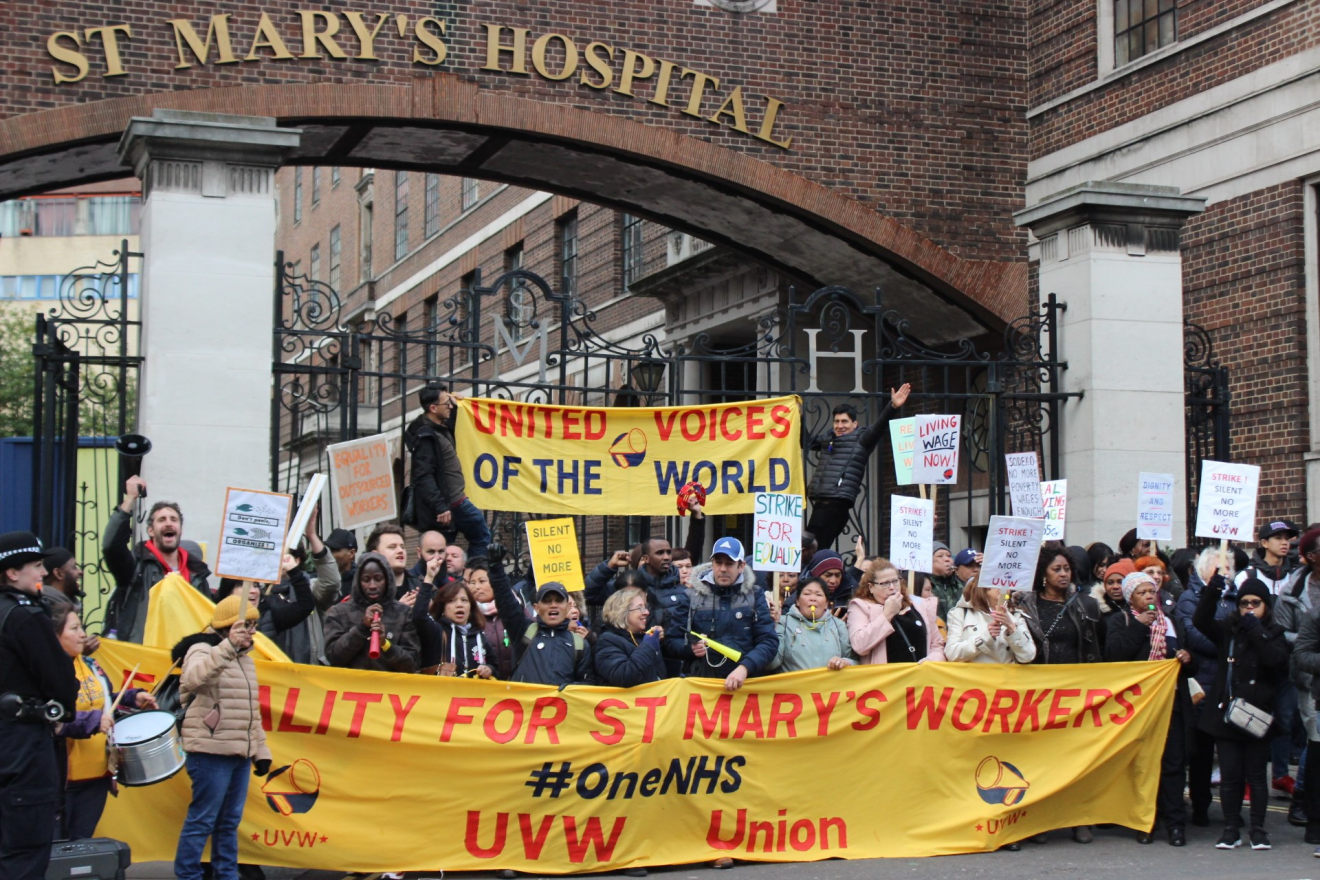
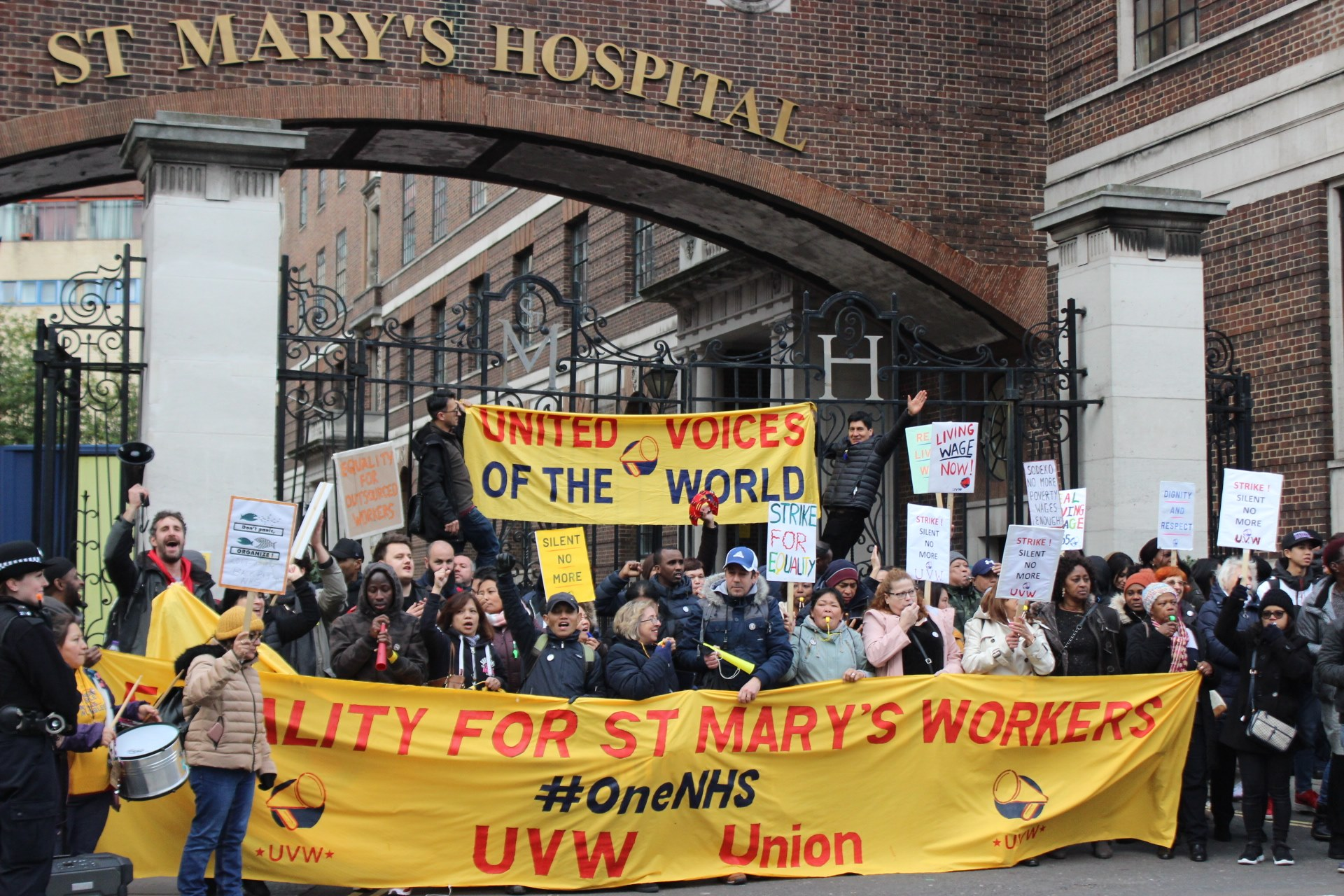
Stunning efforts by the United Voice of the World (UVW) Union-led striking staff have released 1,000 cleaners, porters and caterers at hospitals in west London from unfavourable outsourcer contracts and into permanent NHS employment.
Some 200 UVW members at St Mary’s Hospital spearheaded a nine day strike, mass pickets, blockades, occupation and the storming of an Imperial College Healthcare NHS Trust Board meeting. The staff, as from 1 April 2020, will receive NHS basic pay rates, sick leave and pension entitlements. The new deal will apply to workers at Charing Cross, Hammersmith, Queen Charlotte’s and Chelsea, St Mary’s and Western Eye Hospitals. The workers, who are largely migrants from Europe, Africa, Latin America and Asia, will leave French outsourcer Sodexo.
UVW, formed in 2014, is a member-led campaigning trade union which supports and empowers the most vulnerable groups of precarious, low paid and predominantly migrant workers in the UK. It has extensively researched and documented the correlation between outsourcing, Hospital Acquired Infections (HAIs), cleanliness and patient care. More at:
Jeremy Hunt MP Elected Chair of House of Commons Health and Social Care Select Committee
Mr Hunt was, from 2012 to 2018, an extremely unpopular and unsuccessful Secretary of State for Health (and then also Social Care). This is totally unacceptable and is a clear conflict of interest. The phrase ‘marking his own homework‘ has been heard in Parliamentary circles.
The many health and social care failures under his six year leadership include:
+ His promise of 6,000 new GPs never even remotely materialised
+ His 95% of A&E patients seen in 4 hours target was consistently not met and often widely missed
+ The NHS England hospital maintenance backlog grew under his leadership – and now has reached £6.5 billion
+ care.data, an NHS information patient data sharing scheme, was launched in 2013 and abandoned in 2016 at a cost of £50 million
+ His 2016 new Junior Doctors contract resulted in the first doctors’ strike for 40 years
+ His devotion to the always failing 2012 NHS North West London ‘Shaping a Healthier Future’ plan. It cost over £250 million and was axed just six months after he departed the health and social care stage.
Almost 50% of Senior NHS Leaders Planning to Leave Because of Pension Changes Driven Additional Tax Bills
A recent survey by NHS Providers of executives of NHS ambulance, community and mental health services strongly suggests that the 2016 pension rules changes will cause an exodus of senior managers in 2020/21. The 2016 pension rule changes saw the annual tax free pension savings allowance reduced from £40,000 to as little as £10,000 for incomes of more than £110,000/year. Those earning over £110,000/year could end up paying tax rates of more than 90%. For those nearing this financial threshold, their options include reducing their paid hours of work, quitting the NHS pension scheme or taking early retirement.
It’s a Long Time Waiting for the NHS NWL Long Term Plan (LTP)
The national LTP was published in January 2019. Its appearance and content ‘trumped’ the NHS NWL October 2016 Sustainability and Transformation Plan (STP). Two months later the DHSC abandoned the NHS NWL ‘Shaping a Healthier Future ‘ (SAHF) plan. So here we are in north west London 13 months later with no regional care ’transformation’ plan. Ms Juliet Brown of NHS NWL announced in public in January 2020 that the latest (final?) version of the NHS NWL LTP would be published in April 2020. I’m afraid this person’s credibility is constrained by the fact that every time we see her in public she seems to have adopted a new job title! Since 2016 we’ve seen her as Strategy and Transformation, Director of Operations SaHF, STP Programme Team, Director of the NWL STP, Local Services Transformation Director, Workforce Lead Strategy and Transformation, and now Health and Care Partnership Director.
It’s timely to remind ourselves of what is contained (and not contained) within the national LTP and the draft regional LTP:
+ 60 promises completely uncosted
+ Undemocratic and dangerous legal changes. These include the merging of local CCGs into mega regional CCGs – to cut spending. Even without an approved regional LTP, NHS NWL is targeting April 2021 for the NHS NWL CCG, and ‘partnering’ between local NWL CCGs has started – again for cost cutting reasons. Ealing and Hounslow CCGs are ‘working together’ and some functions will be shared and no doubt ‘duplicate’ staff let go.
+ Nationally the plan is to reduce our 7,500 GP practices into 1,500 super practices. (The eight NHS NWL Primary Care Networks (PCNs) linking 396 GP practices look like they could – painfully perhaps – morph into eight super practices). Nationally this approach might reduce the number of GP practices to under 500. Maybe this will be in the (2022?) NHS plan which replaces the LTP – as transformation planning cycles within the NHS are becoming shorter and shorter….
+ Integrated Care Systems (ICSs) post 2021 will all morph into Integrated Care Partnerships (ICPs). No doubt private companies will compete for these 44 ICP contracts nationally, which as non-statutory bodies will not be formally accountable to public scrutiny.
+ No explicit national/regional LTP programme exists for Ealing Hospital. The NHS NWL SaHF plan (2012 – 2019) mandated the hospital’s downgrade from ‘Major Hospital’ to ‘Local Hospital’ including eliminating its A&E unit – but failed to implement this. The NHS NWL STP plan (2016 – 2019) unhelpfully refers to the ‘the ongoing uncertainty of the future of Ealing Hospital’.
+ The draft NWL LTP proposes to free up a further 100 beds by April 2020. With just seven weeks to go one wonders if this bed reduction has happened or will happen. NHS boss Simon Stevens, the Kings Fund and the BMA have all requested more beds, not fewer. Add to this the worst A&E performance (in December 2019) since records began and reducing beds seems like organisational self-harm.
+ So many references to ‘Hubs’ in the NWL LTP draft – ‘a network of Primary Care Hubs and Community Training Hubs’, ‘Digital Healthy Hubs’ and ‘a Pan NWL London Hub’. Are they contained in existing buildings? If they are to be new buildings just what hope is there for capital grants to build them? Minutes of devolved London care meeting chaired by the London Mayor make it clear that only Imperial and Hillingdon Trusts in NHS NWL will be recipients of any Government money for building work.
+ 100s of £millions have been wasted in NHS NWL in recent years. Very large deficits/debts exist in both the commissioning and service delivery sectors. Common sense dictates there can be no significant financial recovery (i.e. cost cutting) without significant reductions in the quantity and quality of care probably over the next five years. There is a lack of honesty and transparency in the NHS NWL LTP draft to reflect this.
+ Major Improvement in mental health and mental social care provision services is not a feature of the national LTP nor the NWL LTP. Affecting one in five adults – with over 11 million adult sufferers nationally and over 370.000 sufferers in NWL – mental health and mental social care are the major care challenges. Both LTPs fail miserably to address these challenges.
Self-Harming in Gaols Reaches Record Levels
During the period October 2018 to September 2019 61,401 prisoners in gaols in England and Wales self-harmed. This number was the highest figure ever recorded and was 16% higher than in the previous year. One can only conclude that the number of people incarcerated with mental health problems is increasing and/or that the condition of those suffering has deteriorated.
Also the number of attacks on prison staff in the year to September 2019 was 10,059 – which is a staggering increase from 2,937 attacks in 2010.
Rapid Response Teams – ‘Robbing Peter to Pay Paul’?
The failing mantra of ‘treat fewer patients in hospital and more in the community/at home’ was trotted out again at the January 2020 launch of Urgent Community Response Teams. These teams aim to treat older people in their homes. Sounds great on paper but in practice will there be the staff to populate these teams?
The teams will ostensibly be made up of Physiotherapists, Occupational Therapists and nurses. However there are no ‘spare’ nurses or therapists. The current vacancy rate for nurses in England is 43,000 (RCN). So, in order to assemble a mobile team of staff, these staff will have to leave their static treatment bases (hospitals?) and their patients.
To compound the response team challenge, they will be jointly run by Local Authorities (LAs) and NHS bodies. This joint working (or ‘co-production’ to give it its modern label) is going to be the business process of choice in the 44 Integrated Care Systems (ICSs) of 2020/21. The subsequent Integrated Care Partnerships (ICPS) which will grow out of the ICSs will also be LA/NHS dominated bodies.
The track record of LA/NHS ‘integration’ locally is not brilliant. LAs and the NHS working together locally possibly hit its nadir in 2016 when both Ealing and Hammersmith & Fulham Councils refused to be railroaded into signing up to the NHS NWL Sustainability and Transformation Plan (STP). In January 2020 senior staff at the West London NHS Trust Board meeting voiced their frustration in dealing with Ealing Council social care policies and processes.
‘GP At Hand’ Disrupting Analogue-First General Practice
Babylon Technologies’ ‘GP at Hand’ really is running the NHS ragged all over the place. And the Health and Social Care Minister Matt Hancock MP raving about how good the product is and how he’s a user gives a whole new meaning to the phrase ‘inappropriate behaviour’.
GP at Hand replaces seeing your GP in person with having a consultation with a GP on your SmartPhone. The service is underpinned by an Artificial Intelligence-based symptom checker. The service is not available to patients who are pregnant, frail and elderly or have a terminal illness. Apparently patients are also shunned if they have mental health problems, drug problems, dementia, a learning disability or safeguarding needs. A cynic might describe GP at Hand as Primary Care for the healthy.
Allegedly 18 CCG territories have patients who have switched from ’analogue-first’ GP practices to GP at Hand ‘digital-first’ GP practices. New NHS England guidelines are that when/should the number of GP at Hand patients in any CCG territory reach 1,000 in total instead of Hammersmith & Fulham CCG picking up the bill, these patients will be ‘repatriated’ to the CCG where they live.
Latest GP at Hand scores are 72,640 patients in London and 1,718 in Birmingham. NHSE has declined to sanction the services’ expansion into Manchester and says it wants expansion to be primarily in areas currently ‘under-GP’d’.
Eric Leach
|
||||||||||||||||||||||||||||||||||||||||
|

SOCIAL CARE IN CRISIS
There is no clear sign that the crisis in social care will end any time soon. There has been lots of talk for years about changes/improvements but no recently implemented Acts of Parliament, sustainable policy changes or even large amounts of cash thrown at the problem. In 2014 Parliament passed legislation to cap the cost of personal care for older people and then it postponed its implementation indefinitely. The various unkept Government promises about publishing a Social Care Green Paper are quite pathetic. It was announced some two years ago and its appearance has been postponed six times. Prime Minister Johnson has said he wants a year to think about it. Even re-naming the Department of Health by tagging on Social Care has made little difference. All the nonsense about integrating healthcare and social care always comes with an NHS healthcare label on it with social cares just tagged on as an afterthought. As has been pointed out before, the irony of this of course is that in terms of beds and staff, social care is a bigger operation than healthcare!
In December 2019 the Government announced an additional £1 billion (or was it £1.5 billion?) for social care in 2020/21. A veritable drop in the ocean. Of course Local Authorities can increase Council Tax bills by 2% and the money be ring fenced for social care. If they all did this it would raise £500 million – yet another teardrop of help.
The Crisis – Facts and Estimates
+ Since 2010, £7.7 billion has been cut from adult social care budgets (Association of Directors of Adult Social Services – ADASS)
+ £700 million social care cuts in 2019/20 (ADASS)
+ 627,000 people refused social care March 2017 – January 2019 (AgeUK)
+ 1.4+ million older people with unmet social care needs (AgeUK February 2019)
+ 54,000 elderly people have died in England since March 2017 waiting for a social care package (AgeUK February 2019)
+ 5.3 million people over 75 years of age (Centre for Policy Studies 2019)
+ Children in Care – 28% Rise since 2009. 78,150 in 2019, 60,900 in 2009 (Local Government Association – LGA)
+ Children’s services facing £3.1 billion funding gap by 2025 (LGA January 2019)
+ 143,000 older people face catastrophic lifetime costs of £100,000 or more (Independent Age report April 2019)
+ £21.3 billion annual social care spend in 2018/19 (Institute of Fiscal Studies). Total annual healthcare spend in 2018/19 was £129 billion (fullfacts.org)
+ 122,000 current vacancies in social care (Workforce Intelligence October 2019)
+ 24% of care workers on Zero Hours contracts (Skills for Care September 2017)
+ 84% of care home beds are owned by private companies. Just 3% are provided by Local Authorities
+ In 2015, Delayed Transfers of Care (‘bed-blocking’) caused by social care difficulties amounted to some 600,000 hospital bed days (National Audit Office 2016)
+ 100,000 of the 1.4 million social care workforce comes from the European Union (EU). Brexit could make it harder to recruit EU nationals (AgeUK February 2019)
+ 18,500 employing organisations in social care (Skills for Care)
+ Estimated additional social care staff needed by 2035 is 580,000 (LGA)
+ 64.8% of the nation’s population live in an area where there is no community care legal aid provider (Legal Aid Agency).
Cost to Fix the Problems?
Introducing free personal care could cost £17 billion/year (Institute for Public Policy Research -IPPR -report May 2019).
Full funding of long term social care could cost £11 billion/year (Policy Exchange report June 2019).
75,000 extra care home beds could be provided by the State at a cost of £7.5 billion by 2030 (IPPR September 2019).
Barriers to Progress
Brexit will, yet again, dominate Parliamentary business in 2020 as we rush to cram many years work into 12 months to ’secure’ Brexit.
Unless the Government somehow runs healthcare and social care through the same business model the mismatch – on so many levels – between NHS Trusts and Local Authorities will continue.
The introduction of Integrated Care Systems (ICSs) in April 2020 in some parts of the UK and even more in other parts in April 2021 will eventually create 44 new ICS bureaucracies. The reduction in the number of CCGs from 191 to 44 by April 2021 will create its own turbulence. Who knows how the mega ICSs and mega CCGs will work together and whether social care services will improve or degrade in this ‘big is beautiful’ scenario?
In 2018 we saw the creation of hundreds of Primary Care Networks (PCNs), each comprising typically between 30,000 and 50,000 patients. The ultimate reason for these PCNs is unclear to me. However the role and activities of the 1,000 PCN ‘Social Prescribing Link Workers’ may add value or confusion to the social care offering in an area. Current local GP feedback is unhappiness about the PCN Directed Extended Services (DES) specification and in Ealing there is already a 81.25% vacancy rate for PCN DES funded new hires!
GPs Up in Arms Nationwide About Extra Workload Introduced by Primary Care Networks (PCNs)
According to ‘The Guardian’ of 22 January 2020 GPs all over England are furious about the extra workload being introduced this year via the PCN initiative. Professional bodies leading the objections to the PCN workload include the British Medical Association, the Royal College of GPs and the NHS Confederation. Unrealistic and unachievable are just two of the adjectives being hurled at local CCGs and NHS England.
The PCN driven new workload for GPs includes:
+ Regular reviews of patients’ drug regimes
+ Preventative healthcare to vulnerable groups
+ Visiting nursing, residential and learning disability care homes on a weekly basis
+ Improving performance in the early diagnosis of cancer
+ Providing more personal care.
Some of the new roles have to become active in April 2020, with additional roles to be added in September 2020. Ealing GPs at an Ealing CCG meeting on 22 January 2020 left me in no doubt that they were very unhappy about this PCN-driven extra workload.
NHS England, who introduced this PCN workload chaos is apparently now committed to reworking the potential mess it has created.
A McKinsey & Co Director Becomes The Boss of the NHS North West London (NWL) Integrated Care System (ICS)
‘Health Service Journal’ (HSJ) released this bombshell in January 2020. Healthcare activists are shocked and annoyed by this. It was McKinsey & Co’s ‘transformation’ conference papers in 2009 and 2012 which provided the bedrock dogma for the 2012 NHS NWL’s ground-breaking (and ultimately heart-breaking) 2012 ‘Shaping a Healthier Future’ (SaHF) programme. The programme was spectacularly unsuccessful and caused pain and suffering for thousands in north west London. The Government finally killed it off in March 2019. £100s of millions were wasted on SaHF. Researcher Colin Standfield recently sized the management consultancy fees paid to McKinsey & Co by NHS NWL to support the SaHF transformation at £34,680,896:60p as of November 2017 (when CCGs stopped publishing Consultancy cost data).
The new NHS NWL ICS boss is Penny Dash. She was once a hospital doctor, and also worked at Kaiser Permanente (the American integrated managed care consortium). She was Head of Strategy and Planning at the NHS 1999 – 2001 and is now McKinsey & Co’s Head of Healthcare for Europe. After spending over 11 years at McKinsey &Co she is retiring. It’s not clear how old she is but is it appropriate that a retiree should have main board responsibilities for commissioning healthcare and social care for 2.3 million citizens living in north west London? Mind you, it sits well with 70 year old Sir Amyas Morse ‘chairing’ the running of secondary healthcare services at Ealing, Hillingdon, Northwick Park, Central Middlesex and St Marks Hospitals. It’s becoming an old persons club which directs the buying and provision of care services in north west London.
It would seem Ms Dash is the replacement for NWL NHS Collaboration of CCGs boss Mark Easton who officially departs at the end of March 2020. As NHS NWL has delayed its leap into hyperspace (sorry ICS) until 1 April 2020, maybe her full-time role might not begin immediately. However I suppose someone has to run the in-debt Collaboration of eight CCGs as from April 2020 till April 2021.
NHS NWL ICS, by the way, is the new flavour of the 2016 NHS NWL Sustainability and Transformation Plan (STP). Apparently the NHS NWL Long Term Plan (LTP) has drifted into the public domain after being in its gestation phases now since the national LTP was published 13 months ago. Presumably the new LTP will influence the content and operation of the ICS. Ill review the NHS NWL LTP in the next issue.
What is the Future for Ealing Hospital?
With NHS North West London’s 2012 ‘Shaping a Healthier Future’ (SaHF) plan we knew what the gloomy prospects were for the survival of Ealing Hospital. Since March 2019 when the Government dramatically cancelled SaHF, we have heard nothing but empty promises from the Harrow-based Ealing Hospital management. ’We’ll have a draft plan by September 2019’, we were told by LNWUHT Chair Peter Worthington in early summer 2019. It never appeared and by 1 January 2020 he’d disappeared. LNWUHT Chief Executive Dame Jacqueline Docherty nodded in agreement with Mr Worthington and then in August 2019 announced her retirement.
I, for my sins, have been tracking new housing developments and plans in Ealing very closely over the last five years. Since 2015 the number of Ealing tower blocks over 10 storeys high which have been built, are being built, have planning permission or have been announced by developer/land owners is a staggering 105. In these blocks over 36,000 new flats will become vacant by 2030. If all these flats find occupiers there will be over 72,000 new residents by 2030 – 25,000 in Southall alone.
The patient population in Ealing according to the NHS is currently over 440,000. By 2030 it could easily exceed 500,000.
Do 500,000 Ealing residents need and deserve a Major Hospital in their town? Only an idiot would answer no to this question.
So….where’s the plan for Ealing Hospital?
Local Healthcare Commissioning Begins its 13 Month Descent into Regional Commissioning
Local CCGs are beginning to partner with each other. The projected dance formation is:
+ Brent and Harrow
+ Central London, Hammersmith & Fulham and West London
+ Ealing and Hounslow
Hillingdon (forever the maverick) remains gloriously on its own.
I asked the departing NHS NWL Accountable Officer Mark Easton on 22 January 2020 why these partnerships are being created and what they would mean in practice. He was very clear in his answer. There would be a reduction in the number of management positions, and a pooling of staff to provide functions for CCGs to share. One function he mentioned was business planning. Cost cutting is clearly the primary objective. This question was posed at the end of an Ealing CCG Governing Body meeting. For the first time any of us could remember the ECCG Chair and the ECCG Managing Director were both absent from the meeting.
Eric Leach

A new year, a new Prime Minister and lots of promises about extra money for the NHS. However, extricating the NHS from its many crises will take more than money. It will take time, good management, realistic planning, expanded educational resources, effective staff recruitment and retention and sustained prudent decision making.
Goodbye Mr Easton and Dame Jacqueline and Hello Sir Amyas Morse
In NHS North West London (NWL) two of the ‘big beasts’ are about to depart the stage. Mark Easton, NHS NWL supremo for 18 months and Dame Jacqueline Docherty – Northwick Park/Ealing Hospital/Central Middlesex/St Mark’s Hospitals’ boss for 4 years – will both be gone by 31 March 2020. Neither of them have covered themselves with glory. Mr Easton was a cheer leader for the obviously failing ‘Shaping A Healthier Future’ (SaHF) project and famously asked NHS England for £260 million for building work and was granted just £10 million. He’s had 9 different NHS roles in just 13 years. It will be fascinating to see what heady heights he’ll be promoted to now. Dame Jacqueline originally trained as a nurse and has filled NHS executive positions for 23 years. She inherited a disastrous 2014 merger of Ealing Hospital and Northwick Park Hospital creating NWLUHT and oversaw the almost malevolent downgrading of Ealing Hospital, stripping it of its on-site management, Maternity, Paediatrics and Urology services. Both individuals depart organisations mired in debt – NHS NWL’s ‘underlying deficit’ was £324 million and NWLUHT’s ‘operating deficit’ was £37 million in 2018/19.
As of 1 January 2020 another big beast entered the fray. Peter Worthington is gone and replaced as NWLUHT Chair by Sir Amyas Morse. He’s 70 and is the ex-boss of PwC and the National Audit Office. A Scottish auditor who has a high national profile, he is continuing as Chair of The Hillingdon Hospitals Foundation Trust (HHFT). No doubt, with debt reduction still in the air, another merger (NWLUHT + HHFT) seems to be on the cards. Bizarre as it seems the head-hunters started looking to probably pay a fortune for a new Chief Operating Officer (COO) for NWLUHT on 23 December 2019. Sounds suspiciously like going through the motions to advertise over Christmas – no doubt NWLUHT had already found the COO it wants.
None of this probably bodes well for Ealing Hospital. With no on-site management and no development plan, the prospect of it becoming an even smaller pawn in a bigger Trust looms large.
Sir Simon Stevens and Sir Iain Duncan Smith – Oh No!
Simon Stevens is the NHSE/I boss who allowed the NHS NWL ‘SaHF’ farce to decimate Ealing Hospital and to waste £100s millions – during his tenure from April 2014 to March 2019.
Iain Duncan Smith is the genius who introduced Universal Credit and the Bedroom Tax in 2013 which have brought pain, poverty, eviction and death to far too many people.
Circle Health Acquires BMI Healthcare
A £1 billion private hospital business has been created. Circle Health was formed in 2004 by ex-Goldman Sachs banker Ali Parsa. It’s had a chequered history. It famously abandoned the high profile 2010 Hinchinbroke Hospital, Cambridgeshire 10 year management contract in 2015. It cited that the contract was ‘no longer financially viable’. The local NHS Trust ended the year with a £14 million deficit. BMI Healthcare has 54 hospitals and healthcare facilities in the UK. It was formed in 1970 as AM group and became BMI in 1993. Mergers, sell-offs and changes in ownership happened over many years until a South African company Netcare took over control in 2006. Circle Health is significantly smaller than BMI Healthcare. This consolidation in the private hospital market is either a sign of market maturity or of a market in significant difficulty.
Secret Meeting To Discuss Selling Our Patient Data
‘The Times’ of 31 December 2019 reveals details (first exposed by technology news site ‘The Register’) of NHS bosses’ recent meeting with Microsoft, Amazon and Astra Zeneca to discuss selling off patient data. The meeting was held in October 2019 and attending were Chair and Chief Executive of NHS England Lord Prior of Brampton and Sir Simon Stevens.
Apparently what is planned is the creation of a data repository, which could be available within two years, containing patient data from GPs, NHS Trusts and directly from medical devices. Lots of alarm bells ring about this. There was the Tony Blair inspired NHS National Programme for IT, first conceived in 2002, which featured an electronic care record for everyone. It was abandoned in 2011, with little of value created or retained, at a final cost of £12.4 billion. Even more recently we had the care.data fiasco, announced in 2013 and scrapped in 2016. The plan was to extract patient data from GP surgeries and put it in a central database. The project failed because patients did not trust it and GPs wouldn’t support it. The money wasted was £7.7 million.
Just 15 More Months for Ealing CCG
Our local Clinical Commissioning Group (Ealing CCG) has just 15 more months of life. It too wallows in significant debt (losing £5.2 million in 2018/19) and one does wonder how long its boss Dr Mohini Parmar will remain in post. She was, truth be told, one of the signatories of the 2012 £250+ million flop known as the NHS NWL ‘Shaping a Healthier Future’ project. Dr Parmar was also one of the cheer leaders of the now replaced 2016 NHS NWL ‘Sustainability & Transformation Plan’. She is, however, contracted to work with ECCG until 14 July 2021. As well as her it will be interesting to see where the 9 ECCG middle/senior managers (earning over £50,000/year) find themselves new speaking parts in the emerging NHS NWL Integrated Care System (ICS). It will be especially interesting to see where ECCG MD Ms Tessa Sandall – currently earning £100,000+/year – finds herself a new role.
NHS NWL Long Term Plan and Integrated Care System
Ealing Save Our NHS provided copious feedback on the draft NWL LTP on 13 October 2019. However, there’s still no sign of an approved version of the plan. Where is it? It looks like the NHS England Integrated Care System (ICS) web page has not been updated since June 2019. The much vaunted trailblazing Dudley ICP is not even listed. The delegated Greater Manchester ICS is suspiciously silent also. No doubt some NHS footprints/regions will be operating with a single CCG in just 3 months’ time – but where is the news/detail about this? NHS South East London is one of these regions but there’s scant information about collapsing six CCGs into one there.
As Mr Johnson talked incessantly about the NHS during his election campaign it will be interesting to watch what, if anything, he does about it. When he was Mayor of London he had to have his own ‘new’ London Plan. Maybe he’ll want his own ‘new’ NHS Plan.
I have been of the opinion for years now that throwing healthcare and social care together (so called integration) is not a solution to any known care service problem. The ICSs which are being created are accountants attempts to reduce operating costs. As far as I can deduce the ICSs offer no real prospect of improved care services from either a quantitative or qualitative aspect.
Maybe in future years we’ll see more ’mergers’. By 2030 we might have a single ICS (or some fancy new name) for London and possibly just four NHS Trusts in London, and maybe just 10 Major Hospitals. Just think how NHS accountants would love that – with lots of directors, managers, administrators, human resourcers, IT, public relations and others made redundant. Not to mention acres and acres of urban land to sell off to property developers.
NHS NWL’s 4,000-strong EPIC ‘Citizen’s Panel’ Will Not Replace Engagement and Public Consultation with 2.3 million Residents
NHS North West London’s PR supremo Rory Hegarty is currently assembling a ‘super group’ of 4,000 residents who will act as care policy /process reviewers. Quite pointedly very healthcare-savvy residents in activist groups like Ealing Save Our NHS (ESON), Hammersmith & Fulham’s Save Our NHS (SCXH&H) and Brent Patient Voice (BPV) were not on Rory’s invitation list. The panel cheerleaders/bosses held their first workshop on 17 December 2019.
Apparently 3,700 citizens have already signed up to be EPIC members. It’s important to realise that EPIC has no statutory legitimacy whatsoever. Robin Sharp of BPV has described the contents of the 17 December 2019 EPIC Workshop slides as representing a parallel universe. In some ways this is almost a kind comment.
Two of the workshop speakers are of interest. One was Christine Vigars of Central London Healthwatch. She consistently attempts to hold NHS institutions to account in meetings held in public. The other was Carmel Cahill who now has a new role as Chair of North West London Integrated Lay Partners Group. She was one of the founding members of the ill-fated 2013 Ealing Healthwatch which was eventually terminated in 2016 by Ealing Council. She was also a very vocal supporter of the disastrous 2012 NHS NWL ‘Shaping a Healthier Future’ (SaHF) project. She’s also on the Governing Body of the technically bankrupt Ealing CCG which will be wound up by March 2021.
Economy With The Truth
Some of the workshop slides contain some breath-taking content;
+ ‘Historically, our patch has a reputation for engaging well’.
I’ve been researching NHS NWL’s performance since 2012 and in terms of engagement and public consultation NHS NWL has not ‘engaged’ well with its customers – in fact in the classical engagement terms of ‘…during the formative stage of plan making ‘ – not at all.
+ ‘NHS staff, community activists and service users are in regular dialogue’
Not with ESON/SCXH&H/BPV. Dialogue is a two way process. NHS NWL writes/says something. Activists respond. NHS NWL does not respond. Activists write/say something to NHS NWL. NHS NWL does not respond.
There’s a fascinating ‘Diffusion of Innovation’ bell curve diagram, the like of which I saw many times during my IT career in the 1990s. The headline of this slide is a mind boggling ‘Creating a Coalition of the Willing’. It reveals that NHS NWL sees itself as a leading edge innovator. Change in itself is not a benefit. Beneficial change is, of course, to be welcomed. Local activists have for some 7 years consistently asked for evidence to justify changes like SaHF, Sustainability & Transformation Plan (STP) and now ICS. Having received no evidence to support the now abandoned SaHF/STP why would we support the unevidenced ICS? The patronising placard holding cartoon figure supporting the Flat Earth is not in fact ESON/SCXH&H/BPV but NHS NWL!!
Is EPIC Just Expensive Time Wasting for 4,000 Residents?
Another seven slides have the Delphic title of ‘Would the content transend role’. None of this content is remotely understandable. The slides then do indeed go into outer space in academic discussions about three types of organisation structures – hierarchical, hybrid and network.
New jargon emerges – the most prominent for me being QSIR. Quality, Service Improvement and Redesign is an NHS initiative dating back to 2016. Apparently there is a ‘QSIR College’ at which service improvement skills are taught. Seemingly QSIR is ‘a catalyst for place and value-based integration’. If I knew what that meant I might be able to confidently disagree with this.
In the slides mentioning Primary Care Networks there are some outrageously aspirational mentions of ’housing’, ‘QPR’ (!), and ‘retired teachers’. However for sheer brilliance in confusion is the complicated ‘Community Resilience’ graphic. None of my dictionaries can define ‘Transactional Resources’.
And after all care policy does not emanate in NHS NWL but no doubt far away in Dominic Cummins’ brain, via Mr Johnson, his Cabinet, the Department of Health & Social Care, NHS England and NHS London. Do we think if the gang of 4,000 say no to closing Charing Cross Hospital it will influence the decision being reversed?
NHS NWL has come up with the acronym EPIC after describing its citizens’ panel as Engage, Participate, Involve, Collaborate. Somehow I think Expensive, Irrelevant, Patronising and Contrived is more appropriate.
However, judge for yourselves at:
One does wonder what Mark Easton’s replacement will make of this leading edge, innovatory groupthink initiative.
Happy New Year!
Eric Leach

|
||||||||||||||||||||||||||||||
|
|
|||||||||||||||||||||||||||||||||
|
Hospital Beds 2010 – 144,455: Hospital Beds 2018 – 127,225. Why? Why? Why?
The Labour Party’s analysis of NHS Digital data has revealed that over 17,000 hospital beds have been cut since 2010.
In 2018 the British Medical Association warned that 10,000 extra hospital beds were need.
In June 2019 NHS supremo Simon Stevens told NHS bosses that bed cuts should stop because they were leaving hospitals unable to cope with the number of people who needed to be admitted.
Well yes Mr Stevens, bears do indeed defecate in the woods….
Comparing Conservative and Labour Election Manifestos From the Care Perspective
NHS
Conservatives: Annual spend by 2024 – £149 billion. 50,000 extra nurses (this is widely disputed). 50 million extra GP appointments (this is not believable). 40 new hospitals (quite simply this is a lie)
Labour: Annual spend by 2024 – £155 billion
NHS Privatisation
Conservatives: Nothing
Labour: End and reverse privatisation of the NHS
Dementia
Conservatives: Double research funding and speed up trials for new treatments
Labour: Nothing
Mental Health
Conservatives: ‘Mental health will be treated with the same urgency as physical heath’
Labour: Implement all of the recommendations set out in the independent review of the Mental Health Act. Pledge to provide an extra £1.6 billion /year to ensure new standards for mental health are enshrined in the NHS Constitution. Invest £2 billion to modernise mental health hospitals and end the use of inappropriate out-of-area placements.
Social Care
Conservatives: Additional £1 billion annually from 2020
Labour: Additional £7 billion /year 2020/21 rising to £11 billion/year by 2023/24
Carers
Conservatives: Nothing
Labour: Increase Carers’ Allowance to the level of JobSeekers
Residential Care
Conservatives: Nothing
Labour: Reference to ‘…growing public sector provision’
Sheltered Housing
Conservatives: Nothing
Labour: Rent controls, ‘binding minimum standards (with inspections) may apply’
(Sources ONS, parliament.uk, Daily Telegraph)
Keep Our NHS Public (KONP) has put together an excellent list of care questions to ask prospective MPs at local hustings:
NHS Contracts Worth £14.7 Billion Awarded to Private Companies Since 2015
The GMB Union has announce the findings of research it commissioned with Tussell. Tussell provides data on Government contracts. £14.7 billion of the £24 billion outsourced NHS contracts awarded since 2015 went to private companies. That equates to 61% of all outsourced contracts. In 2018 it was 68% at £3.6 billion.
The largest recipients were Care UK (17%) and virgin care (13%). The highest value contract (£1 billion) went to a not-for-profit private enterprise called Sirona Care and Health in south west England for 10 years’ worth of adult community health services.
More at www.gmb.org.uk/news
94% of Directors of Adult Social Services Have Little Confidence They Can Meet their Statutory Responsibilities by the End of 2020/21
The Association of Directors of Adult Social Services (ADASS) has revealed some stark facts and views from its members in its Autumn 2019 survey.
Current Directors are planning to deliver £699 million savings in 2019/20.
They have identified unintended consequences arising from the strong focus on reducing rates of delayed transfers of care from hospitals in their areas. 85.5% of Directors say there have been moderate, significant or very significant increases in rapid discharges to short-term care home placements that become long-term (82.3% in 2018).
More at www.adass.org.uk
43% of NHS Junior Doctors in Obstetrics and Gynaecology are Suffering From Burnout
3,000 doctors working in Obstetrics and Gynaecology were interviewed in an Imperial College London (ICL) study. 43% said they had experienced symptoms of emotional exhaustion and lethargy.
When the ICL research was extended to all doctors, it was discovered that 36% were suffering from burnout.
More at: https://bmjopen.bmj.com
51,534 Adult (16+) Ealing Residents With a Common Mental Health Need: But Only 23,752 (18+) Registered With Their GP as Having Depression or Psychoses
Ealing Council’s ‘Market Position Statement 2019-20’ has been published as part and parcel of its Health and Adult Social Services Standing Scrutiny Panel responsibilities. Other headline facts include 4,886 people registered with their GP in Ealing as having psychoses in 2018/18. This is higher than in England but similar to levels in London.
Ealing CCG and Ealing Council spent over £60 million per year on adult mental health. £56 million of this is spent on NHS services
Ealing’s Substance Misuse Population Have Unmet Needs Way Above National Levels
The prevalence of hazardous substance (drugs and alcohol) use amongst psychiatric patients in Ealing is estimated at between 22% and 44%.
Ealing’s levels of unmet need compared to National levels:
Substance Ealing Unmet Need (%) National Unmet Need (%)
Opiates and/or Crack Cocaine 67.9 51.9
Opiates 62.7 46.3
Crack 70.2 61.1
Alcohol 84.3 82.9
(Source: NDTMS Q3 2018/19 DOMES Report)
In 2017, Public Health England estimated Ealing’s dependent alcohol drinking population at 3,499 residents. For opiate and crack users it’s 2,419. However these figure dwarf the borough’s annual drug and alcohol treatment population (1,492 in 2017/18). With continued budget reductions (35-40% less money since 2015/16) it’s unrealistic to think that Ealing’s treatment service can make any headway in reducing these unacceptable levels of unmet needs.
CQC Finds That Just 42% of Mental Health Patients Feel They Receive Enough Care
CQC surveyed 12,500 mental health patients and the results reveal that mental health services are deteriorating. In 2014 just 43% of patients were satisfied with their treatment – just 1% better than the 42% in 2019.
31% did not know who to contact in the NHS out of hours if they had a mental health crisis.
52% of patients who responded said the mental health staff who saw them were completely aware of their treatment history. 21% were not involved in agreeing a treatment plan.
And to add to our national mental health woes, The Royal College of Psychiatry has pointed out that unfilled psychiatric vacancies have doubled over the last six years.
A Question for You All
As we are reaching the end of the year and maybe time for reflection, let me share with you a question posed by my old friend Ian Hugo:
‘UK National Debt since 2007 has risen from 68% of GDP to 85% of GDP, money borrowed by the Government while public services such as the Police, Fire Brigade and the NHS all suffered cuts in budget and services degraded. So who got the money and for what?’
Have a very Merry Christmas!
Eric Leach

|
18,400 MENTAL HEALTH BEDS IN 2019 – IN 1954 THERE WERE 155,000. WHY? WHY?
Here are some chilling facts about mental health bed numbers in England:
1954: 155,000
1987: 67,000
2008: 27,000
2019: 18,400
The figures are provided courtesy variously of the Royal Society of Psychiatrists and the British Medical Journal. There are many questions to be asked surrounding these figures. Firstly are we in a better place now vis a vis treating the mentally ill and mentally disabled than we were in 1954? Are there more or fewer mentally ill/disabled now than in 1954? Is bed reduction a function of changing the ‘setting’ or clinical ‘pathway’ for care/treatment? If so, is this ‘transformation’ a successful one?
And what are the mental health bed numbers like in other countries, especially in the context of mental health rates in this and other countries? Finally we attempt to evaluate whether quality of care and treatment has improved over the last 60 years. What qualitative metrics exist now and are planned in order to detect and measure ‘successful’ care and treatment.
Mental Health Beds/100,000 Population
The UK is not the worst or the best in terms of mental health beds. Belgium tops the table with 180.1 mental health beds per 100,000 population. The UK stands at 60.6 beds/100,000. Italy ranks very low at 10.6, with Germany, Sweden, Denmark and Spain having fewer beds than in the UK.
National Rates of Mental Illness
Again we don’t have the highest or lowest rates of mental illness. We are 16th in the world at 26%. Switzerland is the worst quickly followed by France, Germany and the USA. Belgium, with the most beds stands at 6th with 29.4%.
1.2 Million Adult Bipolar Patients and 600,000 Adult Schizophrenia Patients in England
There are some 60 million adults in England and 2 in 100 of them are bipolar suffers and 1% are schizophrenics.
And just 14,800 beds……
Measuring The ‘Quality’ of Mental Health Treatment
Victor Leser, Ealing Save Our NHS (ESON) and Keep Our NHS Public (KONP) have mounted a campaign to ensure that all NHS mental health Trusts regularly publish their performance against the 18 week and 52 Week Refer To Treatment (RTT) targets. From 1 April 2015 the NHS target for 18 Week RTT has been 95%. Most of these Trusts are not reporting. Often they justify this (incorrectly) in connection with convoluted reasoning around ‘Non-Consultant led teams’ and the use of ‘Multi-Disciplinary teams’.
Why anyone would ever agree to a 95% 18 Week RTT target is quite beyond me. If you had broken your leg, would you be happy to wait up to 4.5 months for treatment? If you were diagnosed with cancer, would you be satisfied to wait up to 4.5 months for treatment to begin. But if your mind is broken………
After multiple meetings with my local mental health Trust – West London NHS Trust (WLHT) – it seems to be finally dawning on them that they might have to report these figures. However they are still refusing. Local service users and their carers need to know how long patients are waiting/must wait for their treatment. When all mental health Trusts regularly report on performance against the 18 and 52 Week RTT targets, NHS bosses will have a much clearer picture on the size of this massive national failure.
IF WLHT with 114 consultants can’t meet the 95% 18 Week RTT target (which anecdotally they aren’t) just how many consultants would it take to meet this target?
Nationally five NHS mental health Trusts have so far admitted to having consultant-led teams providing elective services and will now report on 18 week RTT performance. 11 Trusts have said no and have given excuses that are based upon misconceptions about Multi-Disciplinary Teams. 12 Trusts are still to answer.
If you thought that you might get a simple answer to the question ‘how long will it take on average for my loved one to get some treatment’, then think again – no answer readily comes back from WLHT and most other mental health Trusts.
However in classic NHS style, new mental health performance metrics are planned for 2020! In March 2019 the Interim Report on ‘The Clinically-led Review of NHS Access Standards’ outlines proposed changes on how to measure access to mental health performance. There are some pilots field testing these proposals. WLHT is one of these pilot sites.
There are some global patient self-reporting ‘measurements’. The Patient Health Questionnaire (PHQ) 9 is designed to facilitate the recognition and diagnosis of the most common mental health disorders in Primary Care patients. General Anxiety Disorder 7 (GAD-7) measures severity of anxiety. As PHQ 9 and GAD 7 rely on patient self-reporting, they cannot be relied upon for definitive diagnosis.
In reality though we are hardly scratching the surface on developing and implementing qualitative performance metrics. Are the diagnosis and treatment regimes actually improving the quality of life of mentally troubled people? Well one way of ‘measuring‘ this is by tracking the physical ailments of the mentally ill. Studies in many parts of the world have illustrated that there is strong correlation between mental illness and physical illness. Greater mental illness severity is often accompanied by a significant number of physical illnesses. NHS North West London (NWL) has begun work on carrying out five physical health checks on its Serious Mental Illness (SMI) population. With an estimated SMI population in NWL of 24,856 this is no mean task. Let’s hope these checks are done on an annual basis, and that the SMI population reduces in number.
In recent years in my region there as been a policy of ‘discharging’ as many mental health patients as possible from Secondary Mental healthcare to Primary Mental healthcare. Presumably the logic behind this is that if a patient is ‘improving’ move them to their local GP so that scarce heavy weight clinical effort can be devoted to those in greatest need. All well and good except from anecdotal evidence many GPs are poorly versed/trained in diagnosing and treating the mentally ill. Added to this we now have Community Mental healthcare. I have yet to grasp what this is, where it talks place and quite how it relates to Secondary and Primary Care.
We also have the arrant nonsense of integrating mental healthcare with mental social care. It has, to my knowledge, never been achieved, and is of unsubstantiated benefit. Two different business models (NHS and Local Government), with different cultures and mission statements have traditionally not ‘gelled’ very well. With both ‘partners’ under the cosh financially each is afraid the other will steal some of its cash. Opening up their financial books to each other is probably the last thing either will do.
Are We Spending Enough on Mental Health and Mental Social Care?
In 2018/19 £12.5 billion was spent on mental healthcare out of a total healthcare spend of £130 billion. For 10 million adult sufferers and some 1.2 million children surely 10% of the total spend is woefully inadequate.
In the private sector a first appointment to see psychiatrist in Harley Street, London can easily cost £600/hour – so no help there for the poor.
Are We Getting Better at Treating the Mentally Ill and Disabled?
If you break your arm, the local hospital can deal with it and 6 weeks later your arm could be 95% back to normal. If your mind is broken, it’s entirely possible that with any and all kinds of treatment you will never be ’better’.
After 25 years of experiencing mental health diagnosis and treatment in West London I have to say that it’s got better over the years. The downside is that I’d ‘score’ it 2 out of 10 in 1994 and 4 out of 10 in 2019.
There are now acres and acres of ’dashboards’, standards, guidelines, statistics and metrics – which I was unaware of (and probably did not exist) in 1994. Internally in the NHS I’m sure there are lots of dedicated knowledge management workers working toward a consistency of mental health treatment reporting. However the unfortunate truth is that there are inadequate numbers of beds, psychiatrists, psychologists, nurses, mental health support staff, social workers, places of safety, residential treatment centres, and carer organisations across the whole mental health and mental social care sector.
National Mental Health Crises for Teenage Girls and Dementia Sufferers
The well documented mental health crisis for teenage girls and young women (2016 research from NSPCC, NHS England/NHS Digital and the Department of Education) is unlikely to improve in the near future. A recent review of dementia studies since 1980 suggests dementia patients are surviving longer and longer, causing the population affected to rise.
And What About Mental Social Care?
I’m not sure anyone has even defined what this is/might be. Thousands of family members provide all kinds of care for their mentally troubled loved ones. Many NHS Trusts and CCGs as well as Local Authorities appear to be unaware of the existence of, and the needs of, these volunteer carers.
General Election Perspective
Labour is promising a focus on mental health – part of a £26 billion overall NHS annual increase by 2023/24. The LibDems and the Greens promise equal emphasis on mental and physical health – how that pans out in an increase in mental health spending (and decrease in physical health spending?) is as yet unclear. The Greens make a specific commitment to ‘evidence-based mental health therapies within 28 days’. The Conservatives have as yet made no explicit commitment to increased spending on mental health.
Eric Leach