Home Blog Page 16

Letter to NHSI London and NHSE London Directors of Finance

0

6 February 2018

We are a group of concerned North West London (NWL) residents, who have invested considerable time and effort in studying regional and local plans for healthcare services in this area. In November 2017 a letter written by NHSI/NHSE London to NHS NWL CCG Accountable Officers came into our possession. The letter asks for further evidence based assurances before committing financial resources to the SaHF ImBC SOC1. At the heart of these concerns is the lack of evidence to support an annual Non–Elective (NEL) admissions reduction of 99,000 by 2025/26.

Read the rest of the letter here and the letter to Colin Stanfield regarding A&E perfomance :


[pdf-embedder url=”https://ealingsaveournhs.org.uk/wp-content/uploads/2018/02/ESON-NHSI-Letter-6-FEB-2018-FINAL.docx.pdf” title=”ESON NHSI Letter 6 FEB 2018 FINAL.docx”]
[pdf-embedder url=”https://ealingsaveournhs.org.uk/wp-content/uploads/2018/02/Letter-to-Colin-Standfield-re-The-Lost-£190-million-and-AE-Performance-2-1.pdf” title=”Letter to Colin Standfield re The Lost £190 million, and A&E Performance (2) (1)”]

ACOs, ACSs, ACPs – Start/Stop – It’s all a Shambles -Feb 2018

0

ACOs, ACSs, ACPs – Start/Stop – It’s all a Shambles


House of Commons STP/ACO Inquiry, House of Commons ACO meeting, two ACO Judicial Reviews, 149 MPs sign up to ACO Early Day Motion, nine Shadow ACSs and goodness knows how many Shadow ACPs ‘paused’- hard to imagine a worse healthcare/social care futures’ shambles.


Hammersmith & Fulham has its own challenges with its GP Federation and five NHS Trusts talking big about a healthcare/social care contract of up to £300 million per year for a population of maybe 212,000. Press publicity reports an ‘alliance agreement’ being signed in April 2018, but the absence of public endorsements by the Local Authority (the social care people) speaks volumes.


Professor Allyson Pollock gave some 85 NHS activist leaders from all over England much food for thought in Laura Pidcock MP’s brilliant ACO meeting in Parliament on 22 January 2018. One of her stunning revelations was about the dichotomy of healthcare and social care patient groups. Sure enough I then did my home-based research on Ealing. 426,000 healthcare patients on 76 GP surgery lists (Ealing CCG 2016) and a 358,445 (social care) population in Ealing (GLA 2017).


Add to this the out of area registration scheme that allows any healthcare patient to register with any GP surgery in any part of the country – assuming the receiving GP surgery will accept them. Then add to this the online Babylon ‘GP Choice’ scheme, which is out of area registration on steroids! Apparently 12,000 patients in less than three months have – via Smartphone app video consultations – left their ‘geographic’ GP surgery and joined Dr Jefferies & Partner’s GP surgery in Fulham, West London. Allegedly this surgery ‘cherry picks’ its new patients – so no-one is accepted with complex mental health problems, frailty, dementia, pregnancy or drug addiction.


So…..integrate that Mr Hunt!


Last week also revealed progress by the #JR4NHS Judicial Review team in winning an important concession from NHS England (NHSE). There will now be a 12 week national, public consultation on ACOs. No ACO contract will be signed until that consultation has taken place. The judge has promised a full hearing ‘as soon as possible after 14 March 2018’. However Secretary of State Hunt still plans to push through new regulations to legitimise ACOs but apparently not now during the next four weeks. Government and NHSE claim that £90,000 has alreadyben incurred in legal costs, which #JR4NHS could have to pay. Advisors to #JR4NHS warn that the £180,000 raised so far needs to grow to £350,000 to £400,000 to cover possible costs. To donate go to:

www.crowdjustice.com/jr4nhs-round3


NHSE has stated that the public consultation will ‘provide further clarity about ACOs’ role and purpose’. I don’t know about ‘further’ but ‘some’ might be good. No doubt the whole thing will be a stitch up just like the 2012 NHS North West London (NWL) ‘Shaping a Healthier Future’ consultation. We won’t be given an opportunity to say if we like or want ACOs. Another bizarre aspect is that NHSE says that an ACO is not a new type of legal entity and that it will not affect the commissioning structure of the NHS. (It doesn’t say whether it will affect the social care commissioning structure of Local Authorities). If all this were ‘true’ why are new regulations being drafted to ‘legitimise’ ACOs?


On 29 January 2016 NHE announced that the ‘second wave’ of ACSs would be delayed and re-named. The phrase ‘integrated care’ gets a mention. So…new dates and new names – but the same old concerns about disintegrated care and degraded health and social care services.


Desperate Attempts at Trying to Justify Closing Down Ealing District General Hospital (DGH) and its A&E Unit


After failing to get £513 million for building work in NHS North West London (NWL) in November 2017, NHS regional bosses appear to have been trying to find some ‘new’ numbers which they might utilise to have another go at getting the cash. These bosses, especially those still wedded to the incomplete and failing 2012 NHS NWL ‘Shaping a Healthier Future’ (SaHF) project, still maintain they need this cash in order to downgrade Ealing DGH and shut down its A&E unit.


The sticking point for these bosses and their army of management consultants is trying to convince the regulator (NHS Improvement – NHSI) that by treating patients at home and at GP surgeries/day care ‘hubs’, 99,000 emergency admissions across NWL can be eliminated annually by 2025/26. This ‘replacement’ approach is so called Out Of Hospital (OOH) services. NHSI wants NHS NWL to supply evidence to support its case.


Let’s examine NHS data to try and discover whether this evidence exists.


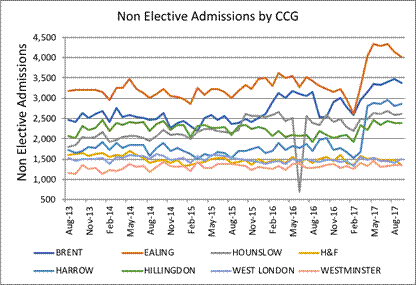
Emergency admissions in NWL (virtually all of which are so called Non Elective Admissions – NELs) are higher now than in 2013. To put the annual NELs reduction aspiration in perspective, here are the NELs totals over recent years –


October to September:

+ 2013/14 – 195,000

+ 2014/15 – 190,000

+ 2015/16 – 200,200

+ 2016/17 – 216,000


There has been no successful reduction in bed numbers since 2011 (when we started collecting the data). In fact in March 2011 there were 3,150 General and Acute beds in use in NHS NWL. In September 2017 that number stood at 3,400. Hospital bed occupancy rates are higher now than they were in 2013.


Hospital bed blocking (so called Delayed Transfer of Care – DTOC) is endemic. In Ealing DTOCs are higher now than they were in 2013. In terms of social care DTOCs in Ealing, they have risen steadily since April 2014 (100 days delay/month) and in July 2017 reached over 900 days delay/month. ‘Get West London’ research reveals that the 75+ population in Ealing has grown by 2,200 since 2012. During that time 50 care home beds and 41 nursing home beds have been lost. Ealing Council’s social care budget has been reduced annually in recent years. In 2013/14 it was £127 million. In the current year it’s £94 million.


Let’s now look at ambulance redirections in NWL – so called Intelligent Conveyance. During the period April 2016 to September 2017, no ambulances were redirected to Northwick Park Hospital. The same was almost true of Hillingdon Hospital except  for 30 times in January 2017 and a handful of times in June 2017. However redirections of ambulances to Ealing Hospital happened every month with 70 in November 2016 and 90 in April 2017. Just where would the sense be to shut down Ealing Hospital A&E?


As for meeting the Type 1 (T-1) 4 hour performance target, no NHS NWL hospital has ever got near to consistently meeting or exceeding the 95% target since Central Middlesex and Hammersmith Hospitals’ A&Es were shut down in September  2014. In January 2017 NHS Northwick Park and Hillingdon’s A&E 4 hour performance slumped to around 50%. By December 2017 neither hospital reached 60%.


Out Of Hospital (OOH) services have been the SaHF ‘replacement’ strategy for removing 40% of patients from hospital Acute beds, for well over four years. SaHF has consistently said that there would be no changes to hospital services until OOH services were in place. OOH services were not in place when the two hospital A&Es were closed in September 2014 – with disastrous, on-going results. And OOH services are scarcely apparent even now. The best NHS NWL bosses can seemingly come up on OOH services amounts to 2,700 hospital admissions prevented in Brent in 2017, and 1,400 hospital ‘admission avoidances’ in Ealing in 2017. Given that NHS NWL SaHF has been trying to develop OOH services and reduce hospital admissions since 2012 it is hardly a recommendation that over five year’s work has resulted in an annual reduction of just 4,100 emergency admissions/NELs.


Apparently NHS Ealing CCG has thrown in the towel in trying to ‘commission’ NHS service suppliers to develop, run and manage OOH services in Ealing. Later this month a business case will probably emerge in an attempt to justify outsourcing Ealing OOH services to a single supplier for 10 years. Apparently this contract value could reach £1 billion. All our attempts to find out the OOH services specification have been frustrated. Apparently Virgin Care is one of the interested parties. No doubt this is all part of the Accountable Care/integrated care bandwagon.


However other rumours swirl around whether ‘austerity’, land values and land sales might be the keys to what happens next. The £513 million request is enshrined in a NHS NWL business case labeled the ImBC SOC1. This bid largely relates to so called outer NWL. There is another NHS NWL business case backed bid, still not submitted, for inner NHS NWL London labeled ImBC SOC2 for £377 million. There are allegations that NWL will only be granted SOC1 or SOC2. In terms of land sell offs clearly inner NWL land will generate far more cash than outer NWL land sales. After all London Mayor Khan’s so called London Care Devolution seems to be mostly about ‘estates’. There clearly is some sensitivity about land values/sales value as Freedom of Information attempts to access this data (so called Naylor 2) are clearly being obstructed.


Nursing Recruitment in NHS North West London is at Crisis Point


NHS Digital’s quarterly recruitment update for North West London (NWL) must ring alarm bells everywhere. In April, May and June 2017, 2,545 nurses and midwives vacancies were advertised. However only 42 new recruits were taken on – that’s just 1.65% of those they were seeking.


Nationally the statistics also make for very depressing reading. One in 10 of all nurses quit each year. The overall number of vacancies for all types of healthcare staff, which hospitals across England advertised to fill in July to September 2017, hit 87,964.

Over 36,000 Hospital Beds in England Closed  Since 2000 – Jan 2018

0

Over 36,000 Hospital Beds in England Closed  Since 2000 : All kinds of Flu Kick In and the NHS is in Meltdown

A&E waiting times have shot up. Patients on trolleys in hospital corridors has become common place. Elective surgery throughout England has been cancelled nationally for a month. Anecdotally I heard that the A&E unit at Ealing Hospital has been under unprecedented pressure. One report also stated that for a recent 21 consecutive day period there were no available beds at Hillingdon Hospital.


Experts are now saying that ‘Australian Flu’ is not the main culprit, but it’s just one of a number of flu types affecting many of us. Shortage of A&E units, doctors, nurses and beds are the main causes of mayhem in NHS hospitals.


The latest NHS Unify 2 data makes for chilling reading. It shows that the number of A&E attendances year on year has remained remarkably stable. For Type 1 A&E attendances at Ealing Hospital and Northwick Park Hospital in November 2017, the number of patients was just 2.81% more than in November 2016.


In NHS North West London the plan for the next three years includes over 25,000 NHS staff being terminated. 600 hospital beds to be closed. By 2025/26 Non-Elective (i.e. emergency) hospital admissions (so called NELS) will, apparently, be reduced annually by 99,000. Ealing District General Hospital (DGH) along with its A&E will closed by 2021. Instead of being treated in residential Acute hospitals the idea is that these seriously ill people will be treated in some expanded GP surgeries, new ‘Hub’ day care centres and/or in their own homes.


However, the plans are in disarray. NHS NWL asked NHS bosses for £513 million for building work and on 7 November 2017 the NHS Regulator – NHS Improvement (NHSI) – said no. NHSI said no compelling evidence had been presented to justify NHS NWL cutting NELS annually by 99,000 beginning in 2025/26.


NWL stated last month that without this cash Ealing Hospital DGH and its A&E would, in effect, continue to exist. The creation of day care ‘Hubs’ and the expansion of some GP surgeries would be abandoned – without this cash. So far we know of no formal attempt by NHS NWL to create a new business case to support another bid for the £513 million. Since 2009 NHS NWL has spent over £89 million on management consultants. No doubt more cash is being thrown again right now at management consultants in order for them to unearth (probably non-existent) ‘evidence’ in an attempt to justify massive cuts in emergency hospital admissions.


Why is NHS Ealing Clinical Commissioning Group (ECCG) Trying to Outsource Out Of Hospital (OOH) Services for 10 years?

Why does ECCG want to outsource OOH services at all? Is it because ECCG, along with the other seven CCGs in NHS North West London, has failed to implement the OOH strategy outlined in the 2012 NHS North West London (NWL) ‘Shaping a Healthier Future’ (SaHF) programme? On page 39 of  SaHF (‘11. Proposals for delivering care outside hospital’) a reduction of 110,000 hospital stays annually is promised along with 48,000 avoided hospital emergency admissions annually. On page 11 SaHF states ‘…it will take at least three years to put…in place’. Now, over five years later, there is still no significant annual reduction in emergency admissions. According to the 2012 SaHF proposal, £120 million was to be invested across NW London to enable this OOH transformation. On 8 September 2017 the ECCG Chair confirmed that OOH NHS NWL spend for 2017/18 is £729,283,000 with OOH NHS Ealing costs at £121,794,000.


The 10 year contract length is interesting. CCGs have three year contracts. Healthwatches normally have three year contracts. NHSE has a five year ‘Five Year Forward View’. So why 10 years? The crunch date is of course 2021 when annual healthcare ‘losses’/’debts’ costs have to be paid off. So no doubt this fixed price ECCG OOH contract will be signed at, let’s say,  20% of current costs i.e. all things being equal at around £100 million per year. Although initial ECCG statements posited a 1April 2018 start date this seems now unlikely to be met.


The estimate in my 15 November 2017 newsletter of the potential size of the ECCG OOH 10 year contract was £1billion. However until (and if) we see the details of the Invitation To Tender it will be difficult to firm up this figure.


On 19 September 2017 and 4 October 2017 ECCG invited interested parties to come to talk to it about an OOH OH contract. A recent Freedom of Information request response has revealed who attended. 25 different organisations attended – 12 of them attended both events! There were nine NHS Trusts and nine private healthcare service suppliers who attended. The private companies were Allied Healthcare, CHS Healthcare, Connect Health, Homelink Healthcare, NRS Healthcare, Philips, Shaw Healthcare, Specsavers and…..

Virgin Care Services   


Jeremy Hunt MP Has His Cabinet Role Increased to Include Social Care

If this was a plot development in a ‘Carry On Caring’ comedy film I might find it far fetched. Presumably no-one else wanted to take the healthcare (or the social care) job on. My take on Mr Hunt is that he is an attention seeker. He’s always smiling when the cameras are on him. In 2017 he sold his Hotcourses business and pocketed £15 million – so he doesn’t really need the work. He’s had a chequered past. An Admiral’s son, he once worked as an English teacher in Japan and allegedly failed in a venture selling marmalade to the Japanese. He has variously been accused of cheating on his Parliamentary expenses and his tax bill, upsetting Junior Doctors which led to strike action, and constantly misleading the public about healthcare reforms.


In theory a single Government department responsible for cradle to grave care is certainly not a bad idea. However new Primary Government legislation and a massive national relocation of resources will be needed to turn the idea into reality. Social care staff in the 326 Council Authorities will now somehow all ultimately report to Jeremy. Exactly how will that work? Of course by 2025/6 all care might well be delivered by Accountable Care Organisations (ACOs) which will, of course, render NHS organisations and Local Authority social care operations powerless. No doubt Mr Hunt will still be with us then with a new job title of ‘Secretary of  State for Accountable Care’.

Accountable Care Is In For a Rocky Ride in 2018

Accountable Care Organisations (ACOs) will at some point in the future, to put it simply, replace NHS organisations and Council Authorities in determining care budgets and managing care service delivery. ACOs will, according to NHSE’s 2014 Five Year Forward View be the STP delivery vehicles to deliver improved care services. ACOs will appear in lots of flavours including ACS, ACP, MCP, PACS and PCH. A single provider (e.g. Virgin Care) might run an ACO, but so could a cabal/consortium of NHS, public, private companies and charities. This could all kick off with some ‘Shadow’ ACOs in April 2018. However the Full Monty 10/15 year £multi-billion ACO contracts will not happen till at least 2019.


ACOs will be ‘command and control’,cost-cutting  vehicles which deliver care at a fixed price over 10 to 15 years.


Fear kicks in when Jeremy Hunt MP tells us all that ACOs are ‘simply about improving the quality of care the NHS offers’. With a First Class Oxford University degree Mr Hunt is clearly not unintelligent. As a founder of a PR agency, he clearly knows how to mislead by not telling anything like the complete truth. (Believe me I’m an expert on this subject having run my own PR agency for 21 years).


ACO Judicial Reviews (JRs)

There are two of these on the go:

+ The JR4NHS ACO JR, filed on 11 December 2017, has attracted £144,000 donated by over 5,000 people. The grounds of the JR are that ACOs have not been subject to any public consultation, and lack Parliamentary scrutiny and legislation.  High profile supporters include Public Health Professor Allyson Pollock and Professor Stephen Hawking. More at:

http://bit.ly/JR4NHS


+ The ‘999 Call for the NHS’ ACO JR questions the legitimacy of replacing payment by results with a Whole Population Budget. (The latter is better known in the founding home of ACOs – USA – as a Capitated Budget). The JR is led by a West Yorkshire health activist Jenny Shepherd, supported by lawyers Leigh Day, and it was filed in November 2017. The first legal hurdle has been cleared as a judge has granted permission for the JR to proceed. The case will be heard in Leeds High Court on 24 April 2018. £12,000 more is needed to fund this JR. Donations can be made at:

www.crowdjustice.com/case/healthcare4all-stage3/


Labour’s Early Day Motion (EDM) on ACOs

Tory plans, apparently, are well advanced to submit new draft legislation soon to legitimise ACOs in February 2018. In response to this, the Labour Party initiated on 6 December 2017 an Early Day Motion (EDM) 660 on these proposed changes – so that the House of Commons can discuss them. The primary sponsor of the EDM is Jeremy Corbyn MP.161 MPs have signed so far. My MP Virendra Sharma has signed, as have Andy Slaughter MP (Hammersmith), Ruth Cadbury MP (Brentford and Isleworth) and Gareth Thomas  MP (Harrow West). Why is it taking so long for all the other North West London Labour MPs to sign?


Dudley ACO Delayed

Hardly a storming start for the flagship pioneer Dudley ACO. Its start date has been put back 12 months! Dudley CCG, in the West Midlands, is attempting a Multi-Speciality Community Provider (MCP) ACO. The contract value is £5 billion. In August 2017, Dudley CCG announced that a hotchpotch consortium of local GPs and four local NHS bodies was the preferred bidder.


Greater Manchester ACOs are Also Delayed

Another of the top ACO pioneers, Greater Manchester – with its delegated care budget – is also failing to meet its ACO plan dates. VAT complications are being touted as the reason the £6 billion MCP contract has not been awarded to the preferred consortium of existing care providers. ACO number two in Stockport aims to ‘create a new care trust capable of holding an MCP contract’. It has been ‘paused’.


And After ACOs……?

One can’t help but speculate what might come next after ACOs. After all recent NHS history is littered with organisations here today and gone tomorrow. Regional Health Boards and PCTs are long gone. If ACOs ever get off the ground and take over nationally then that’s the end of CCGs and possibly the NHS itself. If ACOs never take off or fly and burn – what will come next?


The BMJ Exposes £5+ Million ‘Sponsorships’ of CCGs – Most of It Undeclared Publicly

The British Medical Journal (BMJ) has announced findings, obtained through Freedom of  Information (FOI) requests, that NHS Clinical Commissioning Groups (CCGs) have overtly and covertly received gifts and payments from a range of commercial organisations. Of the total of £5,027, 818 payments uncovered, only £1,283,767 was declared in public registers.  Bath University and Lund University in Sweden carried out this research.


Amongst the undeclared payments was a £24,000 NHS Southwark CCG project funded by drug companies Bayer, Boeringer Ingelheim and Pfizer. Amongst declared payments was a £75 England cricket match ticket given to NHS Medway CCG by AMP Infrastructure, a property investment company.

Chance to Publicly Scrutinise NHS North West London Healthcare Purchasers is Wasted -Jan 2018

0

Chance to Publicly Scrutinise NHS North West London Healthcare Purchasers is Wasted.

One of the few ‘in public’ NHS NW London-wide meetings at which elected Members (i.e. Local Councillors) examine NHS healthcare performance and plans took place on Tuesday 5 December 2017. It was a meeting of the NHS North West London Joint Health Overview and Scrutiny Committee (JHOSC). This is a fairly rare event taking place perhaps only twice each year.


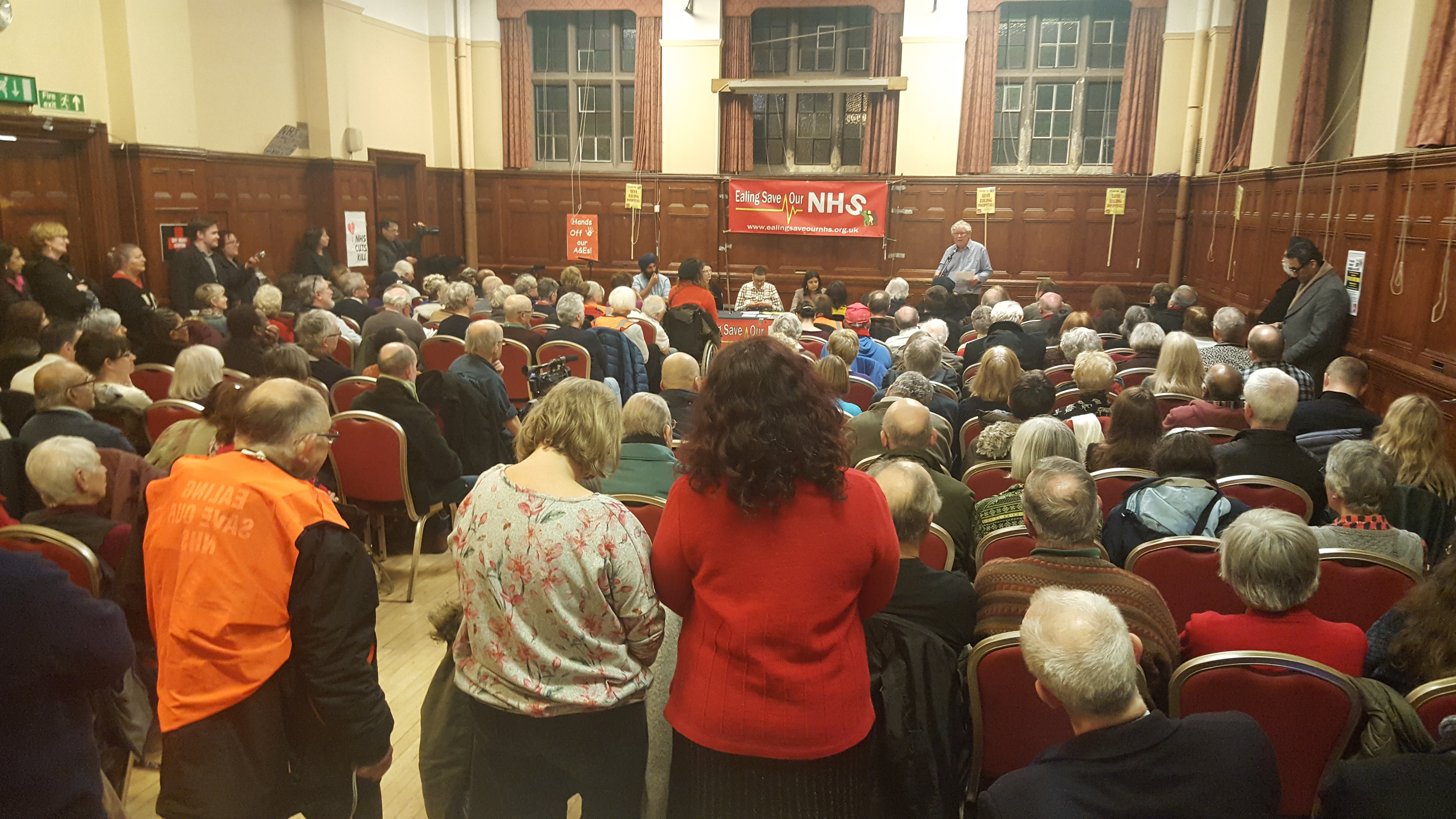
16 Councillors from the eight NHS North West London (NWL) Local Authorities were invited to attend this JHOSC meeting but only four of them turned up. None from Ealing and none from Brent for example. More members of the public attended than elected Councillors in NWL. The strange location of the meeting did not help. It took place in Twickenham, Richmond at 9:30am. Richmond isn’t an NHS NWL borough, but some of its Councillors did turn up.


The NWL Collaborations of CCGs bombarded the attendees with 90 pages of seven papers. The two Accountable Officers for NHS NWL CCGs Ms Clare Parker and Mr Rob Larkman were in attendance. Juliet Brown also attended. She is Local Services Transformation Director. Clinical support was provided by Dr Le Brooy, the new NHS NWL ‘Shaping a Healthier Future’ (SaHF) Medical Director. (Her predecessor Dr Mark Spencer has moved out of SaHF into healthcare management consultancy).


Many of the Councillors’ questions were ‘thin’ on content. This was possibly because they had not had time to study the 90 pages and/or they had insufficiently followed and researched the five year SaHF cost cutting /service transformation to-ings and fro-ings. One Councillor never spoke at all during the 2.5 hour meeting.


Getting Elderly Patients Out of Hospital

Dr Le Brooy, a senior geriatrician, led the NHS attack here under the banner of ‘Front End Frailty Services’. The plan is to admit as few as possible elderly people into hospital. Evidence from Sheffield, Leicester and Poole was quoted. The whole approach can clearly only work if significantly expanded home-based and community-based healthcare and social care support services are in place.   


The nirvana quoted was multi-disciplinary teams working together to assess old peoples’ needs and to offer an alternative to hospital admission. These team members include mental health practitioners, geriatricians, pharmacists, dieticians, speech and language specialists, frailty nurses, social care decision makers and therapists. One does wonder whether this is happening now? Will it happen consistently in the future given the continuing shortage of staff across the board? Is this just pie in the sky?


Dr Le Brooy admitted that there was a shortage of geriatricians . The Chair expressed concern of anecdotes about elderly people being discharged from hospital over night and delivered to empty homes.


Accountable Care Organisations (ACOs)

Mr Larkman and Ms Parker delivered inadequate presentations on ACOs. They ran through some of the usual ACO mantras of fragmentation, misaligned incentives, access, population needs and joined up health and social care services. They mysteriously failed to mention that ACOs will be fixed price, long term contract beasts which will force through massive cost cutting.


They provided sketchy details about the Hillingdon elderly peoples’ Accountable Care Partnership (ACP) which is apparently the most advanced regional ACO. This will apparently feature the Hillingdon CCG and the London Borough of Hillingdon (LBH) working together. Rumour has it that LBH is not co-operating with the CCG on the NHS NWL Sustainability and Transformation Plan (STP) for which ACOs/ACPs are supposedly the STP implementation ‘engines’. What Parker/Larkman failed to tell us all (and none of the Councillors asked) was:


+ What is a Capitated Budget? This is not defined in the NHS NWL ACO Glossary provided – which is the world’s smallest glossary defining just three terms. A Capitated Budget (sometimes called a Population Budget ) is where an annual budget is set by assigning a cost/head for a defined patient population (eg £2,500 per elderly person) and multiplying that by the number of  65+ people within that defined population (eg 40,000 in Hillingdon). In this example the annual Capitated Budget would be £100 million. Over 10 years that would be a £1 billion contract.

+ What is the Capitated Budget set for 2018/19 ( i.e. how much annual cash per elderly head has been allocated?)

+ How will the Capitated Budget be calculated  for 2020/21? My guess will be it will be the 2019/20 annual cost, less say 20%, divided by the number of older people

+ Who will run the Hillingdon ACP? (Has he or she been appointed already?)

+ How will the ACP Board be elected/selected?

+ How long will the ACP contract  run for? Ten years probably.

+ To whom will the ACP be accountable?


Will ACOs Deliver Integrated Care or Just Massive Cost Cutting?

What they did say was that ACOs will result in better integrated care and help in the areas of education and housing. Helping with education is a bit of a stretch – but helping with housing is just beyond belief. NHS NWL ACO priorities are elderly people, adult long-term mental health conditions and Diabetes. The Trojan Horse for ACOs is apparently the Whole Systems Integration Care (WSIC) programme ‘which for four years has been integrating healthcare and social care teams’. Has it really one wonders? Will ACOs deliver the £1.4 billion savings across NHS NWL by 2021? And it they do to what extent might healthcare and service care levels fall through the floor?


Grant funded ACO Vanguards’ performance is quoted as evidence.  This is a bit thin as none of them have reduced admissions to A&E, but some have reduced the growth in A&E admissions.


There’s also mention in passing, of a ‘Multi-speciality  Community Provider’ (MCP) ACO being put together in Hammersmith & Fulham (H&F). Again this seems somewhat doomed as H&F Council is very publicly not supporting the NHS NWL STP.


The printed ACO paper did reveal a lot more information. Apparently the ACO contracts will be at least 10 years long. None of them will commence in ernest before 2019.


There are seven CCG ACOs in various stages of creation:

+ Brent

An MCP ACO is being developed to deliver the WSIC model of care planning.

+ Central London

Working with Westminster City Council and partners a Primary Care Homes ACO is in development which will morph at some point into an MCP ACO

+ Ealing

‘The Ealing Standard’ Out of Hospital (OOH)/ GP services, single supplier 10 year ACO

+ Hammersmith & Fulham

An MCP/Primary & Acute Care System (PACS) is being created to start in 2019. It covers OOH and Primary Medical Services (PMS)

+ Harrow

An ACO for WSIC is being developed for a segment of the 65+ population

+ Hillingdon

An ACP for 65+ integrated care

+ Hounslow

OOH/PMS ACO leading to an MCP ACO.

The final ACO slide contains the killer phrase ‘(ACO) providers take control, commissioners become much more strategic…’. The former is worrying and the latter is meaningless.


Community Hubs

The target is 27 Hubs. 18 of them need £141 million of funding. In Ealing two of these will need £21.1 million (Ealing East) to open in 2019 and £14.6 million (Ealing North) to open in 2021. Both will be funded by the Local Improvement Finance Trust (LIFT). LIFT is seven years old and is the NHS PFI/PPP model (60% private cash and 40% public cash). Acton Health Centre is to close and the site to be sold for £2 million.


Out-Of-Hospital Hub Productivity

22,000 Non-Elective (NEL) hospital admissions will, apparently, be avoided by the use of Hubs. However the NEL annual admissions reduction target is 99,106. Evidence to support this target includes data from ChenMed in the USA. This was one of the sites visited on the McKinsey & Co organised NHS NWL fact finding trip a couple of years ago. This case study features a fleet of 60 vans/courtesy shuttles and 36 specially built Primary Care ‘hubs’. Practioner list sizes are up to 450 – unlike NWL General Practioners’ average list size of 1,700. So the efficacy of this evidence is debatable. Evidence is also presented from Canada.


Local Services Update

+ Access to GPs

In November 2017 21,000 additional appointments were offered, 60% of these were used by patients

+ Diabetes

30% of all hospital beds have patients suffering with Diabetes in them. Diabetes, allegedly, accounts for 30% of all emergency admissions

+ London Ambulance Service (LAS) Prevention of Admission

This is about ambulances taking patients anywhere but to a hospital

+ Home First for Elderly People

One in three hospital patients is medically fit to leave hospital. ‘Home First’ is a multi-discipline team approach to getting the medically fit out of hospital In the first six months of operation (since May 2017), Home First, allegedly, removed 600 patients from NHS NWL hospitals to somewhere else.


Ealing District General Hospital Closure

This transformation will apparently follow the same process as was used to close Maternity and Paediatrics. Key transformation metrics will be:

+ Reduction in occupied bed days

+ NEL admissions

+ Length of stay

+ Capacity of A&E to manage attendances

+ Capacity to manage admissions, including critical care capacity.


No closure date was given. The silence from the non-attending Ealing Councillors was deafening.


Care of the Elderly: STP DA3 Paper

The NHS NWL CCG cabal is clearly working with the West London Alliance (WLA) – a cabal itself of West London Local Authorities. This is probably some kind of work-around given the intransigence of Ealing, Hammersmith & Fulham and Hillingdon Local Authorities. Ealing CCG and WLA both operate out of the same building in Ealing! Lots of data on A&E, hospital mortality, and bed days in here.


Royal College of Nursing: STP Concerns

The JOHSC had received a letter from RCN and wanted to discuss it with NHS bosses. The RCN went into some detail about its concerns, which included lack of evidence, poor engagement, planning behind closed doors, funding, workforce strategy and job security. The NHS bosses seemed largely unconcerned and tried to point out it had engaged with nurses.


MENTAL HEALTH


The CQC ‘Review of Children’s and Young People’s Mental Health Services: Phase One Report’ is a Major Disappointment

This 42 page document was published in October 2017 – 10 pages of it are a list of references. In many ways this is a useful document, but it contains some startling statements and some glaring omissions. I am encouraged but unbelieving that ‘most mental health services for children are ‘good’ or ‘outstanding. This is in the face of:


+ NSPCC Childline: 11,706 young people counselled for anxiety in 2015/16. Up 35% from 2014/15

October 2016

+ NHS England/ NHS Digital: Children self-harming annually up 385% over 10 years. Girls under 18 years of age poisoning themselves is up 42% at 13,853 girls.

October 2016

+ Department of Education: One in three 14/15 year old girls suffering from mental illnesses. A ten year study of 30,000 girls.

August 2016

+ 32 NHS Trusts: 60% of children referred for specialist mental health services are not receiving treatment. 50% increase in A&E admissions for under-18 year olds self-harming, 2011-2016

‘The Guardian’, 27 November 2017


Is this CQC marking its own homework?


What’s Missing from this Report?

Why is there nothing in the report on Sectioning under the Mental Health Act, the incidence of Delayed Transfer of Care, Out of Area Placements, self-harming and suicides?


There’s virtually nothing in here about family carers, and starting, supporting and funding volunteer led carer support groups. Psychologists hardly get a mention either. Although finance may not be strictly part of the CQC brief, the absence of any commentary about inadequate finances and consequent inadequate staff and facility resources makes the report less than credible.The Expert Advisory Group does not include a service user or a family carer representative.


Because social care is not provided by the NHS, this report does not review children’s mental social care services. There is a very strong argument for reviewing both children’s mental healthcare and social care services together. After all the FYFV/STP approach is to integrate healthcare and social care services by 2021.


The picture this colourful and pretty report paints is far too ‘comfortable’ for me. Instead of coming right out and suggesting some service provision is awful, it limply suggests variable quality of services. The growing mental health problems for teenage girls surely criy out for more money, improved resources and sustained and ‘loud’ attention. This report fails miserably on that score.

More at www.cqc.org.uk


Jam Tomorrow is Promised for Mentally Ill Children

A Government Green Paper, bizarrely launched on a Sunday (3 December 2017), proposes pilots, limited ambition and possible future cash to help mentally ill children at school. £215 million could be spent on creating mental health support teams operating in schools and colleges. However, pilots to assess the effectiveness of the approach will have to demonstrate success before cash will be spent to assemble these teams. The limited ambition is that only 20% of England might have such teams in place by 2022/23.


Allegedly thousands of people could be recruited to mental health support teams which could provide treatment to children in or near schools and colleges. But…..who will recruit and train these people? Just when and where will the training and the treatment take place? Every school and college will be encouraged to appoint a leader for mental health. Secretary of State for Health Hunt thinks that teachers will be able to spot those pupils who are anxious and/or depressed and report them to the mental health leader. It’s a nice idea but will it actually work – even at the few schools ‘on stream’ in 4/5 years. time?


Will Mental Illhealth Sufferers Be Helped by £85 Self-Help Videos?

Free, online, questionnaire led triage is being offered online by ‘Calm Clinic’. The depressed, anxious and the seriously mentally ill can fill in the questionnaire then submit it. Something or somebody then decides, on the basis of the answers, to offer the submitter the chance to purchase self-help videos for £85.

More at www.calmclinic.com


Mental Health Services in Ealing

Sadly this month I have had to use these services. I have found the much vaunted Single Point of Access (0300 1234 24) of very little help. On the morning of Monday 20 November I called the number and asked to speak to a mental health clinician. None was available. I called the Ealing Recovery Team East at Avenue House in Acton. Over two attempts the phone was not even answered.


LONDON CARE DEVOLUTION


London Healthcare and Social Care Devolution: More about Building Luxury Flats, Jobs for the Boys and Cost Cutting Than Improving Services

On 16 November 2017, the Mayor of London/London Assembly re-announced care devolution to London – first launched in December 2015. It doesn’t take long when reading the press release (line 6 in fact) to find the Mayor  banging on about £11 billion NHS land sales some of which will fund more new homes (mostly luxury/unaffordable flats no doubt).


Line 1 – the headline – states  ‘….devolution deal to improve health and care…’. No evidence is provided to support this groundless assertion. There are no annual budget or current annual care financial figures to be found anywhere in the release. There is no explicit reference to building new District General Hospitals to cope with the projected 1.3 million increase in London’s population by 2024.


Memorandum of Understanding

The 28 page Memorandum of Understanding tells us, unashamedly, that the focus of the devolution deal is prevention, health and social care integration and estates. This apparently stems from a March 2015 accord within the London Health and Care Collaboration Agreement. What is truly astonishing is that not one of these focuses is:


improving healthcare services, improving social care services, mental health, health and social care inequality, an ageing population, population growth, hospital beds, A&E access and performance, GP access and performance, staff recruitment, retention and shortages, domiciliary care access and performance, and care/nursing home access and performance.


The fact that ‘estates’ outranks all of the above is obscene and should make grown men weep.


79 ‘partner’ organisations are expected to work together. There’s no clarity as to how the 32 Local Authorities, The City of London, 32 NHS CCGs, the GLA and 14 national State bodies will all work together. Oddly missing as partners are NHS Hospital Trusts, NHS Mental Health Trusts, GP Federations, the NHS London Ambulance Service, the five STP/Footprints, NHS CCG Collaborations and the care Unions. On page 9 we first encounter ‘new payment mechanisms’. We also encounter ‘Accountable Care Systems’ on this page for the first and bizarrely the only time.


Devolution Administration and Management

NHS England employs 6,500 staff so pro rata for a devolved NHS London it would need over 1,000 staff to run the healthcare aspect and even more to manage social care and care integration across London. And when the five mega Accountable Care Systems (ACSs) and no doubt the various Accountable Care Partnerships ACPs), Multispeciality Community Providers (MCPs) and Primary and Acute Care Systems (PACSs) come into operation even more management resource will be needed.


There will be plenty of new non-clinical jobs/roles. New bodies to be created and staffed include the London Health Board, the London Workplace Board, the London Health and Strategic Partnership Board, the Partnership Delivery Group, the Partnership Commissioning Board and the Development Programme Board.


Supporting the ‘deal’ is a 28 page document which contains much of the aspirational meanderings to be found in most Sustainability and Transformation Plans (STPs). However some of the ‘new’ waffle is quite annoying. It begins by stating that London is facing unique health and care challenges. Of course this is nonsense as the capital’s care problems must surely closely resemble those in Birmingham, Manchester and Leeds. There are clear signals that a London care regulator will be created. There are few financial figures and these relate to land sale values figures. There’s reference to a ‘2,500 extra housing development’. Why – one must ask? One wacky section discusses illegal tobacco, counterfeit alcohol and gaming machines. Worthy subjects, but surely somewhat out of place.  Another figure which appears is 43% of mental health sufferers are unemployed. The devolved care deal will, apparently, help these people. With no clues as to how much the mental health and mental social care budget will decrease (it surely will not increase) this is cruel and unusual punishment to raise these false expectations.


What’s the Budget?

You can’t really choose which sweets you might buy until your level of weekly pocket money has been set by your mum. So – just how much cash will the devolved London care body get? Annual spend figures for healthcare and social care in London are not readily available to me. It might be useful to crudely extrapolate from the Greater Manchester (GM) experience. The delegated annual budget for healthcare and social care in GM is £7.7 billion. This will be reduced by £2 billion in 2021. There are 2.8 million residents in GM. There are 8.63 million residents in London. Using the GM ‘pattern’, London might get an annual budget of £23 billion which in 2021 might be cut by £6 billion. Trying to deduce it another way, the 2017/18 expected annual NHS spend is £124 billion. Pro rata for London would be £20.6 billion. The NHSE Five Year Forward View annual healthcare cost cutting by 2021 is £22 billion nationally and London’s population is about one sixth of England’s so the reduction in healthcare could be somewhat in the region of £3.5 billion.


Five ‘Devolution’ Pilots

Just living for one year (2016/17) – according to the press release – these pilots explored a range of issues – only tenuously devolution related:

+ Haringey

Developing new approaches to public health issues  

+ Barking & Dagenham, Havering and Redbridge BHR)

Plans were made for an Accountable Care Organisation (ACO) aimed at Primary and Secondary care integration with a focus on early intervention and managing the chronically ill. The 50,000 residents’ ACO could go live in 2019/20

+ North Central London (Barnet, Camden, Enfield, Haringey and Islington)

The focus was on estates’ issues, testing new approaches to collaboration on asset use

+ Lewisham

Given it’s about integrating healthcare and social care this is standard STP stuff

+ Hackney

This seems to be standard STP care integration work with an emphasis on prevention.


Is it ‘Real’?

This is no pan-London plan. It talks about implementing these five devolution ‘learning’ pilots. Within the non-pilot areas- i.e. 22 London boroughs – ‘further devolution will be subject to the appetite of those areas’. This is, of course, very wishy-washy. This isn’t wholesale devolution – it’s more of ‘if you fancy some of this then join in sometime’. I’m not aware of any Primary Legislation/Act of Parliament which supports this ‘handing over of power – if you fancy it’. Is it, in fact, a diversion and yet another confusion to be stacked up on the existing, unstable pile of ‘new’ care organisations, initiatives and aspirations. This pile includes CCGs, CCG Collaborations, Footprints, NHS NWL ‘Shaping a Healthier Future (SaHF), STPs, ACOs, A&E closures, outsourcing to private companies, downgrading District General Hospitals, the ‘mirage’ of Out of Hospital/Intermediate Care services, and the failed NHS NWL  £513 million bid for building work.

More at www.london.gov.uk

£1 Billion+ Out Of Hospital (OOH) Services Contract Up for Grabs in Ealing: Or Is It? – November 2017

0


Issue: 55

15 November 2017


This occasional newsletter is researched, written and edited by a group of concerned residents in Ealing, West London who want to preserve our NHS. We view the wholesale engagement of private, for-profit healthcare service suppliers as unnecessary, profligate and dangerous. Increased financial funding is what is needed in our NHS – not financial cuts, closure of vital services or privatisation.


£1 Billion+ Out Of Hospital (OOH) Services Contract Up for Grabs in Ealing: Or Is It?

Private healthcare companies must be licking their lips at the prospect of winning this ten year contract from the Ealing Clinical Commissioning Group (ECCG). ECCG is looking to hire a single supplier to ‘co-ordinate and manage’ these 31 services. This appointment would be yet another attempt to deliver on the NHS North West London 2012 ‘Shaping a Healthier Future’ (‘SaHF’) project. This initially ‘over three years’ project aimed/aims to improve healthcare services, downgrade some District General Hospitals and remove some Acute services and replace them with OOH services.


Last year it cost £127 million to run OOH services in Ealing. Given the imperative of cost cutting, an annual payment of some £100 million to this ‘outsourced’ NHS or private supplier would seem likely.


However these financial figures did not feature in a recent public ‘engagement’ event run by ECCG in Ealing Town Hall on this upcoming OOH contract. On 31 October 2017 over 60 people sat through almost three hours of presentations and workshops covering such issues as principles, care delivery, Single Point of Access – SPA (telephone not face-to-face) and expectations of a single supplier. ECCG Managing Director and two ECCG Deputy Managing Directors ran the meeting.


There is currently no certainty about exactly which OOH services will be included in the contract. However in the draft list were residential rehabilitation, physiotherapy, community nursing, primary care mental health, and Dementia support. Some of these service contracts are coming to the end of their life. Over the coming months and years each of these services could be provided by different NHS or private suppliers. It’s clearly going to take some time to hire and deploy this single supplier. The earliest start date quoted was January 2019.


There were lots of interesting observations and questions raised by the audience, but few interesting responses and answers from ECCG. Lots of attendees made it very clear that they did not want a private supplier gaining the contract. Some residents expressed astonishment that in 2012, as part of NHS NW London’s ‘SaHF’ project we were promised ‘world-class healthcare outside hospital’. In 2012 we waited two days to see our GP – now we have to wait three weeks. Also SaHF promised us that networks of GPs would be our first point of access – not a telephone service! The SPA also made little sense to some as we have had an SLA for mental health for two years and a NHS 111 telephone point of access. Surely that’s three points of access. Also given that Ealing has a high proportion of non-English speakers, surely any Ealing healthcare telephone service needs multi-lingual support.


In the 2014 NHS England Five Year Forward View and in the October 2016 NHS NW London Sustainability and Transformation Plan (STP) the delivery of social care and the delivery of integrated healthcare and social care are key attributes. ECCG never mentioned social care once – never mind integrated healthcare and social care services. Also not mentioned was the fact that with less money, services would probably be rationed. In NHS speak this is usually referred to as ‘demand management’. Again this phrase and the topic were not mentioned.


NHS NW London SaHF Business Case and £513 Million for Building Work Turned Down

Just 24 hours later a bombshell exploded with ‘Health Service Journal’ (HSJ) announcing that the final NHS NW London 2012 SaHF business case, involving a request for £513 million building work funding in ‘outer’ NW London, had been turned down by NHS Improvement (NHSI) on 28 September 2017. (NHSI is the NHS’s operational and financial regulator which ‘absorbed’ the previous major regulator NHS Monitor and other minor regulators in 2016).


Surely the ECCG MD and the ECCG Deputy MDs knew about this rejection. The whole basis of ‘outer’ NHS NW London OOH ‘transformation’ – the ability of Ealing OOH services to ‘replace’ some of the Acute care beds’ to be eliminated at Ealing Hospital, the creation and re-purposing of the three Ealing  NHA OOH ‘hubs’, the expansion of certain GP surgeries, the expansion of NHS NW London District General Hospitals (DGHs) to replace some of the eliminated Acute care beds at Ealing DGH – were all dependent on this business case and securing the £513 million.


Over 60 residents and NHS staff had three hours of their lives wasted on 31 October 2017 by three highly paid NHS ECCG executives. These three ladies went through the motions of a public ‘engagement’ exercise on OOH services and their outsourcing presumably already knowing that the capital funding request had been rejected over four weeks ago.


Some £70 million has been spent by SaHF with management consultants on formulating and implementing this now rejected business case over the last five years. This really is scandalous.


After press reports hitting TV and online media, NHSI came out of hiding, toned down its criticism and said that the business case trajectory was OK, but the numbers were not credible. At a public ECCG meeting on 8 November 2017 (the Primary Care Commissioning Committee) ECCG Chair Dr Parmar rather arrogantly dismissed the business case rejection by saying ‘we need to refresh the numbers’. More work and fees for McKinsey & Co, Deloitte et al are in prospect no doubt. It’s important to note that the hurdles the £513 million business plan has to clear are NHSI (second attempt), the Department of Health and H.M.Treasury.


Reports of staff leaving and staff shortages at Ealing Hospital are ongoing. Ever since the 2012 SaHF project labelled the District General Hospital ‘for downgrading’, clinical management has grappled with significant staff retention and staff recruitment challenges. Now to discover that SaHF never had a credible business case must make many experienced, overworked and dedicated Ealing Hospital staff very angry.


A Second Judicial Review is Underway Challenging the Legality of ACOs

’The Independent’ of 4 November 2017 reported that three healthcare professionals and a prominent public health academic had instigated legal action against the Department of Health. The foursome are seeking a Judicial review (JR) to stop Health Secretary Jeremy Hunt MP and NHS England from creating Accountable Care Organisations (ACOs).


ACOs will hold fixed price, long term contracts to implement the 44 Sustainability & Transformation Plans (STPs) throughout England. The ACO/STP approach is the Government’s current tactic to involve private care companies, to make large cost savings and to deliver and integrate healthcare and social care services.


Professor Allyson Pollock, the high profile public health academic jointly sponsoring the JR, is quoted as saying ‘..the Government is acting beneath the statutory radar in attempting the Americanisation of our healthcare and this fundamental re-organisation by stealth’.


This JR is separate from – but running in parallel with – the ‘999 Call for the NHS’ JR which claims the August 2017 ACO contract introduced by NHS England is illegal.


Patients Going Online is No Solution to the Shortage of GPs

We have a desperate GP retention, shortage and recruitment situation in England:

+ 400 GPs are quitting the NHS every month (‘Financial Times’ 10 July 2017)

+ 12.2% of GP vacancies are unfilled (‘Pulse’ May 2017)

+ A national shortage of 3,900 GPs (‘The Sun’ 12 May 2017)

+ 40% of GPs are approaching retirement (iNews 17 February 2017)

+ ‘Almost half of the 10,000 EEA doctors in the NHS are considering leaving the UK’ (BMA  March 2017)

+ It takes on average 7.4 months to recruit a GP partner (Commons Public Accounts Committee).


NHS England wants to give GPs £45 million to make them available online. Existing online ‘solutions’ being piloted include:

+ Smartphone appointments or Skype consultations

+ ‘NHS Online App’ which enables patients to ask GPs questions, receive text alerts with a link to doctors at an Urgent Care Centre for ‘red flag’ symptoms out of hours

+ ‘eConsult’ where patients answer questions about symptoms on their surgery web site, which are then reviewed by a GP within 24 hours

+ ‘GP at Hand’ service which promises 24/7 video consultations on smartphones – within two hours.


The latter ‘GP at Hand’ service, recently announced, has been condemned by the Royal College of GPS, the BMA and at the England LMC conference. An Internet enabled patient can get to ‘see’ a GP in two hours, whilst a telephone only patient has to wait, on average, 13 days to see a GP.


The problems many medical practitioners and commentators are identifying are related to the seeming priority being given to online/smartphone patients over telephone patients.  The approach apparently favours 28 year olds over 82 year olds. Also, put even more practically if a GP is diagnosing/treating 20 year olds from 3am to 7am he/she will not be available to diagnose/treat 80 years olds at noon later that day.


With a declining GP workforce the online/smartphone ‘care model’ and its promotion by NHS England amounts to unacceptable inequitable access to NHS branded services.


NHS North West London Has Spent a Gigantic £88+ Million on Management Consultants since 2009/10

Health data researcher and activist Colin Standfield has recently revealed that NHS NW London has spent £88,655,158 on management consultants since 2009/10. It’s quite along list of consultants who have benefited from this NHS largesse. They are: McKinsey & Co, Deloitte, PriceWaterhouseCooper (PWC), KPMG, PA Consulting, Moorhouse, Carnhill Farrar, GE Healthcare Finnamore, 365 Response, The Anna Freud Centre, Osca Agency, Mott McDonald, Qi Consulting, M&C Saatchi, Sky High Technology, Finnamore & Oak Group, Private Public, LCA/Consolidated PR, Baker Tilley, and Consard.


McKinsey & Co are the clear winners in take home remuneration. On one topic alone – ‘Whole Systems Integrated Care’ – it earned £8,755,621 during 2013 and 2014 by creting three reports on the topic. This topic – healthcare and social care services’ integration – is the challenge which is yet unmet in NW London, London and throughout England.


The first question that must be asked is why NHS NW London could not have done this McKinsey work (and in fact all the management consultancy work) in house? After all the salary costs/budget for the eight NHS NWL Clinical Commissioning Groups is at least £40 million per year. With this money one could hire lots of clever people with healthcare and social care experience, MBAs, first class Degrees, Masters and PhDs.


The second question to ask is were these management reports shared with other Footprints? Given that all the 44 Footprints must achieve healthcare and social care services’ integration via their 2016 five year Sustainability and Transformation Plans (STPs) in the world of the sensible these NHS NWL commissioned McKinsey reports would be shared amongst the other 43 Footprints. However from my years in the world of business, sharing of management consultant reports does not happen. So, we have the distinct prospect that, as dealing with healthcare and social care services’ integration is a national problem, each of the 44 Footprints has commissioned management consultants locally to advise them. If this is the case and NHS NW London’s McKinsey bills are typical, the care integration consultancy bill for London’s five STPs could be over £40 million and nationally some £352 million.


The third question to be asked is why didn’t the Department of Health or NHS England carry out this generic transformation research or commission it and then hand it over to the 44 Footprints?


What Will Happen Now to West London’s NHS?

0
What Will Happen Now to West London’s NHS?
Confusion as Top NHS Bosses Refuse to Underwrite NHS North West London Plans.
The controversial plans to restructure local hospitals and community health services have been given a red light.
 
Proposals and Request for £513 Million Funding
 
NHS Improvement, the NHS operational and financial regulator has rejected the NHS NW London ‘Strategic Outline Case’ for its ‘Shaping a Healthier Future’ (SaHF) programme of changes.
North West London Health Bosses had requested £513 million for building work in ‘Outer’ North West London, an application at the heart of their plans for restructuring local NHS services.   But the application has been refused.
 
The respected ‘Health Service Journal’ reported this decision on 1 November 2017, quoting a comment by an NHS Improvement executive member that ‘the numbers for activity reduction were not credible’.  In other words, the plans by North West London NHS bosses to close hospital beds and replace them with community services just don’t add up, something local Councils and campaigners have been saying repeatedly.
 
Shaping a Healthier future – the Story so Far
In 2012 NHS North West London published its SaHF programme of changes and launched a public consultation.  Members of the public were asked to choose one of five options.  However, the consultation was widely criticised by members of the public and local politicians who believed that all of the options were unacceptable and were designed to set one part of the community against another.
Nevertheless NHS NWL started their programme of massive cost savings and reductions in the number of District General Hospitals, A&E units, staff, and Acute beds across five London Boroughs. It promised ‘world–class healthcare outside of hospital’ as a ‘replacement’ for District General Hospitals closure and local acute beds elimination.
 
Central Middlesex and Hammersmith Hospitals were downgraded in September 2014 with the closure of their A&E units.   Unfortunately A&E performance across the region immediately plummeted and has never recovered.
The downgrading of Ealing Hospital began in 2015 with the closure of the Maternity Unit and continued in 2016 with the closure of Paediatrics and children’s A&E. 
 
The ‘Sustainability & Transformation’ Plan
NHS NW London Sustainability & Transformation Plan (STP) was published in October 2016, at the same time as similar plans right across England.  It turned out to be basically a version of the Shaping a Healthier Future Programme. 
One respected healthcare activist and researcher has calculated that NHS NW London has spent some £70 million on management consultant advice on formulating and implementing the SaHF and STP changes over 5 years. However, the ‘final’ business plan was not actually published until December 2016.
 
Eric Leach, a researcher and committee member of Ealing Save Our NHS said: 
 “The 2012 Shaping a Healthier Future Programme and along with it the 2016 STP change programme are now in tatters.  Now nobody knows what will happen next. It’s time local health bosses concentrated on supporting Ealing Hospital instead of finding ways to downgrade them.  In our view the people in charge should resign, including the head of the SAHF and STP programmes and the chairs of the Clinical Commissioning Groups for Ealing, Brent, Central London, West London, Hammersmith & Fulham, Harrow, Hillingdon and Hounslow.”
Although ‘Shaping a Healthier Future’ was mainly driven by cost- cutting, it still needed a one off £500 million capital grant to build new clinics and without that, local health bosses have to go back to the drawing board.
Eve Turner, Secretary of Ealing Save Our NHS, added: “It is quite incredible that NHS NW London executives have been allowed to spend several tens of millions of pounds on consultants and plans for NHS service changes without an approved business plan. That money should have gone to nurses, doctors and consultants, instead of bureaucrats, spin doctors and management consultants.”
 
Ealing Save Our NHS
ESON is a non-Party Political group of local residents who have campaigned vigorously for the NHS as a fully funded, universal healthcare system. It has continuously challenged the lack of evidence to support the SaHF and STP changes by leafleting, demonstrations, public information stalls, street theatre, Freedom of Information requests, public speaking and supporting local, regional and national save the NHS campaigning groups.

Protest against huge privatisation of NHS services

0
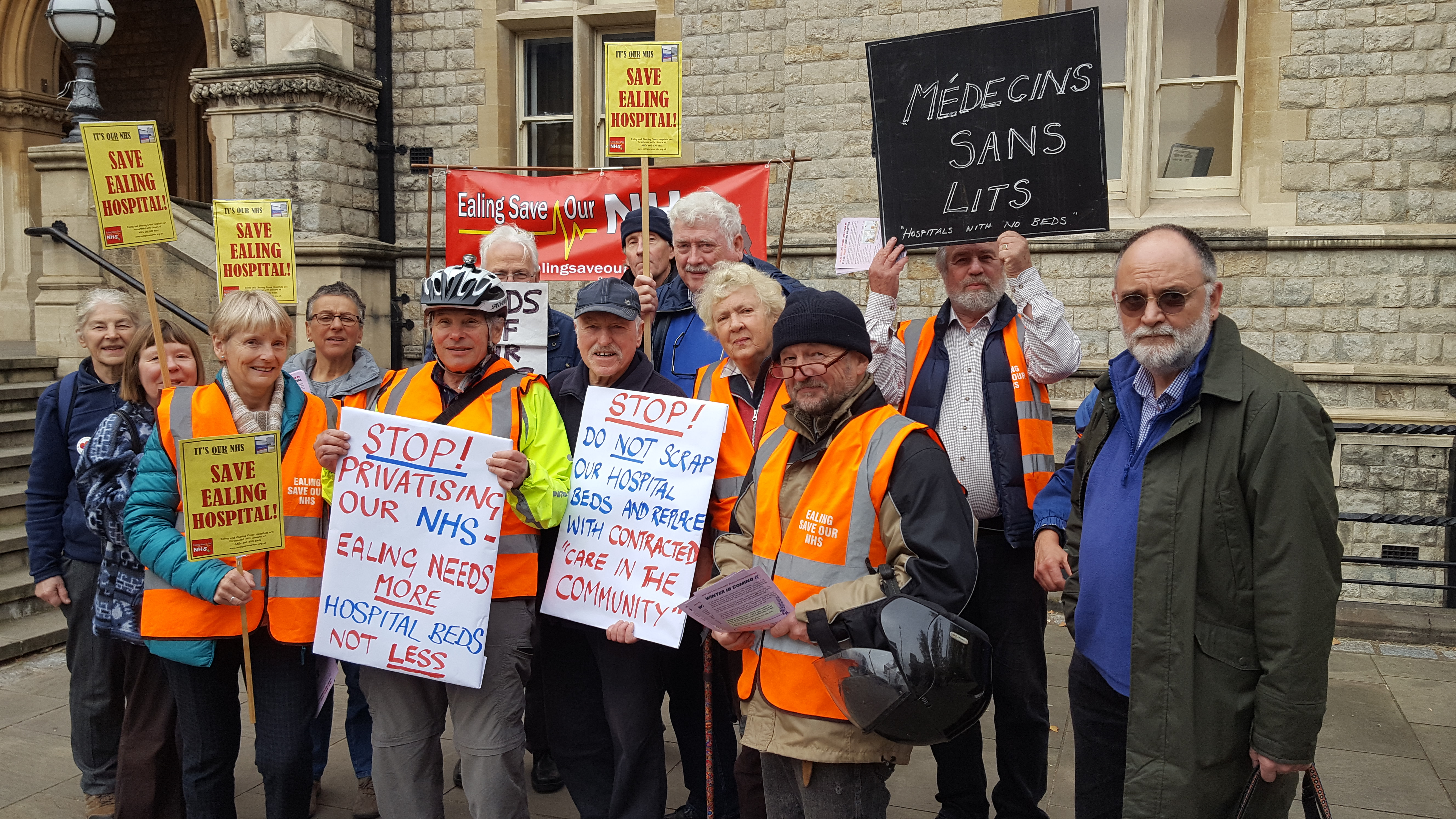
Campaign group Ealing Save Our NHS has protested against plans for a huge sell off of local health services.  “It’s totally horrifying” said Oliver New, Chair of the Campaign.  “The NHS is an essential public service that should never be given over to private companies who’s bottom line is shareholder profits.”
Ealing Clinical Commissioning Group are offering a contract to a single provider to manage all NHS community based, or “Out of Hospital” services including community nursing, diabetes, mental health, dementia and audiology.  On 31st October they held a public consultation in Ealing Town Hall, which led to the protest.  During the meeting angry residents demanded that the whole project be halted or reviewed, while the organisers insisted they were only willing to discuss public feedback on operating principles of the scheme.
Oliver New stated that the Health bosses had no explanation about how any private operators would be accountable to the public, nor would they give any estimate of the value of the contract.  “Make no mistake, this is huge, we believe that it’s worth far more than a billion pounds of public money over the ten-year period of the contract.  Why on earth should private companies be allowed to make profits using the NHS logo – it’s the very opposite of everything the NHS stands for” he said.  “Previous experiences have been that large contracts to operate NHS services have ended in tears.”
Official plans for the NHS in North West London have already proved very controversial.   The ‘Shaping a Healthier Future’ Plan has already led to the closure of the Accident and Emergency Departments at Central Middlesex and Hammersmith Hospital, along with the Maternity and Children’s Wards at Ealing.  Future plans include cutting 500 hospital beds across North West London and closing Ealing &Charing Cross A&Es, to be replaced by “Out of Hospital” services in the community.

The Integration of Healthcare and Social Care is a Failure – November 2017

0


Issue: 54

1 November 2017


This occasional newsletter is researched, written and edited by a group of concerned residents in Ealing, West London who want to preserve our NHS. We view the wholesale engagement of private, for-profit healthcare service suppliers as unnecessary, profligate and dangerous. Increased financial funding is what is needed in our NHS – not financial cuts, closure of vital services or privatisation.


The Integration of Healthcare and Social Care is a Failure

Failed attempts to integrate healthcare services and social care services go back a long way. The National Health Service Act 1977 under Jim Callaghan’s government encouraged Health Authorities and Local Authorities to co-operate. The Health Act 1999 allowed NHS bodies to pool budgets. Successive governments have again and again tried to pull NHS bodies and LAs closer together.


However, it’s been 40 years of failure.


The House of Commons (HoC) has been busy recently churning out extremely helpful and informative impartial briefing papers on various aspect of care. I’ve drawn heavily on one of these papers in this piece – ‘Health and Social Care Integration: Number 7902, 20 October 2017’.


One assumes the goals of this integration would be better patient/service user experiences, efficiency and cost cutting. The elephant in the room is that healthcare is funded and run by the Department of Health (DoH)/NHS England (NHSE), and social care is funded by the Department for Communities and Local Government (DCLG) and run locally by Local Authorities (LAs).


To continue the history lesson we had the Health and Social Care Act 2012 (‘..duty to encourage integrated working’) and the Care Act 2014 (‘..promote the integration of healthcare provision’). It’s unclear as to how much integration these statutory ‘encourage’ and ‘promote’ initiatives actually achieved.


The Better Care Fund (BCF)

The BCF was announced in 2013. It was to be the primary funding mechanism for integrating health and social care. A key goal was keeping older and disabled people out of hospital. £200 million was immediately handed to LAs. Spending the £3.8 billion BCF should have achieved healthcare and social care integration by 2018 – but it won’t have. In 2015 BCF was judged to be missing its bed reduction, elderly hospital discharge and independent living targets. Rather than saving on costs, costs rose by £200 million. An ‘improved’ version was introduced (iBCF). Another £1.5 billion was thrown at it. In 2017 Local Authorities were granted £2 billion for BCF 2017-2020.


There has been much criticism of BCF. Apparently NHSE has effectively abandoned it. It seems the grant money wasn’t ‘new’ money but ‘old money’ re-purposed. Informed observers found unrealistic levels of bureaucracy and expectations. Only 30% of the BCF money has been spent on social care. There are certainly patches of successful integration throughout England but neither DoH nor DCLG has tried to measure integration ‘success’ or estimate BCF cost savings. BCF was rendered largely redundant by NHS Sustainability and Transition Plans (STPs) published in October 2016.  


Integrated Care Pioneers

Launched in 2014 in 14 local areas, and in an additional 11 in 2015, some piecemeal success has been achieved. However the Policy Innovation Research Unit noted difficulties in accessing external support, and problems with data sharing, payment systems, and procurement provider viability.


Vanguards

50 were established in 2015 – often involving NHS bodies and LAs. A National Audit Office report in 2017 highlighted some early integration successes but whether this success could be scaled up and sustained (post grant-aid), and deliver cost savings is debatable.


Health and Wellbeing Boards (HWBs)

The Health and Social Care Act 2012 required upper-tier LAs to create these boards. The Act mandated HWBs with a duty to encourage integrated working. HWBs are required to produce a Joint Strategic Needs Assessment – which looks at current and future local and social care needs. The King’s Fund in 2014 observed that many HWBs showed limited ambitions for integration.


Devolution

The devolution of health and social care to Greater Manchester was announced in February 2015. Care integration is a major aim. Care budgets (£6.2 billion) were pooled as from 1 April 2016. Although there are local integration successes no major integration ‘successes’ or cost savings have been publicised.


In London, a somewhat less ambitious care ‘collaboration’ agreement was signed by 33 NHS CCGs, 33 LAs, Public Health England and NHS England. There are three pilot integration projects in north east London, Hackney and Lewisham. They began in April 2017 and apparently don’t expect success until April 2019. Care integration across London is not a collaboration goal.


In Cornwall (2015), Liverpool (2016) and Cambridgeshire and Peterborough (2016) moves towards devolved integrated care are underway.


Sustainability and Transformation Plans (STPs)

STPs describe how a region will meet the needs of the NHSE Five Year Forward View (FYFV) objectives published in 2014. Implementing STPs must collectively cut annual healthcare costs by £22 billion by 2021.The integration of healthcare and social care is one of the stated goals for all 44 STPs. However details on the social care side of the integration equation are thin on the ground in many STPs. Given that 43 of the 44 STPs are run by NHS executives this healthcare bias is perhaps understandable. The Local Government Association LGA) and the Public Accounts Committee (PAC) have both expressed concerns about STP care integration. The LGA’s main concern is the lack of involvement by LAs in the creation of STPs, and how STPs will interact with LA Health and Wellbeing Boards’ integration plans. The PAC sees the risk that integration will become sidelined in the pursuit of NHS financial sustainability.


Mental Health

Sadly it’s no surprise that the HoC briefing paper makes no mention of integrating mental health care services with mental health social care services. Ignoring mental health needs has been a national pastime for decades. The NHS and LA care resourcing crisis is probably most acute in mental health.


Accountable Care Organisations (ACOs)

Although completely ignored by the House of Commons briefing, ACOs are clearly planned to be the implementation ‘engines’ for cost cutting and care services’ integration. ACOs will have 10/15 year, fixed price contracts to deliver specific services to specific populations. They will use capitated budgets i.e. a standard, fixed annual budget for each service user. Will these ACOs finally deliver care integration? The answer to that is that no-one knows. Many of the ACS contracts will be £multi-billion ones – and nowhere in the world have ACSs been even attempted on this scale.


ACOs is a jargon littered arena. We have Accountable Care Systems (ACSs), Accountable Care Partnerships (ACPs), Multispeciality Community Providers (MCPs), Primary Acute Care Systems(PACS) and Accountable Care Models. The DoH is hoping to get Parliament to agree to new regulations in February 2018 which will allow ACOs, amongst other things, to commission integrated care services. Pioneer ACOs start date is 1 April 2018 – but the NHS rarely hits its target start dates.


There is precious little evidence (or public confidence) that the STP/ACO approach (by those who know about it and grasp the significance of it) will achieve successful healthcare and social care integration or in fact meet the cost savings targets by 2021 or at all.


Disintegration

Whether healthcare services and social care services are integrated or kept as separate services, is a moot point if the human resources and facilities needed to deliver each of the services are inadequate. Consider:


+ The number of care/nursing home beds is decreasing – because of rising costs and falling revenues

+ The numbers of Acute hospital beds and hospital A&E units are decreasing – because of Government/DoH/NHSE policy

+ There are significant shortages of trainee and trained doctors, nurses, mental health staff, social and healthcare support staff – because of cost cutting, the salary cap, bursary removal, student debt, medical schools’ capacities, overwork and Brexit fears

+ Much of the NHS estate is old, not fit for purpose and needs refurbishing/replacing – however the DoH/NHSE approach is to empty the buildings and sell off the land

+ NHS staff and LA staff don’t understand each other, don’t trust each other and don’t want to share data – according to NHSE Director Professor Keith Willett.


Maybe the sensible approach would be to accept that 40 years of trying and failing to integrate is quite long enough as a learning exercise. What we need is both the healthcare service and the social care service to be adequately funded, resourced, equiped and ‘housed’ with clear handover interfaces between each other.


Yet Another Revolution?

It would take a major revolution to scrap the NHS and Local Authority social care services and replace them with a new National Care Service (NCS) which would provide integrated healthcare services and social care services both free at the point of use. I don’t think we have got to that point where yet another revolution looks like the best option.


However, it maybe that we have already embarked on creating this new care body. As from 1 April 2018, in theory, England will start to be covered by ACOs which presumably will take over from CCGs and LAs in commissioning healthcare, social care (Public Health?) and the integration of the two. This will make NHS CCGs and LA social care commissioning organisations redundant. Now imagine a national organisation being created which would manage all these ACOs. An ‘Accountable Care England’ could be set up and would in effect be this new National Care Service, which would make NHS England and probably the NHS itself redundant. All this is speculation on my part as the ‘cunning plan’ no doubt hatched at the WEF in Davos in 2012 has not yet crept into the public domain.


The DoH Wants Parliament to Give the Green Light to ACOs in February 2018

Consultation is underway, initiated by the Department of Health (DoH), on getting Parliament to ‘bless’ Accountable Care Organisations (ACOs) in February 2018. ACOs will be the cost cutting engines used to implement England’s 44 Sustainability and Transformation Plans (STPs) – and reduce annual NHS costs by 20%. (As detailed above there are plenty of flavours of ACOs being touted by the NHS around England).


NHS patients, social care users or even Local Authorities are not explicity asked to comment. NHS professionals, GPs and GP Practice Mangers are, however, expected to comment by 3 November 2017. (Overworked GP staff must be over the moon about even more paperwork to deal with).


Much of the 21 page ‘Accountable Care Organisations’ document relates to allowing GP surgery GMS and PMS contracts ‘to be suspended’ – this, apparently, will facilitate GPs being able to participate in a ‘fully integrated ACO’. It seems that ACOs will be able to dispense drugs and appliances. Clearly the intention is that ACOs will commission care services along with NHS England, Clinical Commissioning Groups and Local Authorities (or ultimately instead of perhaps?)


In all the 21 pages no reference is made to the primary purpose of ACOs which, of course, is massive cost cutting. Tragic really.


999 Call for the NHS Takes On NHSE with a Judicial Review (JR) Claiming ACOs are Illegal

Health Services Journal (HSJ) has revealed that this JR is now underway. 999 claims that the August 2017 Accountable Care Organisation (ACO) contract introduced by NHS England is illegal. 999 claims the ACO contract breaches the Health & Social Care Act 2012 at sections 115 and 116. These sections relate to the price a commissioner pays for NHS services and regulations around the national tariff. The fixed population budget – or ‘Capitated Budget’ as American ACOs call it – does not link payment to the number of patients treated or to the complexity of the medical treatment provided – as required by the Act.


999 Call for the NHS is a grassroots campaigning network dedicated to restoring a publicly funded, run, managed and provided NHS (www.999callforNHS.org.uk)


Demand For A&E Services FALLING Not Rising at Ealing Hospital and Northwick Park Hospitals and Waiting Times for the Chronically Ill and Seriously Injured is the WORST in England

Colin Standfield has been collecting and collating attendance figures at NHS NW London Hospitals for over four years. The NHS in recent years has made this task more difficult by moving from weekly figures to monthly figures, by lumping Urgent Centre Centre (Type 3) figures with Type 2 and (the most seriously ill and injured) Type 1 figures. Merging Ealing and Northwick Park Hospitals into one NHS Trust (money saving no doubt) has further complicated getting at the facts. Finally timely release of data re A&E attendances and admissions is not a current NHS NWL characteristic.


Here is the damning data for Ealing and Northwick Hospitals combined:


A&E Attendances:


July 2017 Types1, 2, and 3 – 28,701

July 2016 Types 1, 2 and 3 – 29, 034


August 2017 Types 1, 2 and 3 – 26,222

August 2016 Types 1, 2 and 3 – 26,911


With these figures just how can NHS NWL executives continue to use terms like ‘unprecedented demand’? Is it down to lack of basic arithmetic skills? Or is there another explanation?


Is the London North West Healthcare NHS Trust (LNWHT) Financially Sustainable?

In the horror show of today’s NHS in which every part of the organisation (sorry – business) must make a profit and no part can be a cost centre, LNWHT (Northwick Park and Ealing Hospitals) appears to have intractable financial problems. Colin Standfield (again) points out that the LNWHT 2015/16 Annual Report stated ‘…the Trust does not have a financial plan which brings the Trust back into financial balance in the medium term’. In the 2016/17 LNWHT Annual Report, LNWHT is seeking a minimum of £49.5 million ‘additional support’. It further states ‘…the existence of a material uncertainty which may cast doubt about the Trust’s ability to continue as a going concern’. Given there’s no evidence that the £49.5 million ‘support’ has been forthcoming, could LNWHT soon being going into ‘intensive care’ of some kind?


Is The Government Review of the Mental Health Act 1983 Being Led by

the ‘Right’ Person

Over 65 disabled organisations, campaigners and mental health professionals have written to Prime Minister May complaining about the appointment of Profesor Sir Simon Wessely.


Wikipedia details a whole host of reasons why the Professor should not have been chosen. These include claims that the Professor has stated that Myalgic Encephalomyelitis (ME) Syndrome was driven by ‘false illness belief’. His ‘Exercise Therapy’ has been shown to cause 50% of ME sufferers deterioration in function. He has also played an active role in devising the theories of ‘malingering and illness deception’ which underpins Work Capability Assessment (WCA). WCA has had a disastrous impact on the lives of disabled people.


Possibly not then an inspired choice for this role. Based on my 20 years as a mental health carer, my choice would have been the appointment of an experienced and respected psychologist, rather than a controversial psychiatrist. Surely the future of mental illness treatment is more one of talking psychological therapies than drug based psychiatric approaches?


What, When and Where is Out Of Hospital (OOH) Care? – October 2017

0


Issue: 53

17 October 2017


This occasional newsletter is researched, written and edited by a group of concerned residents in Ealing, West London who want to preserve our NHS. We view the wholesale engagement of private, for-profit healthcare service suppliers as unnecessary, profligate and dangerous. Increased financial funding is what is needed in our NHS – not financial cuts, closure of vital services or privatisation.


What, When and Where is Out Of Hospital (OOH) Care?

According to the 2012 NHS North West London ‘Shaping a Healthier Future’ (SaHF) programme OOH is:


‘All those services provided in community settings such as in your home by community nurses, at your GP surgery and in health centres. It also includes all the ways that you can ‘look after yourself better’. According to SaHF it could include services in a ‘Local Hospital’. Apparently GPs will be at the heart of delivering OOH.


OOH seems to be pretty much the same as ‘community based services’, ‘community services’ and ‘Whole Systems Integrated Care (WSIC)’. All four terms are seemingly used interchangeably throughout ECCG/NHS NW London publications.


After five years of trying to deliver SaHF OOH, NHS Ealing Clinical Commissioning Group (ECCG) has decided to ‘throw in the towel’ and outsource OOH for 10 years to some as yet to be appointed ‘single lead supplier’. ECCG wants a single point of access for the 76 different service providers involved. A 35 page ‘Prospectus’ about community services has been published. Private briefings were delivered by ECCG to interested parties in late September and early October 2017.


On the subject of SaHF health centres, we might usefully review where SaHF is with healthcare ‘hubs’. There were going to be five in Ealing originally but this then went down to three. Clearly one new hub will be in Greenford at some point by 2023 using developer taxes from the Greystar mixed use development on the old GSK/J. Lyons site. (This hub will be shared with Hillingdon’s residents). One of the others will be what’s left (by 2021) of Ealing General District Hospital after all its life saving services and facilities have been closed down. The other will be a new build (or re-purposed) facility somewhere in East Ealing.


Some questions and observations which come to mind include:


+ Why a 10 year contract? Surely the typical NHS ‘tenure’ contact period is five years. It’s five years for CCGs, STPs and NHSE’s Forward View.


+ If this single lead supplier approach to OOH/Community Services is so right for Ealing, why will it not apply across the whole of the NHS NW London/NWL CCGs’ cabal domain?


+ If this single lead supplier approach is so right why was it not part of the five year NHS NW London STP?  None of the five STP Delivery Areas is for OOH services.


+ If the single lead supplier who is chosen is a private company then some of the money that would have been spent on OOH services will be creamed off as profit.


+ Why the continued secrecy about the location of the East Ealing hub?


+ Surely the current flavours of the month for business models are the Accountable Care Organisations (ACOs). There are plenty of them, including ACS, ACP, MCP and PACS. Why isn’t the ECCG OOH business model one of the flavours of ACO?


+ How will the contract value be calculated? Again, the current ACO approach is using a  ‘Capitated Budget’. Using this approach you take the GP list population of 426,000 and multiply that with a cost/head/year (e.g. £1,000) and you then multiply that by 10 (years) and arrive at eg £4.26 billion.


+ On 16 December 2016 NHS NW London SaHF announced it was asking H.M. Treasury for £513 million for building work in ‘Outer NW London’. Some of this cash would be used to build/re-purpose/extend hubs and selected GP surgeries throughout Ealing. It’s 10 months later and no response has been forthcoming from H.M. Treasury. Presumably without these new/expanded facilities the new NW London OOH single lead supplier will not be able to actually deliver what’s needed come contract start date of 1 April 2018.


UCC Outsourcer Vocare Ltd Suffers the Indignity of its St Mary’s Hospital UCC Going into CQC ‘Special Measures’ and Being Sold For a Song to Totally PLC

In July 2017 St Mary’s Hospital Urgent Care Centre UCC) in Paddington was rated ‘inadequate’ by the Care Quality Commission (CQC). Up until April 2016 the UCC had been run by hospital staff. But Central London Clinical Commissioning Group (CLCCG) took the contract away from the NHS and gave it to Newcastle based Vocare Ltd. CQC has now placed the UCC in ‘Special Measures’.


Vocare is a supplier of UCC, 111 NHS telephone and GP out-of-hours services. No stranger to controversy, Vocare caused public concern when confidential documents became public in 2012 revealing it was experiencing ‘issues’ with its 111 NHS North East telephone service. It was also fined £141,281 for failing to meet NHS Tees contract conditions for a GP out-of-hours service.


Almost co-incidentally (or possibly not) London based Totally PLC has purchased Vocare Ltd in October 2017 for £11 million. In 2015/16 Vocare had a turnover of £77 million. These two figures only stack up if Vocare was making only small profits or worse it was in all kinds of trouble. Mere speculation, of course, on my part as a retired businessman.


Totally is a small AIM listed company. It missed the deadline for filing its 2015/16 accounts at Companies House. Totally’s web site lists Declan Gilhooly as Head of Finance but Companies House, again, show that he left the company in March  2017, having been in post for just five months.


One does wonder what kinds of due diligence was undertaken for CLCCG to hire Vocare in the first place. In the Tot–ally acquisition of Vocare we see just one of the liabilities of the NHS awarding a contract to a private company. That a company can be bought by another company and the NHS and citizens have absolutely no say or oversight on the suitability and financial probity of the new service supplier.


Thanks to Anne Drinkell, Tony Brewer and Colin Standfield for information and research on CQC, Vocare and Totally.


The National Mental Health Crisis

+ Health Secretary Jeremy Hunt MP has promised that sometime over the next four years an additional £1.3 billion will be invested annually in mental health services. This money is needed now. Also there is no commitment for extra money after 2021. It is just not credible to run a national mental healthcare service using such a short planning window as five years.


+  One in six adults in the UK are currently suffering from mental health problems. That adds up to 8 million adults (Mind, Mental Health Foundation (MHF)). To put the scale of this into context, in 2015 it was estimated that 2.5 million people were living with cancer in the UK (Macmillan).


+ 1.2 million people each month use the NHS mental health services. (NHS Providers, 2017). This suggest that many suffers are not presenting themselves to GPs.


+ 50% of adults aged 55 or over have experienced mental health problems. 7.7 million suffered with depression and 7.3 million suffered with anxiety. (YouGov research for Age UK, October, 2017)


+ One in ten children currently have mental health problems. (MHF). There are one million children with diagnosable mental health problems. (Centre for Economic Performance (CEP)).


+ 80% of young homeless people have a mental health condition. (National Audit Office, 2017)


+ In 2014/15, 1,180 students left university early because of mental health problems. In 2009/10 the number was 380.


+  Mental health problems are the largest burden of disease in the UK. They are 28% of the total. Cancer and heart disease are each 16% of the burden. (MHF, 2015).


+  In 2015/16, the NHS plan was to spend £11.7 billion on mental health services. No-one is quite certain whether all this money was actually spent on mental health commissioning. (NHS England). However assuming this was the mental health spend, this represents just 10% of the total annual NHS spend.


+ Of the 3,500 ‘locked rehab’ mental health patient beds, 2,500 are in the very expensive, ‘unscrutinisable’,  private sector. (The Guardian, 16 October, 2017)


+ Only 15% of adults with depression and anxiety disorders are offered National Institute for Health and Care Excellence (NICE)-recommended psychological therapies. (CEP).


+ The number of people detained under The Mental Heath Act 1983 has increased every year since 2007. (The Guardian, 11 October 2017).


+ Mental health patients having to travel miles – sometimes 100s of miles – for ‘out-of-area placements’, because no beds are available locally, have increased by 40% in two years. (NHS Providers).


+ Only 25% of children with mental health disorders receive NICE-recommended treatment. (CEP).


+ There are just 1,440 NHS mental health hospital beds for children in England. (NHS England, 2017). In 2014/15, 10,132 children were admitted to hospital for a mental health illness. (Public Health England).


+ 37% of girls aged 13 and 14 years old had three or more symptoms of psychological distress. (Department of Education, September 2016).


+ Mental health research receives 5.5% (£115 million) of the total health research budget (MHF). Cancer Research UK (CRU) alone spent £666 million on research in 2016/17. (CRU).


+ 10,000 mental health jobs have been axed since 2010. (The Guardian, November, 2016)


+ 70 million days are lost from work each year due to mental illness. (MHF, 2015).


+ Bad mental health costs our economy £10 billion each year in extra physical healthcare due to mental illness. (CEP).


+ Nationally Police receive half a day’s training in mental health.


+ In 2015/16 the Met Police handled 115,000 telephone calls relating to mental health. This volume of calls is up by a third since 2011/12. (Labour Party FOI response, August 2017)


Ealing’s Mental Health Crisis

+ There are 420,000 patients registered with Ealing’s 76 GP surgeries. (Ealing GP Federation). Ealing GPs now provide mental health Primary Care. (Ealing Clinical Commissioning Group). 78% of Ealing’s population (327,600) are adults. (London Borough of Ealing). This means that 54,600 Ealing adults are currently suffering from mental health problems. If they were all to present themselves to an Ealing GP surgery, each surgery on average would/could be swamped with 718 mentally ill adults. If we do the same calculation with children, each surgery would have 92 mentally ill children potentially presenting themselves.  


+ There are just 33 Acute mental health beds in Ealing at St Bernard’s Hospital.


+ Ealing Police have been complaining about the lack of available Ealing Hospital beds for patients Sectioned under the Mental Health Act.


+ By 2021, Ealing Hospital will have no A&E services so there will be nowhere in Ealing for mental health patients to be referred/assessed or be medically cleared before they could be admitted to St Bernard’s Hospital 136 suite (for those sectioned under the Mental Health Act).


+ There is no NHS Mental Health Mother and Baby Unit in Ealing.


+ West London Mental Health NHS Trust (WLMHT) provides Secondary mental health services to Ealing residents. For each of the last two years it has received a poor CQC inspection report. In 2017 nine of its eleven core services were rated ‘Requires Improvement’ (CQC).


+ Staff numbers at WLMHT have still not recovered to their 2014 level of 4,000. In 2017 they are 3,325 (WLMHT Annual Reports).


+ A WLMHT Director’s total remuneration in 2016/17 was between £455,000 and 460.000. Her pension pot at 30 March 20917 stood at £1.619 million (WLMHT 2016/17 Annual Report).


ECCG Signs Up With 7 Other CCGs As Regional Healthcare  Purchasing ‘Partner’ With Seemingly No Parliamentary Legitimacy for Joint Commissioning

Starting at 8:45am in Ealing Town Hall on Wednesday 27 September 2017, I sat through 90 minutes of a public Ealing Clinical Commissioning Group (ECCG) meeting in which – unusually – some difficult questions were asked by members of the ECCG Governing Body.


Under discussion was a 12,000 word CWHHE paper on regional CCGs working together. CWHHE is a cabal of north west London CCGs – Central London, West London, Hammersmith & Fulham, Hounslow and Ealing. Ever since the Health and Social Care Act 2012 created CCGs, ECCG has been quite obsessed about working with other CCGs. Various CCG cabal flight formations have been attempted over the last five years. I’ve have often wondered why they were doing this and whether these CCG ‘super groups’ had any statutory legitimacy.  


Now, apparently, these CCGs want to organise more formally so they can collectively purchase healthcare services across their various geographies in NHS NW London. This is all very confusing  For 4.5 years I have sat in public ECCG meetings and been preached to about how local GP led CCGs made of local GPs with local healthcare knowledge were purchasing local services. Now these local GPs will gang up together to purchase regional healthcare services.


The CWHHE paper tells the reader that the reasons for acquiring this regional purchasing role are responding to patients, improving patient care, increased collaboration benefits, supporting Primary Care purchasing, sharing capacity and capability, and enhanced clinical leadership. To this end CWHHE wants to create two new posts – an Accountable Officer for the region and a Chief Financial Officer for the region. I suspect with a healthcare purchasing budget of £100s of millions these posts will command huge salaries.


CWHHE CCG’s Chief Officer Clare Parker’s take on this was that it’s all about the patient perspective, an ageing population, challenges for GPs and money. Dr Mohini Parmar, the local CCG boss and regional STP boss, chipped in with reasons of patient flows, finance and effective work.


The regional purchasing ‘function’ is to be run by a CCG representative committee of 17 or maybe 24. An independent chair would be appointed for at most the first 12 months.


Over a period of an hour there were a torrent of questions – many of them ineffectively answered – covering finance, organisation, legal issues, conflicts of interest, balancing local concerns with regional concerns, duplication, accountability, public access and regional purchasing policies. Clear answers to some of these questions were thin on the ground. Dr Parmar’s and Ms Walker’s favourite response was ‘…that’s a really interesting/challenging governance issue…’.


One persistent questioner (whose identity is not revealed on the ECCG web site) kept asking ‘where’s the glue that will make all this happen?’ She never got her answer.


Lay member Philip Young made some seven points, most of which seriously questioned the viability, accountability and effectiveness of the CCG/regional board dichotomy. His most impassioned plea was along the lines of ’..how do we stop CCGs imploding if regional decisions go against them’.


I observed that what was being created was some kind of regional health board. Oh no said Parmar/Parker. I then said in my experience when businesses merged the new merged entity had to make decisions which at times would not benefit one or more of the merge businesses. But, said Parmar/Parker, we are not merging businesses. I pointed out that I was not aware of any primary Government legislation which supported what was being proposed in this meeting. No response from anyone to that one. My final comment was that I had recently studied the South Yorkshire and Bassettlaw (SYB) STP Proposals to create a regional Accountable Care System with each of the constituent  CCG towns forming Accountable Care Partnerships. If what was being proposed by ECCG for the region was on similar lines to SYB why not be honest enough to admit this. Oh no – this is not anything to do with Accountable Care Parmar/Parker said. This final comment had a hollow ring to it as sitting in the public space with an anonymous presence was David Freeman. In 2016 he was billed as NHS NW London’s Accountable Care expert and is now billed as NHS NWL’s ‘Director of Development’.


Missing from the deliberations was any mention of social care. The STP and ‘Shaping a Healthier Future’ were each mentioned once. Mental health was mentioned just twice and attracted Dr Parmar’s possibly massive understatement of ‘..needs some more working through…’.


Finally Dr Parmar strongly hinted that CWHHE was regarded as a national ‘thought leader’ in CCG collaboration and the move towards joint commissioning. Make of that what you will.


Under Pressure Ealing GPs Now Have a New 107 Page Contract To Wrestle With

When I last worked for someone else – in the early 1980s – my

‘contract’ was two pages of paper on which my role was defined and the terms and conditions of my employment were spelt out. In my own business (1983 to 2004) the longest client contract we signed was 10 pages long. How things have changed.


The 76 Ealing GP surgeries historically signed a ‘contract of employment’ with NHS England (NHSE). But they don’t all ‘enjoy’ the same contract. There are three contract types and they are General Medical Services (GMS), Personal Medical Services (PMS) and Alternative Provider Medical Services (APMS). Not simple eh? To further complicate things, in 2017 Ealing Clinical Commissioning Group (ECCG) ‘acquired’ these contracts from NHSE.


Now these surgeries have another contract to deal with, as well as their GMS/PMS/APMS contract. This new ECCG contract is an 107 page long work-in-progress and is (bizarrely) called ‘The Ealing Standard’ (TES). In implementing this contract (sorry standard) ECCG says that patients can expect improved access, better health outcomes, a more resilient General Practice, consistency, and long term sustainability. (The last expectation makes me wonder just what ‘short term sustainability’ might actually look like).


NHSE has grant funded Ealing GPs with an additional 11.8 million from March 2018 to 2021. There are other bits of cash also – £1.7 million extra up to 1 April 2017 and £11.4 million from then to 30 March 2019. If I understand the figures (possibly unlikely) on a pro rata basis each GP surgery will receive an additional £80,000 of funding each year for the next four years.


Some features of this TES contract and the machinations around it include:


+ Immediate opening hours and appointments available to see a doctor or a nurse from 8am to 8pm at just three of the 76 GP surgeries in Ealing. This only applies to the 430,000 patients registered at the 76 GP surgeries.


+  The whole raft of extra work demanded (except improved access at three surgeries) will have to start on 1 April 2018.


+ By April 2020, all Ealing GP surgeries will be operational 8:00am to 6:30pm Monday to Friday.


+ Half Day closing is abolished


+ There is an ECCG Steering Group charged with making all these changes come about. At 21 strong it would appear to be too large.


+ The Local Medical Committee (LMC) has submitted 84 written queries about the standard. (LMCs are the statutory bodies which represent the interests of GPs and GP surgeries)


+ Future payments to GP surgeries will be based on the Thatcherite principle of meeting targets. Keeping it complicated there are three different payment regimes:

  • Capitation-based
  • Activity-based
  • Prevalence-based


+ The NHS jargon for targets is KPIs (Key Performance Indicators). Some of the KPI weightings are mind-bogglingly vague and esoteric. They include effective care, difficulty to implement, patient experience, clinical impact elsewhere, financial impact elsewhere and collaborative working.


+ There are 23 care ‘standards’and 51 KPIs related variously to them. ‘25% of capitated activity is subject to a KPI payment’ (whatever that actually means). There are KPIs for ‘access’ and also the threats of ‘mystery shoppers’ There are pages and pages on payment distribution, schedules, monitoring and disputes. The level of complexity is surely not helpful, sensible or justifiable.


+ ‘Standard1: Adult mental health: serious long term mental illness & complex common mental illness.’

There are 3.5 pages of detailed ‘standard’ expectations of GP performance which, after 20 years of my wrestling with Primary and Secondary mental health services in Ealing, I find to be totally unrealistic. Anecdotal evidence reveals that many Ealing GPs are not trained to diagnose and treat serious, complex mental health conditions. The evidence also suggests that a significant number are not disposed to want to attempt to deal with the mentally ill. This is all very dangerous ‘pie in the sky’.


+ There is a ’Homeless Standard’. This is aspirational and in places unrealistic. It’s expected a GP will discuss the person’s housing status, financial issues, legal issues, reconnection, educational and employment support. I find this hard to accept as a professional healthcare role for a GP. Surely these are social care issues which should be handled by a trained social care specialist. Would a GP have time to do this anyway? BTW the published TES tariff for ‘care for homeless is £16:25p for 10 minutes of consultation’…..


+ There are long prescriptive ‘standards’ on medicines, safety, optimisation, drug monitoring, patient experience, diabetes, respiratory disease, cardiovascular disease, musculoskeletal health, Ring pessary, care planning and co-ordination, end of life care, wound care, phlebotomy, Dementia, cancer screening, immunisation and vaccination, health improvement in children, self care and learning disabilities.  


+ ‘Standard 22: Demand Management’.This is jargon for refusing NHS healthcare to a patient. TES states ‘The NHS is not obliged to provide every treatment that a patient, or group of patients, may demand’. What a fatuous red herring this is. The Hounslow CCG web site, apparently, explains the rationale and mechanics of treatment refusal. And of course we have the well established Ealing Referral Facilitation Service by which a GP can overrule your GP’s referral to a consultant or to a hospital.


+ There are education and training requirements


+ There are numerous ‘capacity’ targets.


+ Omissions from the TES list include requirements for maternity, HIV/AIDS, liver disease, sexually transmitted diseases, Tuberculosis and mental health carers.


My overall feelings about the contents of the 107 page TES include:


+ Will they inspire, depress or put off existing Ealing GPs and potential future Ealing GPs?


+ How did Ealing GPs manage without these requirements in the past?


+ How much extra clinical and administrative work will TES demand?


+ Anecdotal evidence suggests the Ealing GP Practice Managers are fully extended as it is. Will Ealing GP surgeries have to pay for additional administrative resources?


+ Is TES more about saving money than improving services? Or is it, like the failed NHS NW London Shaping a Healthier Future’ and the stuttering NHS NW London STP initiative, an amateur attempt likely to fail on both counts.


Has  NHS England awarded Six Integrated Care (ACO) Contracts to Five Foreign, Private Companies? – October 2017

0


Issue: 53

October 2017


This occasional newsletter is researched, written and edited by a group of concerned residents in Ealing, West London who want to preserve our NHS. We view the wholesale engagement of private, for-profit healthcare service suppliers as unnecessary, profligate and dangerous. Increased financial funding is what is needed in our NHS – not financial cuts, closure of vital services or privatisation.


Has  NHS England awarded Six Integrated Care (ACO) Contracts to Five Foreign, Private Companies?

Veteran NHS analyst John Lister and 38 Degrees are both quoting ‘Healthcare Europa’ who apparently stated that Simon Stevens has awarded six Footprint/STP Accountable Care Organisation (ACO) contracts to six private healthcare companies. The only company named in the publication is OptiMedic of Hamburg. OptiMedic describes itself as an Accountable Care development and delivery company with a close working relationship with Imperial College Healthcare Partners (ICHP). Ealing Clinical Commissioning Group is one of the 20 ICHP partners. The other five private ACO companies are apparently American.


I wonder whether one of the five American companies is Centene Corporation of St Louis, Missouri. Via outsourcer Capita, Centene has been awarded a £2.7 million ACO contract in Nottingham. Centene is heavily involved in running Medicaid programmes in 20 American States and has annual revenues of over $40 billion.


A Cabal of NW London CCGs Rushes to ‘Enable’  Regional Bosses to Run Regional Commissioning

A sudden rush of hastily convened local CCG meetings has been set up in Ealing and in  other NW London towns in order, seemingly, to ‘bless’ the concept of a single ‘Accountable Officer’ (AO) and a single Chief Financial Officer (CFO) for the region. In Ealing the meeting starts at 8:45am! Ealing’s CCG region seems to be an amalgam of Central London, West London, Hammersmith & Fulham, Hounslow and Ealing.


It’s always amazed me why these cabals of CCGs exist at all. Surely the CCG dream was local GPs purchasing local services armed with their local knowledge. Now we are about to have a single regional AO and CFO for 2.1 million people. Why?


Could it be that this is all under the radar manoeuvring as part of setting up a regional  ACO or multiple ACOs across NW London?


Ealing CCG and London Borough of Ealing (LBE) Involved in International Trawling For Interest in Bidding for £Multi-Million Care Contracts

Research into the EU publication ‘European Procurement’ by Oliver New of Ealing Save Our NHS has revealed that Ealing Clinical Commissioning Group (ECCG) and LBE

are touting for private companies across the world to potentially bid for the following:


Date:     Contracting Body:  Service:                            Value:           Duration    

01/2017:      H&F CC Telemedicine:                 £15M Unspecified


12/2016:        LBE:   Home Care            £22M 10 years


09/2017:        ECCG Out-Of-Hospital *          Unspecified 10 years


09/2017  NWL CCGs          Care Home Services **  £130M Unspecified


*Potential suitors pitching to ECCG in Ealing on 19 September and 4 October 2017

**Potential suitors pitched to the NWL CCG cabal on18 July 2017.    


Not much of this has been heavily publicised (or publicised at all) by the contracting bodies. Such secrecy fuels the flames of distrust between citizens and those elected to represent us and those appointed by Government to serve us.                            


NHS England Director Professor Keith Willett Thinks NHS Folks and Social Care Folks Don’t Understand or Trust Each Other

On 12 September 2017 I attended a packed audience in Pop-Up University, PUU5 Stream at the NHSE Innovation extravaganza in Manchester. The topic was ‘Local Government and the NHS: are they serious about working together’. The main speaker was Professor Keith Willet. Professor Willett is an NHS veteran. He is the NHSE Director for Acute Care and leads the transformation of urgent and acute care services across England.


His comments lit up the ‘pop-up’ room.


He kicked off by pointing out that £1 billion had been removed from financing social care services over the last six years. Then he threw in the organisational mismatch between appointed NHS folks and Elected Members’ controlled Local Authority (LA) social care folks. He then said that Local Authorities were a Venn Diagram. People like me in the audience with just ‘O’ Level Maths were confused. In the comfort of my home some days later I asked Google to define a Venn Diagram:


‘A diagram representing mathematical or logical sets pictorially as circles or closed curves within a enclosed rectangle (the universal set), common elements of the sets being represented by intersections of the circles’.


I can only conclude that this mathematical reference was the rather serious Professor’s attempt at humour. What came next was no joke. He stated that the culture, language, attitudes and bureaucratic differences across both care worlds are immense. Tribal concerns dominate. Both care worlds need to mature and build understanding and trust together. Everywhere ‘co-production’ was being attempted.


NHS people don’t understand Social Care people – he claimed. No-one in the audience jumped up to dispute this.


He then threw out some questions about the size and ‘primacy’ of both care sectors:

Who has the most beds, the most staff and the most power? The numbers he then came out with were very revealing:


+ NHS – 100,000 beds: Social Care – anywhere between 300,000 and 500,000 beds

+ NHS staff – 1.3 million: LA  Social Care staff – 1.5 million

+ 7,500 independent GPs: 8,500 Social Care domiciliary staff

+ NHS STP bosses – NHS 44: LA Social Care – 1.


As for Delayed Transfer of Care, 10 days in hospital for an elderly person results, on average, in a 10 year reduction in life expectancy. (Wow!)


Then came his pleas:


+ Why can’t we (healthcare and social care) share information? Why are we continuously and continually re-keying the data?

+ Why do we have too many different financial/costing/purchasing approaches – some per head, some as block contracts , some as activity based costings etc, etc?

+ NHS and Local Authorities can only work together if they trust each other – but do they?

+ Everybody needs to open up their financial books and openly share the data – but do they….will they?


The NHSE Innovation Expo held at Manchester Centre on 11/12 September 2017 must have cost someone (us?) a fortune. 170 exhibitors, 264 free-to-attend conference presentations across 16 streams.


Will South Yorkshire and Bassettlaw’s Accountable Care System and its Five

Accountable Care Partnerships be Ready to Launch For Real on 1 April 2018?

STP Footprint no:9 is South Yorkshire and Bassettlaw (SYB). Its Sustainability and Transformation Plan (STP) is scheduled to be implemented with an Accountable Care System (ACS) and five Accountable Care Partnerships (ACPs) on 1 April 2018. Operating now is a Shadow ACS and (possibly) five Shadow ACPs, which are variously described in a 30 page ‘Memorandum of Understanding: Agreement’ (MOU) dated June 2017.


The MOU tells quite a lot, but a lot is also missing. These first thoughts on omissions and observations include:


  1. The goals and aspirations contained within the MOU are indeed worthy ones. However from my perspective it is the mechanics and details on how these aspirations will be met which are suspect or indeed missing from the MOU.
  2. When and how will the Capitated Budgets (‘population budgets’ in SYB-speak) be set for the SYB ACS and the five SYB ACPs?
  3. What are the annual 2021 cost saving targets for the SYB ACS and the five SYB ACPs. (On a pro rata basis, SYB’s annual share of the NHSE FYFV national annual £22 billion savings would be some £600 million).
  4. What sophisticated software will SYB deploy to run the SYB ACS and the five SYB ACPs?
  5. Who will be the CEO of the SYB ACS business and the five SYB ACP businesses?
  6. Who will choose and appoint the six Accountable Care CEOs?
  7. Will the six Accountable Care contracts operating from 1 April 2018 be for 10 or 15 years?
  8. To whom will the SYB ACS CEO report?
  9. How can any rational person have any confidence in this MOU which admits not to be a plan or a legal contract or to have any statutory basis. The SYB MOU throws around the words ’partner’ and ‘partnership’ like a drunk chucking confetti around at a wedding party. My business background reminds me that partnerships are all about sharing profit, loss and risk. I am astonished at the possibility that 28 public bodies would enter into formal business relationships with each other to share profits, losses and risk – especially given that the MOU content consistently trashes some of the strictures of the Health and Social Care Act 2012.
  10. It’s a sobering thought that if SYB is viewed as a thought leader/pioneer of ACSs in England it still needs capital and revenue grants to support it until 31 March 2019
  11. There is plenty of motherhood and apple pie in the MOU. For example on page 6 it states ‘…to enable safe, sustainable and equitable hospital services across SYB..’. Surely such a platitude is outside the gift of the SYB ACS? For starters, with national NHS staff vacancies running at 85,000, on a pro rata basis SYB has staff vacancies of 1,913. The National Care Homes Association estimates we will soon need 71,000 more care places. On a pro rata basis that means SYB is short of 1,613 care places. Hospital bed blocker monitors please note. On the mental health hospital bed blocking front, 17,509 bed days were lost nationally in October 2016. Annualise that and you get to 211,100 bed days lost. Pro rata that for SYB and you get to 4,797 hospital bed days lost annually owing to the inability to discharge mentally ill patients.
  12. At 1.12 we read about ‘…an altruistic approach to each other as partners working as one’. This all very inspiring but it surely cannot be the basis for an operational and organisational strategy. ‘…putting the needs of individuals, patients and the public before organisations…’ is clearly a recipe for organisational chaos.
  13. The MOU is remarkably ‘light’ on including and defining Local Authority (LA) and social care roles and responsibilities. At 1.17 there is a reference to ‘separate and specific agreements with …local statutory organisations’. One of the big national goals of STPs is the integration of (NHS) healthcare services and (LA) social care services. These NHS/LA agreements will be complicated and contentious to draft, agree and implement. No wonder the MOU steers clear of them!
  14. At the end of Section 6. is an extraordinary ‘Overarching Principle’ – ‘All organisations will retain their current statutory responsibilities’. How that sits with the ‘altrusitic approach’ set out in 1.12 beggars belief. Imagine you are a cricket club groundsman. Because, through an ‘altruistic approach’ by club management, you help the coaching staff, help with making the players sandwiches and spend time looking for a lost cricket ball, you fail to apply the heavy roller to the pitch by 6pm – and you end up being fired.
  15. At 7.03 the MOU drives a coach and horses through the Health and Social Care Act 2012 by replacing the commissioner/service supplier split with ‘…collaboration and integration’.
  16. At 8.2 we at last have some substance on cost savings with references to reducing system demand (cancelling some GP referrals) and efficiency improvements. At 8.4 reference is made to ‘…reduce demand on A&E and acute beds’.
  17. At 8.3 GPs get another mention. Expanding ‘multidisciplinary care’ is emphasised – although when it came to specifics about numbers of (additional perhaps) clinical pharmacists, mental health therapists, physicians associates and GP nurses – it was a ‘TBA’.
  18. At 8.5 mental health is featured. ‘Alternative Commissioning’ and ‘System Commissioning’ are referred to. The latest (August 2017) issue of ‘NHS Care Models: ACOs and the NHS Commissioning Systems’ makes no reference to either of these terms. One can only suspect that alternative commissioning might mean involving the private sector.  System commissioning may refer to ACS commissioning I suppose.
  19. Mental health provision in SYB is strange. There are no NHS Mental Health Trusts providing Secondary mental health services for 1.5 million residents. Consequently there is no mental health partner on the SYB ACS ‘board’.
  20. At 7.4 ‘Financial’ one might reasonably expect some figures here – maybe grant income, maybe Shadow ACS/ACPs actual or projected cost savings for 2017/18. but… no such luck. However there is a reference to a ‘..basket of efficiency indicators’ but there is no MOU commitment to adopt one……
  21. Why is there not even one care home group partner in the SYB ACS?
  22. Why is there no GP Federation partner in the SYB ACS partnership?
  23. Where does this organisational distinction between an ACS and an ACP come from? ACSs seemingly are single supplier-run whereas ACPs are run by consortia.
  24. I see no clues as to how the five ACPs relate to (report to?) the Footprint/STP ACS
  25. The MOU keeps referring to itself as a ‘framework’ without defining what it means by this. Dictionaries are not much help here and ‘outline of anything’ can mean anything you want it to mean I guess.
  26. To give you some idea as to how complex and unwieldy the SYB/Footrprint/STP/ACS/ACPs management is and will be, there are 55 members on the Collaboration Partnership Board.


NHSE Tries to Position Accountable Care Organisations Within the Context of Clinical Commissioning Groups

NHSE in August 2017 published ‘ACOs in the NHS Commissioning System: Accountable Care Organisation (ACO) Contract Package – Supporting Information’. It is quite an extraordinary 25 page document. Right up front it states that ACOs will not change Clinical Commissioning Group (CCG) statutory functions – and then spends over 20 pages effectively refuting this.


In defining CCGs role in the ACO world, NHSE excludes the key word ‘purchaser’ completely! The document talks about working with grant-aided NHSE Vanguards which suggests to me that it’s a make-do document with a short life.


‘Pooled Budgets’ are discussed, under the aegis of the NHS Act 2006. An opportunity exists in the Act for NHS (healthcare) and Local Authority (social care) budgets to be ‘pooled’. However the document does point out that changes to Section 75 of the Act are needed for full ACO operational flexibility.


Now to the meat of the story. The bulk of the document is made up of two Annexes. In Annex A are listed and described a whole host of historic CCG responsibilities and how ACOs will ‘relate’ to them. In short ACOs will have a major role in ……subcontracting services, allocating CCG-level resources (through ‘Capitated Budgets’), configuring and providing services, implementing patient-centred strategies, addressing health inequalities, managing supply chains, creating and managing demand management, re-designing services, improving service quality, decision making relating to funding routes, pathway planning, ensuring patient choice, enabling personal health budgets, managing subcontractor contracts, sub-contractor quality management and responding to patient complaints.


Annex B maps out how ACOs can jump statutory CCG fences, crawl through regulatory NHSE tunnels and negotiate around the Act of Parliament Local Authority bollards.

Various ACO healthcare and social care flight formations are listed along with the tortuous list of potentially adverse Primary legislation weather patterns which need to be avoided when filing ACO Flight Plans.


Thanks for visiting us

Sign up to receive all the latest news from Ealing Save our NHS

We don’t spam! Read our privacy policy for more info.