Home Blog Page 25

Is the NHS NW London ‘Shaping a Healthier Future’ Programme/Strategy Being ‘Disappeared’? – November 2015

0


Issue: 30

November 2015


This occasional newsletter is researched, written and edited by a group of concerned residents in Ealing, West London who want to preserve our NHS. We view the wholesale engagement of private, for-profit healthcare service suppliers as unnecessary, profligate and dangerous. Process improvement is what is needed in our NHS – not revolution.


Is the NHS NW London ‘Shaping a Healthier Future’ Programme/Strategy Being ‘Disappeared’?

The ‘Shaping a Healthier Future’ (SaHF) programme proposed in 2012 ‘…changes that will improve care both in hospitals and the community and will save many lives each year’. However the real goal was to cut spending by £1billion by 2015.


The SaHF web site at www.healthiernorthwestlondon.nhs.uk has been revamped and any ‘banner’ reference to ‘Shaping a Healthier Future’ has been removed! The last SaHF reference is a 28 August 2015 news item ‘Shaping a healthier future – information for your area’. When you click on ‘…download your area Fact Pack here’ – nothing happens. No fact pack, no information – no SaHF any more perhaps?


What could this mean? Here are a few choices:


  1. SaHF is now complete and is at its scheduled end. However this is clearly not the case
  2. SaHF is being abandoned, possibly because the bloated £1.3 billion capital funding cannot be secured
  3. SaHF is being abandoned because the perennially delayed 20+ business cases needing to be finalised will not stand up to public scrutiny.


First Mental Health Recovery House Opened in Ealing

On 9 October 2015 the West London Mental Health Trust (WLMHT) opened its first Recovery House in Ealing. Amadeus House in Corfton Road has 17 private bedrooms and 24/7 residential community-based care. It provides an alternative to hospital care and offers a half-way house between discharge from hospital and a return home. The home is being run by the charity Rethink Mental Illness. As well as bedrooms there is a beautiful garden, ‘quiet rooms’ for residents and a communal kitchen and lounge.


This recovery facility was originally to be located at the Lammas Centre on Mattock Lane. Although empty in recent years the centre has been owned and used by the NHS for over 60 years. Plans were drawn up to convert the building. The Council agreed these plans. Then, all of a sudden, the NHS/WLMHT sold the building for private development for £2.9 million.


Incidence of Tuberculosis (TB) is Still High in Ealing

The London Assembly has published World Health Organisation figures which show that parts of London still have high rates of TB. The worst borough is Newham with 107 cases out of 100,000 residents. Ealing is fourth worst with 62 cases, but parts of Ealing had rates of over 150. The UK average rate was 13. The rate in Iraq was 45.


Are Hunt, Osborne and Cameron Making Conscious Efforts to Antagonise All NHS Staff?

It is impossible to run a viable, sustainable universal healthcare service when huge swathes of NHS staff are disenchanted with current or future proposed conditions of work.

Prime Minister Cameron’s obsession with seven day working is clearly driving junior doctors and GPs out of their jobs and future careers in England. With regard to seven day working of GP surgeries, some of the pilot schemes indicate very low demand by patients for surgeries on Sundays. Also if you have a finite number (or reducing number) of GPs trying to ‘spread’ service across seven days rather than five, this must degrade the service during week days.


Junior doctors say that the new terms and conditions now being offered specify a 90 hour week and will result in between 15% and 40% loss of earnings. They think the Government proposals are dangerous for patients, doctors and the health service. The BMA is balloting junior doctors as from 5 November 2015 about taking industrial action. Over 50,000 medics will have two weeks during which to cast their vote. Thousands of junior doctors demonstrated outside Parliament on 28 September 2015 and on 17 October 20,000 marched in London to support the junior doctors! On that day 1,000s demonstrated in Nottingham and 100s in Belfast. Hundreds demonstrated in Leeds town centre on 28 September and on 28 October. Around 1,000 demonstrated in the centre of Manchester on 29 September. On 24 October 4,000 junior doctors and their supporters marched through Newcastle centre. Other packed meetings of junior doctors were held in September and October in Liverpool, Newmarket, Southampton and Durham. Meetings in November are scheduled in Birmingham, Taunton and Oxford. Secretary of State Jeremy Hunt MP’s response to these demos is that junior doctors don’t understand the good deal they are being offered. His stance is both patronising and pathetic.


As for nurses, those from non-EU countries will be deported, if after six years in this country, they are not earning more than £35,000 per year. The Royal College of Nursing calculates that 6,620 non-EU nurses will have to be deported by 2020. The Government temporarily eased the situation last month by lifting the ban on recruiting nurses from overseas. A Unison survey earlier this year revealed that 55% of hospital nurses are caring for eight or more patients on night shifts.


The Unison survey also revealed that a third of ambulance service paramedics have taken time off for stress.


Chancellor Osborne wants to reduce tax credits. This will cut the wages of low paid workers, who will no doubt include hospital ancillary workers such as porters and cleaners and GP surgery receptionists. Some families will lose more than £3,000 per year. Heartening and inspiring pleading in the House of Lords on 26 October gave Osborne a bloody nose on the Tax Credits Bill and stopped the Bill becoming an Act of Parliament on that day. Baroness Hollis performed like a saint and Tory Earl Howe attempted bullying tactics, but was publicly humiliated.


According to Roy Lilley (nhsManagers.net) there are currently 33 Chief Executive posts vacant in the NHS.


In October 2015, The Guardian’s ‘ClockOff’ survey revealed that of all public sector workers those working in the NHS are the most stressed. 61 % reported they are stressed all or most of their time at work. 26% don’t take any break during the working day. 96% work beyond their contracted hours – on average working five extra hours per week.


So the Government has managed to stress out and upset NHS bosses, doctors, nurses, paramedics and ancillary workers. Is this any way to run our national health service?


‘For Emergency use only: A&E is for life-threatening emergencies only’

NHS posters with this headline are appearing. The 195 bus (Southall to Brentford) is displaying one. Just what are these posters all about?


If I hurt my leg (possibly fracturing it), because it’s not a ‘life-threatening’ condition should I not go to a hospital A&E unit?


If I’m in pain and clearly ill, am I supposed to diagnose myself as to whether I am close to death and suitable to be treated at a hospital A&E unit?


As most hospital A&E units seem to have Urgent Care Centres (UCCs) co-located with them surely people who have been involved in accidents and are in pain should not be discouraged from going to hospital?


Just where are those people hurt in accidents supposed to go if not to hospital?


NHS Better Care Fund (BCF): Probably Frozen in 2016: Possibly Redundant in 2017

NHS England has announced its intention to freeze the BCF National Government contribution in 2016/17 at £3.8 billion. The BCF is an attempt to integrate NHS healthcare and Local Authority social care. The BCF was announced in June 2013 and the grand hope was that it would be spent in such a way as to reduce emergency admissions to hospitals. The fund amalgamated some existing NHS funds (£3.8 billion) and Local Authority funds (almost £2 billion) to create an initial annual budget of £5.3 billion. The dream was that the BCF would lead to savings of £1 billion each year.


In November 2014 the National Audit Office (NAO) branded the BCF a shambles. The NAO could not find any evidence as to exactly how these cash and A&E savings could be achieved. In February 2015, the Public Accounts Committee (PAC) concluded that the initial intention of the BCF – to transform local health and social care services by pooling resources – had been replaced by the intention to protect NHS resources. The PAC echoed serious concerns by Local Authorities that BCF was failing to protect adult social care services.


The NHS England BCF web site stopped publishing ‘user’ comments and questions in April 2015 and the last NHS reply to one of them was in February 2015. The latest FAQ information was published in August 2014.


It now seems the world has moved on and that BCF will be quietly buried as a failure. Regional devolution, capitalised budgets allocated directly to providers and integrated personal commissioning are, according to ‘Health Services Journal’, the bolder solutions which will make BCF redundant.


TTIP and ISDS Still Pose Major Threats to Keeping Our NHS Public

TTIP is the Transatlantic Trade and Investment Partnership. Its supposed purpose is to make it easier and cheaper for EU companies to sell to US customers and vice versa. Proponents talk about cutting down on red tape, simplifying regulatory processes and increasing international trading revenues. Critics say that TTIP will lead to the adoption of lower environmental, health and safety standards. Even the most optimistic financial projections for TTIP reveal very small increases in transatlantic trading sales and profits.


ISDS stands for Investor State Dispute Settlement. It gives foreign investors and foreign trading companies the right to sue nation states in private arbitration courts for any action which could damage their profit expectations. ISDS emerged in Germany in 1959 when the first Bilateral Investment Treaty (BIT) was signed with Pakistan. Its history however goes back much further and its existence is a response to the inadequacy of international law in protecting the property of foreigners. International arbitration has been used to resolve claims by foreign investors since the 18th century. ISDS is embedded in 3,400 investment agreements worldwide. The UK has 94 BITs almost all of which include ISDS provisions.


TTIP/ISDS negotiations between EU and US officials have been taking place behind closed doors for months and months. Opposition to TTIP/ISDS is particularly strong in Austria and Germany. For the EU to ratify any TTIP/ISDS agreement all EU nation states will have to sign up to it. Proposed ISDS provisions in TTIP have a 20 year timescale and would be binding even if the UK exited the EU.


The concern for the NHS is that US healthcare giants will use TTIP/ISDS to sue the UK government if they feel they are being excluded from bidding for NHS contracts or when they lose such contracts.


20 UK Councils have voted to reject TTIP. In London only one Council has done this – Lewisham.


On 7 October 2015 a European Citizens’ anti-TTIP petition was presented to the European Commission in London. With 3,263,920 signatories it was the largest petition of its kind.


On 26 October 2015 ‘The Independent’ announced that leaders of Labour, UKIP, SNP and Green parties had all signed a public appeal for the NHS to be excluded from any TTIP/ISDS agreement. Prime Minister Cameron refused to sign.


80% of NHS Hospitals are Running at a Loss – October 2015

0


Issue: 29

October 2015


This occasional newsletter is researched, written and edited by a group of concerned residents in Ealing, West London who want to preserve our NHS. We view the wholesale engagement of private, for-profit healthcare service suppliers as unnecessary, profligate and dangerous. Process improvement is what is needed in our NHS – not revolution.


80% of NHS Hospitals are Running at a Loss. If the NHS were a ‘Real’ Market These Hospitals would Close Down

The farcical notion that the NHS can be run on market lines is being crucially exposed by most NHS hospitals being deemed to be failing. The biggest ‘failure’ to date is the £135 million annual loss at Barts Hospital. These failures revolve around the impossibility of balancing the books while maintaining clinical services at the level expected.


With an effective annual uplift in the NHS budget of just 1% set against the 3/4 % annual increase in patient demand, no doubt all NHS hospitals will make losses next year. Add to this the proposed 30% reduction in pay for junior doctors, which will increase staff emigration, turnover, recruitment and agency staff costs, then the losses will exceed the current year’s.


When will the Government accept the reality that providing a state healthcare system is a cost centre not a chocolate teapot of a profit centre?


‘Of Course, Shaping a Healthier Future is Dead In The Water,’ Said Sir Richard Sykes

The Save Charing Cross and Hammersmith Hospitals Group have reported this remark made to them at the Imperial College Healthcare NHS Trust AGM on 9 September 2015. Sir Richard is the Trust’s Chair.


If this is true one must ask the question what is the new NHS NW London strategy? Will Charing Cross and Ealing Hospitals remain as Major Hospitals? Will the two A&E units survive? Will the ailing Out Of Hospital strategy be ditched? Will the architects of SaHF fall on their swords?


NHS Ealing Hospital Urgent Care Centre: Trial by TV and then by Ealing Council

Ealing Council’s Health and Adult Social Services Standing Scrutiny Panel met on 9 September 2015. The feature of the meeting was the scrutiny of Ealing Hospital’s Urgent Care Centre (UCC). This scrutiny was triggered by the damning UCC revelations by patients and staff in the ITV ‘Despatches’ programme which was screened on 22 July 2015. Ealing Council summoned the UCC operator Care UK, the NHS entity managing the Care UK contract  Ealing Clinical Commissioning Group (ECCG), ITV and the independent programme maker to attend. Care UK senior management and ECCG senior management attended. The ITV folks and the programme maker failed to turn up. The grilling took 70 minutes.


Highlights for me were:


+ An annoying thread (which ran through the whole session) was talk of ‘allegations’ made in the TV programme. These were not allegations, they were video footage of evidence.


+ The Care UK MD said that Care UK had never made a profit in all the four years of the UCC contract. My business background tells me that suppliers making a loss is an unhealthy and unsustainable state of affairs. Also, if her statement is in actual fact true, then unless there was more money on the table why would Care UK bid to continue the UCC contract from 2016 to 2021? And if this were the case, why should they burst a gut for the remaining 10 months of the contract?


+ Care UK pretty much suggested that the journalist had somehow tricked Care UK staff to say and do inappropriate things. This smacks of a classic symptom of denial.


+ ECCG and Care UK gave the impression that they really did not think there were problems with the service. One of the Councillors suggested there was a systemic ‘cultural’ problem amongst UCC staff. What he wanted to see was evidence of Care UK attempting to change this culture. Care UK had no response to this well made point.


+ Care UK’s MD was asked what were patients to do if they were not happy with the service at Ealing Hospital UCC. Her response ‘go to Brent UCC’ brought gasps of shock from members of the public in the audience. It really was a crass response.


+ ECCG has commissioned an independent review of aspects of the UCC service and ECCG’s relationship with UCC/Care UK. As ECCG is responsible for monitoring Care UK, and in fact paying it, it seems inappropriate for ECCG to be specifying the terms of this review or even commissioning it. It’s a bit like marking your own homework. A formal review should have been commissioned by someone other than the NHS – Ealing Council or Healthwatch Ealing possibly.  Let’s not also forget that money paid to consultants to carry out a review could have been spent on providing healthcare services. ECCG also failed to confirm it would place the review into the public domain.


+ There are only 10 months left of the five year Care UK UCC contract. Ealing PCT chose Care UK to set up and run the UCC in 2011. ECCG subsequently inherited the contract. What will matter soon is who will run the UCC as from August 2016 to July 2021. This is a period during which, as far as we know, Ealing Hospital A&E will close (as per the NHS NW London Shaping a Healthier Future strategy), much of Ealing Hospital will be demolished and a new ‘Local Hospital’ will be built on the site. However, amazingly, ECCG at the meeting stated that Ealing Hospital A&E will not close down. But this is all semantic gobbledegook, as some time in the medium term flashing blue light ambulances will not arrive at Ealing Hospital and there will be no acute/ICU consultants and no acute/ICU beds. And in the well established vocabulary of the NHS this amounts to no A&E.


Ealing Council Scrutiny also Highlights Areas of Concern for Children’s Health in Ealing

Areas of concern were MMR vaccination rates, low birth weights for babies, 4-5 year old obesity, under 5 year olds’ tooth decay, 0 –4 year olds’ A&E attendance and poverty amongst dependent under 20 year olds.


Ex-Ealing Hospital Midwives Overworked and Unhappy After Relocation to Paddington and Isleworth.

Anecdotal evidence is reaching us about former Ealing Hospital midwives being overworked and unhappy working at St Mary’s and West Middlesex Hospitals. The break-up of the happy and successful Maternity Unit at Ealing Hospital will forever be a stain on the ailing NHS NW London ‘Shaping a Healthier Future’ (SaHF) strategy.


Independent Healthcare Commission (IHC) to Launch its Final SaHF Report on 21 November 2015

The IHC – also known as the Mansfield Commission – will reveal its final report at an event at Hammersmith Town Hall on Saturday 21 November 2015. The commission was set up by Brent, Ealing, Hammersmith & Fulham and Hounslow Councils in 2014. It has spent months collecting evidence on the implementation and performance of the 2012 NHS NW London ‘Shaping a Healthier Future’ (SaHF) strategy. The completion of the final report has been delayed by the NHS submitting additional information after the submission deadline.


John Lister, one of the IHC commissioners, addressed Ealing Save Our NHS on 22 September 2015. Some of the points he highlighted included:


+ SaHF cost estimates have risen from £120 million in 2012 to £1.3 billion in 2015


+ Some 28 final SaHF Business Cases have been consistently promised and not delivered


+ SaHF has effectively stalled because the Treasury has not signed off the £1.3 billion capital costs. The closure of Central Middlesex A&E, Hammersmith Hospital A&E and Ealing Hospital Maternity Unit is all SaHF can do without cash for new build.


Neighbourly Care Southall (NCS) Wins Ealing Council Grant of £1+ Million to Provide Care Services for the Elderly Across Ealing. Appeal By Age UK Ealing is Rejected

Apparently the reason why NCS won the grant award and won the appeal is because its proposal was adjudged to better meet Ealing Council’s needs. It seems Ealing Council wants a single organisation to provide elderly care services in all seven Districts of Ealing embracing all major religious and ethnic groups.


NCS, now re-branded as Neighbourly Care, has 3,500 members in Southall alone, with 76 different countries of birth. It suspects that it is the most multi-cultural group operating in the UK. It plans to set up 16 community hubs for the elderly throughout Ealing and is specially targeting Districts which have historically had little support, including Greenford, Northolt, Perivale and parts of Acton.


Age UK Ealing has received significant annual grant funding from Ealing Council for years. However as from April 2016 it will receive no council funding for providing services to the elderly over the following three years. Ealing Council announced this in July 2015. Age UK appealed and lost its appeal in September 2015. It is only because of prudent financial management over the years that Age UK Ealing will be able to continue operating its range of services – giving it time to search for alternative sources of funding.


One of the big losers through withdrawal of Ealing Council grant support is Southall Day Centre, which has lost 75% of its funding. The centre, founded in 1978, is affiliated to the housing organisation Catalyst which loans the centre premises. The centre is run by seven organisations including Age UK Ealing, MIND, Mencap, the Anglo Caribbean Society and the Centre for Armenian Information and Advice. The centre was the first one in the UK to tailor its services for older people from the Asian community. It has over 2,000 members. However it’s alleged that the centre exclusively supports the Punjabi community. If true then this may have counted against it. The loss of grant will mean the closure of its only two sites in Shackleton Road and Western Road. So a valuable community service operating successfully for 37 years will disappear.


CQC Rates West London Mental Health Trust (WLMHT) as ‘Requires Improvement’

Following a five day inspection in June 2015, The Care Quality Commission (CQC) has reported that the WLMHT requires improvement in relation to its being safe, effective and well led. It also found fault in the Trust’s failure to keep proper records. CQC also rated the Trust’s running of the Broadmoor high security hospital as inadequate. It found inadequate staffing levels at the hospital. CQC had concerns about patients being physically restrained too often and spending too much time in their rooms.


WLMHT was though credited by CQC for being caring and responsive. CQC found many areas of WLMHT where care was delivered by hard-working, caring and compassionate staff.


NHS care.data Boss Kelsey Jumps Ship

Tim Kelsey, NHS England’s National Information Director, has announced he is leaving his job and this country for Australia. Kelsey is responsible for the care.data shambles. care.data was supposed to help the NHS to share medical records. Kelsey launched the project in 2013 and it has consistently been beset with problems. The biggest problems have been the sale of medical records to private companies, data insecurity and an unsuitable patient opt-out system. In February 2014 it was revealed that 47 million NHS patients’ records were sold to insurers by the Institute and Faculty of Actuaries. In September 2015 the care.data pilot trials were halted by the Government.


Kelsey initially worked as a journalist and co-founded Dr Foster Intelligence in 2000. Dr Foster collects and publishes performance data on healthcare services. In 2006 the Department of Health acquired a 50% stake in Dr Foster for £12 million. Some said the price was 50% too high. After a spell with the NHS gravy train called McKinsey & Co, he joined the Cabinet Office and then the NHS in May 2012. In Australia Kelsey will be re-united with Dr Foster as he joins Telstra Health who acquired Dr Foster in March 2015.


Informed sources claim that Kelsey is leaving at a time when serious questions regarding consent and transparency concerning NHS England’s flagship data programme remain unanswered.


Cancer Diagnosis Within Four Weeks: But What About Mental Health Diagnosis Targets?

This is an admirable new target for cancer patients. A similar target needs to be set for mentally ill patients. There are an estimated 2.3 million cancer sufferers in the UK. But there are probably three times that number of mentally ill people. It’s true that cancer can lead to an early death and terrible suffering. However mental ill health can mean a lifetime of suffering.

One probably cannot make direct comparisons between diagnosis for cancer and diagnosis for mental illness. There are currently no ‘tests’ for mental health problems and mental health diagnosis is not a straightforward process. For mental health the four week target should be an assessment by a psychiatrist.


An encouraging sign for mental health from the new labour Party opposition team is the creation of the new post of Shadow Minister for Mental Health. This reflects Jeremy Corbyn’s support for increased expenditure on mental health services. Luciana Berger MP has been appointed to this position.


Where Does the Provision of New Health Care  Services Fit Into the Planning System?

What planning system you might ask. Statutory Local Plans and Neighbourhood Plans are typically spatial plans which stretch over 15 years. Our regional plan – the London Plan – has a planning window of 26 years. However NHS England seems to have a five year plan. NHS NW London’s ‘Shaping a Healthier Future’ (SaHF) plan was initially conceived with a three year plus time frame, beginning in 2013.


A big part of the SaHF plan involves demolishing some major hospitals and replacing in-hospital healthcare services with ‘Out-Of-Hospital’ (OOH) healthcare. OOH services need premises in which patients can be treated. These premises could be our own homes, existing or new GP surgeries or new community healthcare centres.


Ealing’s 2012 Local Plan targets building 12,400 new homes by 2026. To service the healthcare needs of the 30,000 new patients who will occupy these new homes will need 14 additional GPs in Ealing. We’ll need expanded and new GP surgeries, new community healthcare centres and more GP practice nurses. To supply premises there will have to be some change of use obtained for existing buildings and land for new build. So where is the 15 year spatial plan for NHS services in Ealing? I can’t find one and I suspect it does not exist.


However according to the London-wide Local Medical Committee (representing GPs in 27 London boroughs), the GP service in London has reached saturation point. Add to this that 140 London GP surgeries are at risk of closure over the next few years. Also the number of GP practice nurses in London is declining. In February 2015 London’s population was sized at 8.6 million. ONS predicts that by 2030 the population will reach 10 million. This translates to over one million additional NHS patients.


So ..to use an aviation analogy we are not only flying blind we are also running out of fuel…


Is NHS A&E Performance Data in Ealing Unfit for Purpose? – September 2015

0


Issue: 28

September 2015


This occasional newsletter is researched, written and edited by a group of concerned residents in Ealing, West London who want to preserve our NHS. We view the wholesale engagement of private, for-profit healthcare service suppliers as unnecessary, profligate and dangerous. Process improvement is what is needed in our NHS – not revolution.


Is NHS A&E Performance Data in Ealing Unfit for Purpose?

The NHS is riddled with targets and performance is measured against these targets. Waiting more than four hours for treatment in an A&E unit is deemed unacceptable performance. A target of 95% of patients waiting less than four hours is a well established metric. Clearly all managers at all levels of any organisation need ready access to relevant and accurate performance data in order to manage, but evidence is increasingly coming to light which leads me to believe that much of the NHS NW London A&E performance data is becoming variously irrelevant and ‘hidden’.


+ Aggregating A&E and Urgent Care Centre Data

Common sense tells us that the key A&E performance data is the data relating to Type-1 patients i.e. those who are the most unwell. However the only A&E performance data quoted by NHS NW London/Shaping a Healthier Future is aggregated data of all A&E Types and Urgent Care Centre (UCC) data. This is a pretty useless metric. UCCs are not A&E units and their relevance to A&E units is tenuous. In virtually all cases UCCs act as triage units for A&E units.


+ Discontinuing the Publication of Weekly Performance Data

On a very hot day in July 2015 the A&E unit at Ealing Hospital was over run and performed very badly. If weekly performance data had been published this poor performance would have shown up. However monthly data would not have revealed this dip in performance.


+ Aggregating Ealing Hospital A&E and Northwick Park A&E Performance Data

Since the merger of the two hospitals into a single Trust, A&E performance data of both hospitals is aggregated together. There is much recent evidence which shows that Ealing Hospital A&E performance is consistently better than that of Northwick Park Hospital A&E. However merging the two units’ performance data together overstates Northwick Park’s A&E performance and downgrades Ealing Hospital’s A&E performance.


+ Untimely Publication of A&E Performance Data

As of 7 September 2015 NHS NW London Hospital A&E performance data for July 2015 had still not been published.


And for the record, across the whole of NHS NW London the 95% performance target remained unmet from September 2014 to June 2015. It reached its nadir at 82% in January 2015. For Type-1 patients in January 2015 it plummeted to 53%.


Reflections on Ealing Clinical Commissioning Group

One of the many strange anomalies of the current NHS organisation is that all the knowledgeable people never get round a table to discuss keeping us all healthy and alive. It’s true that some local GP doctors sit on Clinical Commissioning Group (CCG) Governing Bodies – but hospital doctors do not. CCGs are a part of a ‘confrontational’ system with NHS service purchases on one side and service suppliers (NHS Trusts, charities and private healthcare suppliers) on the other side. This artificial separation of buying and supplying is of course a device to facilitate the entry of private healthcare suppliers into the NHS.


I’ve attended a few Ealing Clinical Commissioning Group (ECCG) Governing Body meetings. The meetings last over four hours and there are pages and pages of material full of unexplained acronyms you need to read prior to the meetings. Often there has been very little discussion and few arguments. I’ve never witnessed a formal vote on any issue. At one of these meetings only 7 of the 27 ECCG attendees actually spoke. All this persuades me that topic discussions and decisions are made in other private meetings.


Ealing Council to Confront Care UK and ECCG Publicly About Ealing Hospital Urgent Care Centre Failings Revealed by ITV

The London Borough of Ealing’s Health and Adult Scrutiny Panel (H&ASP) is holding a public meeting on Wednesday 9 September 2015. At this meeting the H&ASP will hold Care UK and ECCG to account for the Ealing Hospital Urgent Care Centre failings revealed in an ITV documentary broadcast on 22 July. The meeting starts at 7:00pm and it will be held in Committee Room 3 at Ealing Town Hall.


Age UK Ealing Appeals Against Ealing Council’s Plan to Starve the Charity of Funding

Age UK Ealing’s day services for older people are still in danger of imminent closure. Ealing Council decided in July 2015 to no longer provide financial support for Age UK Ealing. The charity launched three appeals against this decision and on 25 August 2015 Ealing Council informed it that two of the appeals have been successful. It has to resubmit its bid by 31 August 2015 and should hear by 11 September 2015 whether Ealing Council has changed its mind.


Ealing GP Surgery News

+ NHS Cuckoo Lane Surgery in Hanwell is rated ‘Outstanding’ by CQC

The surgery is one of only 36 highly rated surgeries out of 1,100 inspected by the Care Quality Commission (CQC). The provision of mental health services at Cuckoo Lane has been singled out for praise. 19 patients with mental health problems, who would previously have been treated in secondary care, are being treated at the surgery instead this year. Rob White, a primary care mental health worker with the West London Mental Health Trust, holds clinics at the surgery twice a month.


+ NHS Somerset Medical Centre in Southall is Shut Down by CQC

CQC ordered the closure of the centre because of ‘concerns about patient safety’. The centre was given two days notice of closure. The centre’s Dr Dodhy Bashir said that the order was made concerning ‘paperwork and policies’. CQC stated that it was a temporary suspension.


Charing Cross Hospital

Andy Slaughter MP continues to try and discover what the future might be for this hospital. The definition of ‘local hospital A&E’- promised for a future Charing Cross Hospital – is just not available. It seems it could be till autumn 2016 before this is revealed. There is no business plan to examine for the new local hospital. Apparently this will not be finalised till at least autumn 2017. Andy Slaughter has issued Freedom of Information requests for both the details of the A&E services and the business plan.


Independent Healthcare Commission

This body, set up by Brent, Ealing, Hammersmith & Fulham and Hounslow Councils, spent months collecting evidence on the implementation and performance of NHS NW London’s ‘Shaping a Healthier Future’ (SaHF) strategy. The body’s final report will be launched at a press conference in late October 2015.


The initial report was published on 26 March 2015. It found serious failings in SaHF implementation in the areas of access to care, quality of care, the business case and flawed business processes.


One hopes that the Local Authorities will make constructive use of this report and use it to hold the NHS and the Government to account. Independent Healthcare Commission witness statements and hearings’ transcripts can be viewed at www.bpv.org.uk


Care UK Cries ‘Foul’ When It Loses Out to an NHS Trust

Barking, Havering and Redbridge Hospitals NHS Trust has won an £multi-million contract to provide a range of elective NHS services. The commissioned services include general surgery, orthopaedics and ophthalmology for 965,000 people. Four Clinical Commissioning Groups awarded the contract. Care UK, the incumbent service supplier, has lodged a complaint with NHS Monitor. Care UK says that the CCGs’ refusal to renew its contract and switch to the Trust was discriminatory. Keep Our NHS Public has accused Care UK of being a bad loser.


Massive Nurse Shortage in London Causing Stress, Bed Closures and Huge Agency and Overtime Costs

Hospital wards and operating theatres in London are being closed because of a shortage of nurses – reported the ‘London Evening Standard’ on 30 July 2015. At the country’s largest NHS Trust – Barts Health – there were 1,173 nurse vacancies in June 2015. The Trust runs five east London hospitals. The situation has deteriorated since March 2015 when there were 562 nurse vacancies.


‘Health Service Journal’ reports nationally that more than two-thirds of hospitals failed to have sufficient numbers of nurses working at any one time. Also 83% of acute trusts have failed to meet their own safe staffing targets.


Monitor Tells NHS Trusts to ‘Ensure Vacancies Are Filled Only When Essential’

This is all about heading off a predicted £2 billion deficit for 2015/16. Monitor has also told Trusts to ensure that safe staffing guidance has been adopted in a ‘proportionate and appropriate way’. ‘Health Service Journal’ (HSJ) readers’ comments are that Trusts will just ignore this ‘advice’. As for safe staffing guidance surely it is followed or not followed. If not followed then no doubt patients and staff are put at risk.


Safe staffing guidelines for A&E were expected to be published on 30 July 2015. On 29 July 2015 HSJ was told that NICE would not, after all, publish these guidelines. NICE went on to say that an ‘NHS Improvement’ release would publish the A&E staffing guidelines later this year.


Treasury To Cut Annual Public Health Grant to Local Authorities by £200 Million: Impact Could Cost £1 Billion

August 2015 was the month for public consultation on the proposed 6.2% cuts announced in June 2015. This consultation is unlikely to stop the cuts. Expert commentators estimate that these cuts could generate costs exceeding £1 billion – due to cuts in many local services and rapid increases in preventable diseases. Services affected are likely to include child health, mental health, drug and alcohol, sexual health and health improvement.


All this seems completely at odds with the heart of the NHS Five Year Forward View, which emphasise the importance of prevention and public health. (Story source – the Kings Fund).


Thousands of Blood Donors Turned Away by NHS – And 40% Slump in Volunteer Donors

Between June 2013 and June 2104, 6,798 people who wanted to give blood complained to the NHS that they did not have their blood taken. Apparently shortage of staff – lack of appointments and cancelled appointments – was the NHS excuse. There have been plenty of warnings about a potential shortage of blood stocks. (Story source – Keep Our NHS Public).


Corbyn on the NHS

All polls are predicting that in September 2015 Jeremy Corbyn MP will become the Leader of the Labour Party. As such, his views on the NHS are very important to those of us who want to save our NHS.


Jeremy’s wants for the NHS include:


+ protecting the principle of universal healthcare which is free at the point of use

+ removing any element of privatisation in the NHS

+ increased support for mental health

+ more money for hospitals, doctors and nurses

+ removing the PFI burden from the NHS

+ improving public health

+ the service not to be diminished to a service of last resort for the poorest people

+ supporting the NHS Reinstatement Bill – a Bill which he co-sponsored.


I sat in Ealing Town Hall on 17th August 2015 along with 400 others and heard Jeremy’s loud, impassioned plea for the NHS ‘….away with the market opportunity!’


Cost of Use of Private Ambulances by NHS Ambulance Trusts soars to Over £40 Million in 2014/15

In 2010/11 the figure was around £16 million. These figures do not include the £16.5 million spent on volunteer ambulance services including St John’s and the Red Cross. The College of Paramedics said that the pressure of increased demand, staff leaving and lack of training places has forced Trusts to rely on private services and overseas recruitment.


CQC Keeps Closing Care Homes and Shipping Out Fragile Elderly People in the Dark

Roy Lilley (nhsManagers.net) tells the horrendous story of CQC doing this TWICE!

Just before Christmas 2014 CQC closed Merok Park Care Home in Surrey. They shipped out the patients in the evening, in the dark. It was freezing and 48 hours later an 85 year old patient died.


At 6:30pm on Friday 7 August 2015, CQC closed the Old Village School Care Home in Bedfordshire. Transfers were carried out over the following 6 hours. Complications developed for some patients and they finished up in A&E in Bedford Hospital.


Why couldn’t these closures and transfers be started in the morning, in the day light? Why couldn’t interim management be put into these places – local social services, the NHS or nominees – to run the failing home so that adequate time, care and planning could be given to make effective, safe and risk free transfers to other care homes?


No More Babies Born at Ealing Hospital – August 2015

0


Issue: 27

August 2015


This occasional newsletter is researched, written and edited by a group of concerned residents in Ealing, West London who want to preserve our NHS. We view the wholesale engagement of private, for-profit healthcare service suppliers as unnecessary, profligate and dangerous. Process improvement is what is needed in our NHS – not revolution.


No More Babies Born at Ealing Hospital

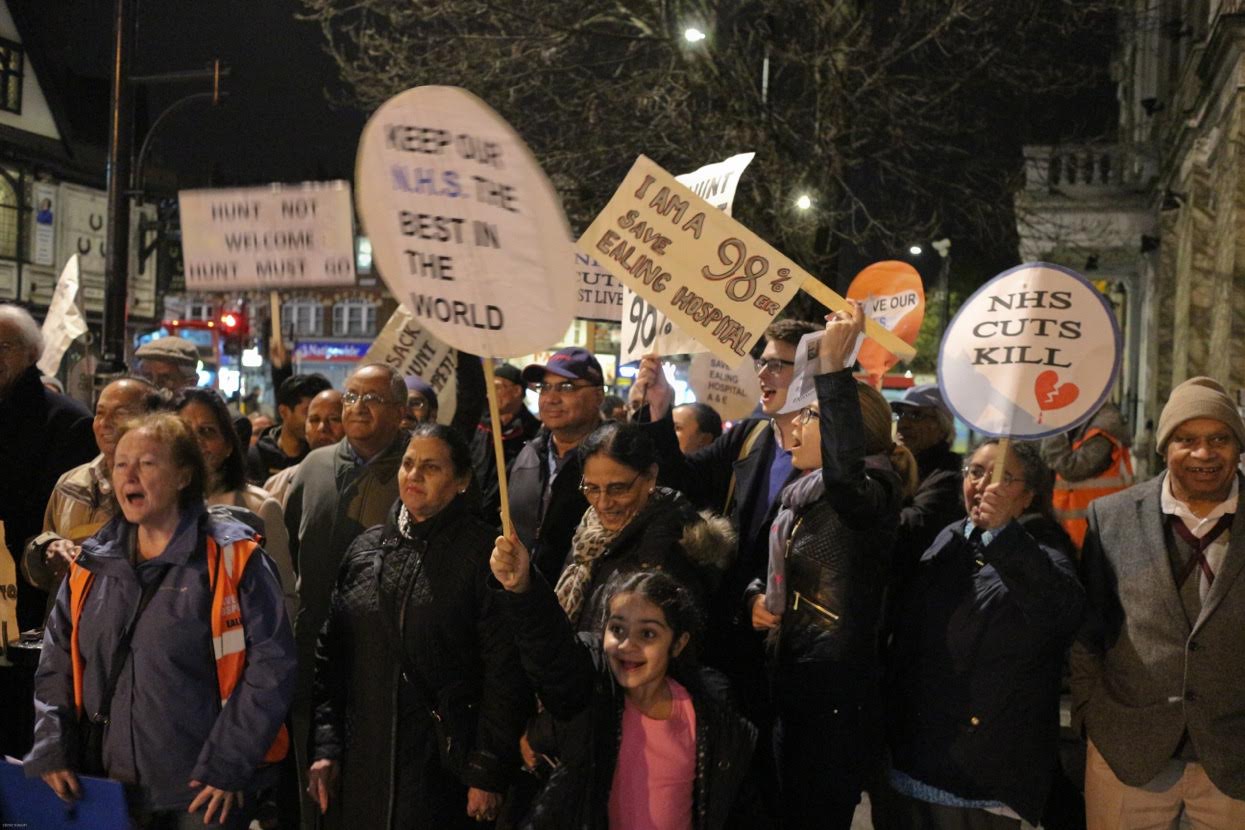
Around 100 demonstrators turned up outside Ealing Hospital on 1 July 2015 to protest about the closure of the Maternity Unit there on that day. In fact the last baby born there was on 25 June 2015. Given this was the hottest day of the year, the size of the demonstration was remarkable. The core of the protest group were members of Ealing Save Our NHS (www.facebook.com/ealingsaveournhs).


Midwives still working at the hospital came out to greet the protestors. They were cheered. But tears were to follow shed by both staff and protestors. Drivers in car after car hooted their support as they drove past the demonstration. Protestors from Charing Cross, Hammersmith and Lewisham Hospitals were welcomed at the event.


I can’t help but think that this closure is of historic significance. Will it prove to be a dreadful mistake – a tragic error of judgement? Will we ever know? As has been stated so many times before, the people most likely to suffer most from this closure are impoverished, pregnant women in Southall with complex needs.


ITV ‘Exposure’ Documentary Reveals Failings at Care UK’s Urgent Care Centre at Ealing Hospital

On Wednesday evening 22 July 2015 an ITV investigative programme featured covert filming of the workings of Ealing Hospital’s Urgent Care Centre (UCC). The UCC is run by Care UK, a private healthcare company.


The programme highlighted multiple failings whose causes hinged around meeting targets and making profits rather than meeting patient needs.


Failings exposed included:

+ Doctors not fully trained

+ Record keeping ‘fudged’ in order to meet targets

+ Under-staffing

+ Inadequate stocks of drugs

+ Patients discharged too early

+ Triage carried out in public at the UCC reception instead of being carried out by a nurse in private.


For those who missed the programme, it can be viewed until 22 August 2015 at:

www.itv.com/itvplayer/exposure-out-of-hours-undercover


Care UK has responded to the programme and their rebuttal can be found at www.ealingtoday.co.uk. Southall’s MP Vivendra Sharma has called for an investigation. He doesn’t (for some reason) identify Ealing Commissioning Group (ECCG) as having any responsibilities for these failures. The Evening Standard quotes the ECCG Chair. She said ‘…an urgent clinical visit found no immediate cause for concern’. Her statement is very much at odds with the programme content and places ECCG in the category of ‘cause for concern’. After all ECCG chose Care UK to run the UCC and it is the ECCG which is responsible for ensuring that Care UK delivers a first class service.


NHS England (London) has announced it will, along with ECCG, commission an independent clinical and lay review of any patient safety concerns at Ealing Hospital UCC. However the Director of NHS England (London) in an email to colleagues refers to ‘allegations’ made in the ITV documentary. This clearly is misleading as the film/video footage is clearly evidence and not allegations.


AgeUK Ealing’s Survival at Risk as Ealing Council Withdraws Funding for 2016 – 2019

Ealing Council is planning to allocate the entire voluntary sector older peoples budget to just one organisation – Southall Neighbourly Care. This will total £1 million over the next three and a half years.


The impact of this decision will be severe and immediate. AgeUK Ealing – a well established charity serving the needs of many older people – is now severely under threat. Also under threat is the AgeUK Ealing supported Southall Day Centre. Hundreds of centre users demonstrated against these proposals outside Ealing Town Hall on the evening of 28 July 2015.


Doubts are being expressed as to the suitability of Southall Neighbourhood Care to receive all this grant money. It’s a consortium of 21 organisations not all of which are charities, some of which don’t offer services to the elderly and some which don’t even operate in Ealing. Charity Commission records show consistent annual overspend by the organisation over the last five years.


Charing Cross Hospital

Andy Slaughter MP met with Hospitals Minister Jane Ellison in July 2015. He says the SaHF timetable is slipping and SaHF funding may not be agreed till 2018. With £1 billion now needed in capital costs and £250 million required in implementation costs,  SaHF looks increasingly rocky. She did however say the intention was still to demolish Charing Cross Hospital and replace it with a new ‘Local Hospital’. She also confirmed that there would be no new Keogh Report, which supposedly was to be the document which would define the nature of a ‘Local Hospital’.


The Save Our Hospitals (SOH) group in Hammersmith have, surprisingly, received an invitation from Hammersmith & Fulham CCG (H&FCCG). The CCG wants to ‘…establish a more constructive dialogue…’. SOH has yet to decide whether to agree to a meeting.


NHS Announce Eight New ‘Vanguards’ Aimed Towards Transforming Urgent and Emergency Care

On 24 July 2015, NHS England Chief Executive Simon Steven said:


‘Urgent care will be delivered , not just in hospitals but also by GPs, pharmacists, community teams, ambulance services, NHS 111, social care and others, and through patients being given support and education to manage their own conditions’.


These are no doubt laudable aspirations for ‘joined-up’ urgent care operations. Current Vanguard projects around England are trumpeting successful initiatives including mobile treatment services, street triage services and acute home-visiting.


Currently these Vanguards are funded from a £200 million transformation fund. No inner London Vanguards are referenced in the announcement. There is one in outer London at Barking, Dagenham, Havering and Redbridge. One does wonder what the cost would be to run these joined-up urgent care services nationwide.


It is of course ironic that this NHS urgent care announcement came just two days after the ITV documentary portraying Ealing Hospital Urgent Care Centre (UCC) as a shambles. Under the NHS ‘Shaping a Healthier Future’ strategy Ealing Hospital’s A&E unit will close and all we will be left with in Ealing for emergency and urgent care will be Care UK’s UCC. Never mind joined-up urgent care throughout Ealing we, seemingly, can’t even deliver urgent care adequately at Ealing Hospital’s UCC.


McKinsey’s NHS NW London A&E Post Closure Performance Whitewash is Finally ‘Sort of’ Placed in the Public Domain

After disastrous local A&E performance following the September 2014 A&E closures at Central Middlesex and Hammersmith Hospitals, NHS NW London/Shaping a Healthier Future (SaHF) commissioned management consultants McKinsey to research the failure. Ironic really as one suspects that the A&E closure strategy originated within McKinsey themselves!


Sometime in July 2015 a document was quietly published on the NHS England web site entitled ‘Review of the Implementation of North West London A&E Changes’. The document is not the McKinsey review itself, but NHS England London Region’s ‘report’ on it.


The report contains the expected nonsense about ‘…increase in acuity’. In normal speak this means more ‘iller’ people turned up at A&E than expected. However there is no supporting qualitative or quantitative data to support this alleged increased severity of illnesses.


The old chestnut of  ‘…a national increase in (A&E) demand’ is trotted out in the report. Colin Standfield of Save Our Hospitals has repeatedly refuted this lie. In fact the NHS’s own data shows no increase in the numbers of patients visiting our local A&Es. In North West London over the last four years A&E attendance fell by 26.2%.


Another quote is ‘…the underlying cause for this increase in acuity could not have been linked to the A&E changes’. This really is a totally meaningless statement.


And let’s not forget how disastrous the A&E performance was. For example in the week ending 30 November 2014 NHS NW London was the worse performing NHS region in England for Type-1 A&E patients – with only 65.7% of patients being seen within four hours. For the week of 15 December 2014 at Ealing Hospital A&E 62.6 % of patients were seen within four hours – making it the worst performing hospital in England.


The report pats SaHF on the back for getting its post-closure A&E patient modelling correct. It then claims that unfortunately patient demand was not as predicted. How truly pathetic this is.


Over the last two years NHS North West London has spent £33 million on management consultancy help in strategies and programmes to cut and privatise local hospital services. One has to ask whether this really was a good use of public money.


Independent Healthcare Commission to Publish its Final Report in September 2015

This commission – also referred to as the Mansfield Commission – was launched in December 2014. It is examining the progress, success and impact of the NHS North West London ‘Shaping a Healthier Future’ (SaHF) strategy. SaHF, announced in 2012, aims to save money by reducing the number of major hospitals, A&E units, Maternity units, and hospital beds. SaHF envisions better, cheaper healthcare being delivered outside of hospitals. The commission was set up by four Local Authorities – Brent, Ealing, Hammersmith & Fulham and Hounslow.


It will be interesting to see what the four authorities decide to do with the evidence collected. The commission’s Interim Report, published in March 2015, was very damning about SaHF in many aspects, which included access to care, quality of care, the business case and the whole SaHF process. It’s quite clear that the body of evidence collected about the operation of SaHF is enormous and unique. I suspect the only external attack which could dent or perhaps ‘sink’ the SaHF supertanker would be one carried out in the Law Courts. The commission’s evidence base would be a crucial weapon to be used in any legal challenge.


Tories Move Towards Inquiry on Whether NHS Should be Funded by User Charges and Insurance

On 9 July 2015 in a debate on NHS sustainability in the House of Lords, Lord Prior announced a move towards setting up an inquiry into ‘Pay NHS’. Lord Prior is an ex CQC boss and an ex deputy Conservative Party Chair.


Not a hint of this came out running up to the General Election. Also the Kings Fund recently carried out an inquiry into the topic and rejected the user charging approach.  


Hammersmith & Fulham Council Challenge the Financial and Operational Viability of the Planned Merger of NHS Chelsea & Westminster  and NHS West Middlesex Hospitals

On 7 July 2015 Hammersmith & Fulham Council (H&FC) for a second time publicly slated the NHS Chelsea & Westminster Hospital Foundation Trust (CWHFT) for its failure to reveal the business case supporting the merger of the two hospitals. H&FC also expressed concerns on the impact of the merger on local services, particularly the potential effects on A&E and paediatric services. CWHFT says it expects the Secretary of State to sign-off the merger in August 2015.


CWHFT says that its Board members have all signed confidentially agreements which prevent them disclosing the financial details of the merger. This clandestine approach seems entirely inappropriate where public money is involved.


Mental Health Risks Top Head Teachers’ Concerns

67% of 1,180 school head teachers surveyed by The Key stated that the risk of children developing mental health problems was their biggest concern. The survey included responses from Primary school and Secondary school heads. Given the budget cuts to mental health spending this widespread concern by head teachers is extremely worrying.


The Key (www.thekeysupport.com) is an independent company providing leadership and management support to 47,000 school leaders and governors.


GP Groups All Highlight that Government Funding for 7 Day GP Working is Inadequate

Dr Morton’s – an online medical helpline staffed by GPs – estimates that 7 day working by GPs will cost over £3 billion/year.


The Royal College of GPs estimates that if 50% of GP practices operate 7 days a week it will cost the NHS £1.2 billion /year.


The BMA GP Committee say that 7 day working by GPs will require more investment by the NHS than what has been promised.


So far the Government has invested just £175 million to facilitate the evening and weekend opening of GP surgeries.

Closing the only Maternity Unit in Ealing was listed as an “achievement”!

0

ccgEaling Clinical Commissioning Group held its AGM last night and gave itself a big thank you for its work over the last year. Closing the only Maternity Unit in Ealing was listed as an “achievement”!
So was all the privatisation and outsourcing of Ealing health services.
The audience of about 80 including GPs, health workers and campaigners obviously wasn’t convinced. Most of the questions were critical and an open letter signed by 500 Ealing residents was given to CCG Chair Mohini Parmar. The letter objected to the indefensible closure of Maternity. A similar letter from Southall residents had already been sent in.

Ealing CCG is engaged on cutting and privatising as part of a Government attack on the NHS. We gave out leaflets saying just that!

Solace Centre Will Remain Open but as a Much, Much Smaller Facility. Will It Still be Viable? – July 2015

0


Issue: 26

July 2015


This occasional newsletter is researched, written and edited by a group of concerned residents in Ealing, West London who want to preserve our NHS. We view the wholesale engagement of private, for-profit healthcare service suppliers as unnecessary, profligate and dangerous. Process improvement is what is needed in our NHS – not revolution.


Solace Centre Will Remain Open but as a Much, Much Smaller Facility. Will It Still be Viable?

The Solace mental health drop-in centre in Bowmans Close West Ealing, which was in danger of closure this year, has apparently won a reprieve until April 2016. However the funding model must change if the centre is to survive beyond this date. The London Borough of Ealing (LBE), who owns the centre, has looked at five options for alternative funding and an invitation to tender will be issued by LBE in September 2015.


The preferred option, which was agreed at the 16 June 2015 LBE Cabinet meeting, links the continued out-of-hours mental health service with a residential service at Marron House. Marron House is owned by LBE and it houses the Solace Centre. The service supplier will be London Cyrenians. London Cyrenians is a 43 year old charity which provides shelter and support across west London for over 500 single, vulnerable, homeless and mentally ill people. The option involves the conversion of much of the Solace centre into two additional supported living units on the Marron House site.


Activists are up in arms because this arrangement reduces the actual size of the new Solace to just one room and a small kitchen. The fine detail on how an arrangement might work with Solace users, Marron House residents, London Cyrenians, LBE and the NHS West London Mental Health Trust (WLMHT) has yet to be worked out. WLMHT has confirmed that it will continue its annual funding of £47,000 to support the Solace centre service.


Ealing Hospital

A minimalist version of the NHS ‘Shaping a Healthier Future’ plans for Ealing Hospital were aired at the North West London  Joint Health Overview & Scrutiny Committee (JHOSC) meeting on 16 June 2015. The message carrier was the NHS NW London CCG ‘supergroup’ – the North West Collaboration of Clinical Commissioning Groups.


Here below is what the terse statement says about future hospital provision for the 340,000 residents across the 21 square miles of Ealing. I believe this statement has been the one consistently trotted out in recent years.


‘Ealing Hospital

Ealing Hospital is being modernised and redeveloped (as) a new 21st century facility for the local community. The hospital will have a local A&E and 24/7 GP-led Urgent Care Centre, with access to 24/7 specialist care, as well as a range of specialist services designed with – and for – the local community, such as a Diabetes Centre of Excellence.


Ealing will become a new local hospital for the whole of the local population. In particular, it will improve care for elderly patients, those with long term conditions and the most vulnerable members of the community by integrating primary and secondary care with community and social care. Services proposed include: access to specialist opinion; social care and psychiatry; a wide range of diagnostic services including pathology and radiology; the ability to admit people to beds on the hospital site for assessment, treatment, observation and rehabilitation; outpatients services; ‘Transition’ beds; an enhanced diagnostic service, comprising X-Ray, Ultrasound, CT and MRI scanning and ECG; a range of therapies, podiatry, audiology  and dietetics; ophthalmology; education and research; a hospital and community pharmacy; a sexual health clinic; space for GP practices; a day assessment centre; pregnancy assessment centre; ambulatory chemotherapy; and renal dialysis.’


Some questions and comments come to mind which include:  


+ Does ‘modernised’ mean updating and repurposing existing buildings?


+ Does ‘redeveloped’ mean demolish and new build? If so then no doubt a Private Finance Initiative (PFI) will come into play.


+ What exactly is a ‘local A&E’? There is no mention of an Intensive Care Unit or Intensive Care beds


+ What might ‘access to 24/7 specialist care, specialist consultant opinion, social care and psychiatry’ actually mean. Note that there is no mention of ‘on-site access’. Might it mean telephone access, email access, Skype access, ambulance access, guaranteed real time access to staff/beds/resources in other NHS hospitals in the region?


+ No mention anywhere of ‘mental health ‘service provision. If the oft stated NHS goal of treating physical and mental health issues in the same ‘Setting of Care’ has any validity then both physical and mental health care must be delivered in the new Ealing Hospital


+ ‘….integrating primary and secondary care with community and social care’. This is a truly laudable aspiration, but is outside the scope of the specification for a new local hospital on the Ealing Hospital site


+ No indication of how many hospital beds will be provided and for what purposes they will be used


+ No mention of any operating theatres


+ No mention of ante-natal and post-natal Maternity services on site


+ No indication of the timescale for creating this new 21st century healthcare facility


+ Where is the London North West Healthcare NHS Trust in all this? It’s the Trust which currently runs Ealing Hospital and (presumably) it’s the Trust who will deliver the medical services at the new Ealing Hospital. The ECCG is only involved in the purchasing of these services.

+ One of the biggest gripes about Ealing Hospital is the inadequate size of the car park. Surely, with the local population of Southall expected to expand by more than 10,000 people by 2026, a commitment to more car parking spaces is needed?


+ If this is truly going to be a local hospital for local people just how many Ealing or Southall residents are going to be involved in articulating the local needs and specifying the service mix for this new Ealing Hospital?


Healthwatch Ealing: A Sickly Patient?

Each Local Authority has a legal obligation to ‘commission’ and fund a local Healthwatch organisation. These local Healthwatch organisations are independent consumer champions for both health and social care. The Health and Social Care Act 2012 created the Healthwatch initiative.


I’ve often wondered why Healthwatch Ealing (HE) consistently fails to represent local residents’ concerns about current and planned ‘transformations’ to NHS services. Thousands have taken to the streets in recent years to demonstrate against the NHS ‘Shaping a Healthier Future’ plans to downgrade Ealing Hospital and close its Maternity Unit. But I’ve seen no sign of  HE leading or even joining these demonstrations. On the day the Maternity Unit closed down HE’s web site proclaims details of improvements to local maternity services on its home page!


I recently spent some time perusing the HE constitution. I have to say that it does contain some peculiar clauses. For example it grants extraordinary powers to the housing and support charity Hestia. HE employs Hestia to provide a range of services which include accounting, IT and HR. (In fact all five HE employees are employed by Hestia). There is a historical link here as Hestia performed a similar role for HE’s precursor organisation, Ealing LINk. Another bizarre clause absolves HE from having to convene Annual General Meetings.


Anecdotal evidence suggests that the majority of EH Board members do not see HE as a campaigning organisation, although it’s quite clear that Healthwatch guidelines explicitly allow this. For some reason HE members cannot attend HE Board meetings even as observers.


2015/2016 is likely to be a challenging year for HE as its annual Local Authority grant will be reduced by £57,700 to £140,000. Elections are being held to create a new HE Board and there are rumours of a HE public meeting at Ealing Town Hall on 16 July 2015. Allegedly the composition of the new Board will be announced at this meeting. However as a member of  HE, as at 1 July 2015 I have yet to be invited to this meeting.


HE could be transformed into a really useful open and transparent campaigning group which truly represents Ealing residents. Clearly a new constitution is required along with new leadership. I encourage residents to join HE at www.healthwatchealing.co.uk. If this process is problematic (and it can be) people can always leave a message with their contact details on 0800 652 7200.


NHS Mental Health Services in Ealing

I attended a meeting of the excellent mental health Carers’ Support Group based at NHS WLMHT’s Recovery East Team base at Avenue House in Acton on 9 June 2015. The group receives financial support from LBE. Around 30 carers attended to hear WLMHT’s Robert Murray present and answer questions. Robert is the Senior Manager for Planned and Primary Care Service Line. Interestingly two members of the Care Quality Commission (CQC) also attended. CQC has just completed an evaluation of the performance of WLMHT.


Robert outlined current and future planned changes to local mental health services in the context of the 2012 NHS NW London ‘Shaping a Healthier Future’ programme. He emphasised the goal of treating physical and mental health illnesses in the same ‘Setting Of Care’. The main thrust of achieving this is the ‘discharge’ of as many as possible mentally ill patients (‘service users’) from WLMHT care to GP/Primary Care. Those service users discharged are presumably those who have ‘recovered’ or who have stable behaviour and treatment regimes. Those who are not discharged and remain under WLMHT care are no doubt those who are unstable and/or with complex needs.


Currently 80% of Ealing GPs have contracted to provide mental health primary care. The 179 Ealing GPs are being organised into seven ‘clusters’ of GP surgeries and each cluster will have some specialist mental health support. Concerns were raised about those mentally ill patients whose GP has not contracted to provide mental health primary care. Doubts were also expressed about GPs’ abilities (even after some training) to be able to manage anti-psychotic medication regimes.


Two carers complained about the lack of consultant continuity in WLMHT. Seemingly every time their service user loved one meets a consultant it’s always a different person. Robert suggested that this was happening as consultants were being trained by meeting a wide range of service users in order to gain wide ranging experience.


A heart-rending case study was presented by a local carer about a mother and daughter – both service users – living together in a run-down LBE housing estate. These people are being exploited by drug dealers. Their flat has serious health and safety problems. They have difficulty living independent lives and looking after themselves. The situation became critical one evening when it was no longer safe for them to stay in the flat. All the best efforts of LBE and the NHS came to nothing. After standing outside their tower block for hours in the dark they finally finished up at Acton Police Station.


This case study highlights that there is no joined up out-of-hours emergency service in Ealing to provide health and social care. There are known to be around 10 residents on the estate with mental health problems. Their inability to live an independent life, to cope on a regular basis and to avoid being exploited can lead to their homes being trashed. This can result in eviction and homelessness. This ‘result’ can hardly be viewed as a successful outcome.


I asked how the NHS would measure the improvement achieved by changing the Setting Of Care for many mentally ill patients. He said the NHS uses a ‘Well-being Tool’ to measure mental health service user performance. As interesting as this measuring technique might be I asked whether an increase in the service user population might be an indication of success. This rather stopped him in his tracks. I further pointed out that probably everybody in the room knew of people with mental health problems who were yet to present themselves to the NHS. Getting more of these people into NHS diagnosis and treatment might indeed be an indicator of success. My second question was about time scale. He said it would take another 18 months to transform this Setting Of Care.


Improving Access to Pyschological Therapies (IAPT) in Ealing

Anecdotal evidence collected in recent months indicates progress is being made in making NHS psychological therapy treatment more readily available in Ealing. Self referral on 020 3313 5660 seems to result in a detailed telephone interview within a few days of first contact. NHS Cognitive Behavioural Therapy (CBT) specialists are readily available. NHS Counsellors are less available and there is up to a three month waiting list for treatment. However the IAPT service gives patients the option of using local, inexpensive, charity-based Counsellors who are more readily available.


WLMHT CEO Resigns

Steve Shrubb, WLMHT CEO, resigned his position on 19 June 2015. He had been in the job for just three years. After almost 40 years working in the NHS he is retiring on 20 November 2015 in order to care for his aging and ailing parents.


He’s had some tricky problems to deal with at WLMHT. These include psychologist whistle blower Dr Hayley Dare, poor CQC reports and the recent £3.9 million hole in the WLMHT accounts allied to potential fraud allegations.


NHS Hospitals Paid Out £3.3 Billion on Agency Fees and £600 Million to Management Consultancies in 2014

The Government is unhappy about the level of these costs and will implement some measures to bring about change by September 2015. These measures include:


+ A maximum hourly rate for agency doctors and nurses

+ A limit of £50,000 on all management consultancy contracts.


It’s hard to predict the impact of these measures. If the agency cap results in more staff taking up permanent positions in the NHS it is to be welcomed. If NHS bodies get round the management consultancy contract cap by issuing multiple £50,000 contracts then nothing will have been achieved.


NHS care.data is Still a Shambles

care.data is the NHS medical data service. The data is to be used in enhancing healthcare and social care. Development of the service has stuttered along since 2013. There have been constant fears expressed by various bodies about protecting confidential patient data. A key feature of the service is that patients can opt out of their data being used outside the NHS.


The confidential data of up to 700,000 NHS patients has been shared with insurance companies against their wishes. The breach happened in February 2015. The organisation responsible is the NHS Health and Social Care Information Centre. The data released was line-by-line data – every individual hospital episode for every patient, with unique pseudoanonymised identifiers.


Ealing Maternity is now closed but the campaign continues

0

march1Excellent turnout of campaigners and local residents to protest against the closure of a beloved and much needed Maternity Unit.

A brief and colourful march departed from Hanwell Clock Tower and arrived at Ealing Hospital where a  rally was then held.

Among the many speakers Dr Onkar Sahota, Chair London Assembly Health Committee, Labour Assembly Member for Ealing & Hillingdon. Chair  of Ealing Save NHS and GP, Olivia O’Sullivan from Save Lewisham Hospital and campaigners from Ealing Save our NHS and Hammersmith & Charing Cross Save Our Hospitals, Raj Gill from Unite Community and hospital unions.

Ealing Maternity midwives and staff briefly joined to say thank you to the campaigners.

Press release can be found here

[gmedia id=6]


Ealing Hospital Maternity to Close on 1 July 2015 – June 2015

0


Issue: 25

June 2015


This occasional newsletter is researched, written and edited by a group of concerned residents in Ealing, West London who want to preserve our NHS. We view the wholesale engagement of private, for-profit healthcare service suppliers as unnecessary, profligate and dangerous. Process improvement is what is needed in our NHS – not revolution.


Politics and the NHS

I thought the ‘noise’ around supporting the NHS prior to the General Election would now subside, but after a short lull it’s headline news again. Jeremy Hunt MP has been re-appointed as Secretary of State for Health. Most NHS activists fear the worst with the prospect of five years of a Tory Government. We see the spectre of the destruction of the NHS as we know it.


On 18 May 2015 PM Cameron announced his desire to meet his pre-election commitment to a 7 day NHS. He said again that he will inject another £8 billion each year into the NHS, but it’s not clear where that money is coming from. The Royal College of Nursing reacted badly to this and its members could take industrial action if 7 day working impacts unsocial hours and weekend working payments. 51 NHS bosses have also written to Cameron saying that the £8 billion extra is not enough and more is needed for ‘transformation and social care’. Cameron committed again to recruiting 5,000 more GPs by 2020.


In North West London the swing to Labour in the General Election was very striking. Many of us feel that was the result of very active grass roots NHS campaigns. For example there were Labour gains in Central Ealing & Acton, Brent Central and Brentford & Isleworth. There were increased Labour majorities in Ealing North, Ealing Southall, Hammersmith, Harrow West, Feltham & Heston and Brent North.


Ealing is now very much a one party state with all Labour MPs and Labour having a massive majority on Ealing Council. It would be good to see all the MPs, Labour councillors and Ealing Save Our NHS working together to save Ealing Hospital A&E. Other local healthcare battlegrounds on which politicians should fight include saving Clayponds Hospital in South Ealing and saving the Solace mental health walk-in centre in West Ealing.


Now all this assumes that UK Labour and Ealing Labour want to make a priority of fighting changes to the NHS. Maybe the £12 billion cuts in welfare benefits will be a much bigger national Labour priority. As UK Labour is currently headless and direction-less, it’s hard to tell. As for Ealing Labour, with austerity cuts continuing unabated. it might be too pre-occupied with keeping the Ealing Council services ship afloat generally to have much time or money trying to save the local NHS.


Ealing Hospital Maternity to Close on 1 July 2015

At a five hour public meeting on 20 May 2015 held at a ‘remote’ location (Ealing Trailfinders Sports Club, West Ealing) the ECCG finally bit the bullet and publicly sanctioned the closure of the Ealing Hospital Maternity Unit as from 1 July 2015. So as of a few weeks time there will be nowhere across the 21 square miles of Ealing where Ealing women can have their babies delivered in a bespoke, hospital ‘setting’. This closure trashes the recent investment in new birthing facilities at Ealing Hospital. Over 27 years of birthing on the Ealing Hospital site is hereby terminated. The major reason given for the closure is the inability of Ealing Hospital Maternity Unit to meet the London Quality Standards for maternity services. The numbers of women having babies at Ealing Hospital has been falling in recent years – not surprising as the decision to close the maternity unit was first announced in 2012!

50 demonstrators turned up outside the venue. They included mums with babies, Ealing MPs Rupa Huq and Steve Pound, Ealing Save Our NHS, Save Our Hospitals, 38 Degrees and Occupy. Many of them attended the meeting, with over ten asking questions.


Southall mothers-to-be with complex needs will be the hardest hit by this closure. 39% of those who gave birth at Ealing Hospital in 2013/14 live in Southall. In future, pregnant women will have to travel to Hillingdon, West Middlesex, St Mary’s, Queen Charlotte’s & Chelsea, Chelsea & Westminster or Northwick Park Hospitals. Average travel times by bus and car for those living in Southall Broadway will almost double according to the ECCG. ECCG says that by the end of May 2015 extra birthing capacity for up to 3,650 additional births will have been added to the six hospitals. Up to 120 staff will have longer journeys to work given they accept their relocation offers.


We were told at the meeting that the closure had nothing to do with cost cutting. It, apparently, is all about providing a better maternity service across the whole of North West London. My take on this is that meeting Ealing mothers’ needs is being sacrificed for a greater ‘good’.


Ealing Hospital Emergency Gynaecology will also close in July 2015, with Paediatrics closing in July 2016.


Healthwatch Ealing – Ignore It or Support It?

A local Healthwatch is a ‘consumer champion for patients and the public in health and social care’. A local Healthwatch is accountable to its Local Authority and has been since Healthwatch came into operation in April 2013. Local Healthwatch bodies have formal working relationships with the Care Quality Commission (CQC).


Concerns have been voiced all over the country that local Healthwatch bodies are too close to Local Authorities to be independent. The People’s Inquiry into London’s NHS recommended that Healthwatch England be closed down and that local Healthwatch bodies be segregated from the CQC and modelled on the old Community Health Councils.


Healthcare is in turmoil in Ealing. The NHS Shaping a Healthier Future (SaHF) seeks to downgrade Ealing Hospital, rob it of its A&E unit as we know it and close its maternity unit on 1 July 2015. Thousands of Ealing residents have signed petitions and participated in marches, rallies and demos in protest against SaHF. To what extent has Healthwatch Ealing represented the views and concerns of these protesters? On current evidence the answer has to be very little.


Healthwatch Ealing’s Chair was interviewed in public by the Independent Healthcare Commission for North West London on 21 March 2015. There were questions about the impact of  SaHF she could not or would not answer. Some of her answers were factually incorrect. It was also revealed that her written submission had not been approved by the Healthwatch Ealing Board! Overall the Healthwatch presentation lacked credibility and was sympathetic to SaHF.


Maybe it’s possible to change Healthwatch Ealing so it does represent the views of patients and residents. In order to bring about change more Ealing residents disaffected by SaHF need to join the organisation and make their views known at Healthwatch Ealing’s AGM on 16 July 2015. BTW funding for Healthwatch Ealing is to be slashed by £100,000 a year beginning on 1 July 2015.


To join Healthwatch Ealing go to:


http://healthwatchealing.co.uk/join_us


SaHF Playing Fast and Loose with the Truth


In a 6 May 2015 email to Peter Latham, SaHF’s Medical Director Dr Mark Spencer gets the facts all wrong in trying to shore up the ailing Shaping a Healthier Future (SaHF) transformation programme for NHS NW London.


Firstly he misquotes the Independent Reconfiguration Panel (IRP) and the Secretary of State (SoS). He states they both forced SaHF’s hand in the urgent closing of Central Middlesex and Hammersmith Hospital’s A&E units ‘as soon as practicable’. The SoS did not ask for urgent closure, but closure ‘as soon as practicable’. As for the IRP it stated that ‘the NHS’s implementation programme must demonstrate that, before each substantial change, the capacity required will be available and safe transition will be assured’. The IRP emphasised the need for and lack of Out of Hospital services. The IRP also did not ask for any urgent closure.


Secondly Dr Spencer states that there is no NHS A&E target for Type-1 patients (the most ill). This is nonsense as there is a target and nationally data is collected for ‘percentage in 4 hours or less (type-1)’. This Type-1 performance in NW London after the two A&E closures has been disastrous. However Dr Spencer shamelessly completely ignores this. As he confirmed at the Independent Healthcare Commission public hearing on 9 May 2015, SaHF likes to consider only performance figures of A&Es and UCCs combined.


Finally, Dr Spencer attempts to rubbish the findings of the Independent Healthcare Commission by labelling it as having ‘pre-formed views’. This really is rich coming from SaHF, as even before SaHF’s public consultation its ‘pre-formed view’ was that four out of nine hospital A&Es in NW London must close.


North West London Independent Healthcare Commission Public Hearing at Brent Civic Centre 9 May 2015: SaHF Supporters in the Spotlight


I listened to three stalwart supporters of SaHF being questioned at this event – Dr Mark Spencer, Dr Mohini Parmar and Ms Ursula Gallagher. Dr Spencer and Ms Gallagher appeared completely unconcerned about the welter of continuous criticism about SaHF. All three of them would not answer any finance related questions. No-one was able to explain why the required, approved business cases for closure were still unavailable three years into the SaHF programme.


Commissioner Dr Stephen Hirst took issue with Dr Spencer about the geographic spread of the proposed five major hospitals. Hirst’s contention is that in the least deprived section of NW London, i.e. in central London, we’ll have two major hospitals (St Mary’s and Chelsea and Westminster) close together with UCH close by. But as for the deprived area of Southall, with Ealing Hospital gone it will have no major hospital close by. Dr Spencer was having none of this. He contended that close proximity by patients to a major hospital A&E had no significant effect on healthcare outcomes.


Commissioner Dr John Lister asked Dr Parmar where the 28,000 seriously ill patients who attend Ealing Hospital A&E each year would go to after its closure. She would not, or could not, answer that question. Dr Parmar said that Ealing Hospital A&E would not close for three years. Dr Lister pointed out that hiring permanent staff in that situation would be very difficult. He also strongly suggested that the recruitment challenges would be so great that this would force the closure sooner rather than later. At least Dr Parmar was aware that after closure the future loading on the London Ambulance Service would be very high.


In 2012 SaHF stated that its cost-cutting transformation programme would take ‘at least three years’. SaHF also stated in 2012 that Out of Hospital replacement services ‘are already (being) put in place..’ However Dr Spencer told the commission that the transformation was ‘complex’ and would take ‘five or six years’. So now SaHF is at least an eight year programme…..


West London Mental Health Trust (WLMHT) Refuses to Reveal Findings of Fraud Investigation

‘The Independent’ has revealed that WLMHT has refused to publish the findings of a year long fraud investigation. The investigation was triggered by the discovery that the Capital, Estates & Facilities department had initiated several unfunded and unapproved schemes. A £4million ‘black hole’ in the accounts led to the scrapping of several clinical projects.


Apparently there were a number of ‘failed’ projects. £560,000 was overspent on refurbishing the Lakeside Mental Health Unit on the West Middlesex Hospital site. £80,000 was spent on building a cafe which has failed to open.


WLMHT, the UK’s largest mental health trust, is ranked in the bottom five of the 56 mental health organisations nationally – and has been for four years. CQC will be inspecting WLMHT later this month.


Management Consultancies Invited to Spend Our NHS Money on ‘Commissioning Support’ – Money Which Should Be Spent on Patient Care


NHS England has published a list of approved private suppliers who can and will no doubt exert enormous power and influence over CCGs. The question to be asked is why can’t the NHS hire and train its own staff to provide this commissioning support?


Management consultants dominate the list, which includes McKinsey, PwC and KPMG. These companies will no doubt replace the role of NHS Commissioning Support Units, many of which have disappeared anyway. One of the companies on the list is healthcare services giant UnitedHealth. Surely there is a conflict of interest here, as it legitimises UnitedHealth’s role as both a healthcare service supplier and as an adviser to CCGs on the selection and management of healthcare service suppliers.


US Senate Votes to Block TTIP


President Obama’s plan to ‘fast track’ both TTIP and TPP in the US Senate has failed.


The Transatlantic Trade and Investment Partnership (TTIP), a treaty being negotiated in secret, is aimed at making it easier for the US and Europe companies to trade. However it’s really all about large US corporates having the right to bid for European contracts and to enjoy unusual rights to compensation should they fail to win them. (TPP is a Pacific TTIP look-alike).A major worry is that the NHS would prove to be a TTIP victim.


Senate democrats who voted against TTIP warned of its threat to US manufacturing jobs. Commentators predict even tougher opposition to TTIP in its attempted passage through the US House of Representatives.  


In the European Parliament its trade committee has backed trade commissioner Cecilia Malstroem to remove public service from TTIP. The proposal also, apparently, disposes with the Investor-State Dispute Settlement (ISDS) at the heart of the contract.


NHS Out of Hospital (OOH) Care By Private Companies is Supported by Tax Relief


‘The Independent’ has revealed that whereas NHS hospitals have to pay VAT on purchasing drugs, private companies under contract to the NHS do not. This arrangement skews any comparison on costs between NHS OOH services provided directly by NHS and those provide by contracted out private companies, as the procurement of drugs by the latter is 20% cheaper.


What are they really doing to our hospitals?

0

leaftletThe truth is that health bosses still intend to knock down both Ealing Hospital and Charing Cross and replace them with far smaller units. Hundreds of beds would go, along with the existing Accident and Emergency Departments. These plans are in a document called ‘Shaping a Healthier Future’, which is supported by local health chiefs, and the Government.

They tell us they will SPEND £80 MILLION on new NHS facilities, but what they DON’T say is that this money is just to pay for their small replacement hospitals with a quarter of the beds there are now. Then they would sell off the remaining land to property developers.

Health bosses say Ealing and Charing Cross will keep our A&Es. But in the small print these so-called A&Es would not take emergency ambulances or have consultant cover. They will be urgent care centres, the real A&Es would be miles away.

Now they are closing our Maternity!

Health bosses are going to close Ealing Hospital Maternity Unit on July 1st, along with gynaecological services. After that, there will be no more babies born in Ealing, except at home.

So once again, Southall is chosen for cutbacks…Southall mothers will be affected the most. Next year, the same people want to close our paediatric (children’s) services.

These closures have no public support, they are part of Government plans to cut and privatise our NHS.

Government-appointed health bosses have plenty of money for their friends: in the last two years North West London NHS has given £33 million pounds of our NHS money to private management consultants, to advise them how to cut and privatise local hospital services.

One firm called McKinsey & Co has been paid £27,000 every day for the last year. That alone could have been used to pay for over 300 new nurses.

Follow Ealing Save our NHS on Twitter @EalingSoNHS or on Facebook

Protest against the closure of Ealing Maternity 20/05/15

0

Ealing Save our NHS campaigners were joined by 38 degrees with their Save our NHS ambulance and local MPs Rupa Huq and Steve Pound.protest

The CCG meeting rubber stamped the closure of Ealing Maternity, a decision which had been postponed to after the General Election.

Ealing Maternity and  Emergency Gynaecology will close by the 1st July, followed by the closure of Paediatrics a year later.

Ealing NHS Campaigners will carry on the fight to save Ealing A&E and all remaining NHS services in the area.

Read some of the reactions on Twitter:


Thanks for visiting us

Sign up to receive all the latest news from Ealing Save our NHS

We don’t spam! Read our privacy policy for more info.