One week to go!
|
|||||||||||||||||||||||||||||||||
|
|
|||||||||||||||||||||||||||||||||
|

Hospital Beds 2010 – 144,455: Hospital Beds 2018 – 127,225. Why? Why? Why?
The Labour Party’s analysis of NHS Digital data has revealed that over 17,000 hospital beds have been cut since 2010.
In 2018 the British Medical Association warned that 10,000 extra hospital beds were need.
In June 2019 NHS supremo Simon Stevens told NHS bosses that bed cuts should stop because they were leaving hospitals unable to cope with the number of people who needed to be admitted.
Well yes Mr Stevens, bears do indeed defecate in the woods….
Comparing Conservative and Labour Election Manifestos From the Care Perspective
NHS
Conservatives: Annual spend by 2024 – £149 billion. 50,000 extra nurses (this is widely disputed). 50 million extra GP appointments (this is not believable). 40 new hospitals (quite simply this is a lie)
Labour: Annual spend by 2024 – £155 billion
NHS Privatisation
Conservatives: Nothing
Labour: End and reverse privatisation of the NHS
Dementia
Conservatives: Double research funding and speed up trials for new treatments
Labour: Nothing
Mental Health
Conservatives: ‘Mental health will be treated with the same urgency as physical heath’
Labour: Implement all of the recommendations set out in the independent review of the Mental Health Act. Pledge to provide an extra £1.6 billion /year to ensure new standards for mental health are enshrined in the NHS Constitution. Invest £2 billion to modernise mental health hospitals and end the use of inappropriate out-of-area placements.
Social Care
Conservatives: Additional £1 billion annually from 2020
Labour: Additional £7 billion /year 2020/21 rising to £11 billion/year by 2023/24
Carers
Conservatives: Nothing
Labour: Increase Carers’ Allowance to the level of JobSeekers
Residential Care
Conservatives: Nothing
Labour: Reference to ‘…growing public sector provision’
Sheltered Housing
Conservatives: Nothing
Labour: Rent controls, ‘binding minimum standards (with inspections) may apply’
(Sources ONS, parliament.uk, Daily Telegraph)
Keep Our NHS Public (KONP) has put together an excellent list of care questions to ask prospective MPs at local hustings:
NHS Contracts Worth £14.7 Billion Awarded to Private Companies Since 2015
The GMB Union has announce the findings of research it commissioned with Tussell. Tussell provides data on Government contracts. £14.7 billion of the £24 billion outsourced NHS contracts awarded since 2015 went to private companies. That equates to 61% of all outsourced contracts. In 2018 it was 68% at £3.6 billion.
The largest recipients were Care UK (17%) and virgin care (13%). The highest value contract (£1 billion) went to a not-for-profit private enterprise called Sirona Care and Health in south west England for 10 years’ worth of adult community health services.
More at www.gmb.org.uk/news
94% of Directors of Adult Social Services Have Little Confidence They Can Meet their Statutory Responsibilities by the End of 2020/21
The Association of Directors of Adult Social Services (ADASS) has revealed some stark facts and views from its members in its Autumn 2019 survey.
Current Directors are planning to deliver £699 million savings in 2019/20.
They have identified unintended consequences arising from the strong focus on reducing rates of delayed transfers of care from hospitals in their areas. 85.5% of Directors say there have been moderate, significant or very significant increases in rapid discharges to short-term care home placements that become long-term (82.3% in 2018).
More at www.adass.org.uk
43% of NHS Junior Doctors in Obstetrics and Gynaecology are Suffering From Burnout
3,000 doctors working in Obstetrics and Gynaecology were interviewed in an Imperial College London (ICL) study. 43% said they had experienced symptoms of emotional exhaustion and lethargy.
When the ICL research was extended to all doctors, it was discovered that 36% were suffering from burnout.
More at: https://bmjopen.bmj.com
51,534 Adult (16+) Ealing Residents With a Common Mental Health Need: But Only 23,752 (18+) Registered With Their GP as Having Depression or Psychoses
Ealing Council’s ‘Market Position Statement 2019-20’ has been published as part and parcel of its Health and Adult Social Services Standing Scrutiny Panel responsibilities. Other headline facts include 4,886 people registered with their GP in Ealing as having psychoses in 2018/18. This is higher than in England but similar to levels in London.
Ealing CCG and Ealing Council spent over £60 million per year on adult mental health. £56 million of this is spent on NHS services
Ealing’s Substance Misuse Population Have Unmet Needs Way Above National Levels
The prevalence of hazardous substance (drugs and alcohol) use amongst psychiatric patients in Ealing is estimated at between 22% and 44%.
Ealing’s levels of unmet need compared to National levels:
Substance Ealing Unmet Need (%) National Unmet Need (%)
Opiates and/or Crack Cocaine 67.9 51.9
Opiates 62.7 46.3
Crack 70.2 61.1
Alcohol 84.3 82.9
(Source: NDTMS Q3 2018/19 DOMES Report)
In 2017, Public Health England estimated Ealing’s dependent alcohol drinking population at 3,499 residents. For opiate and crack users it’s 2,419. However these figure dwarf the borough’s annual drug and alcohol treatment population (1,492 in 2017/18). With continued budget reductions (35-40% less money since 2015/16) it’s unrealistic to think that Ealing’s treatment service can make any headway in reducing these unacceptable levels of unmet needs.
CQC Finds That Just 42% of Mental Health Patients Feel They Receive Enough Care
CQC surveyed 12,500 mental health patients and the results reveal that mental health services are deteriorating. In 2014 just 43% of patients were satisfied with their treatment – just 1% better than the 42% in 2019.
31% did not know who to contact in the NHS out of hours if they had a mental health crisis.
52% of patients who responded said the mental health staff who saw them were completely aware of their treatment history. 21% were not involved in agreeing a treatment plan.
And to add to our national mental health woes, The Royal College of Psychiatry has pointed out that unfilled psychiatric vacancies have doubled over the last six years.
A Question for You All
As we are reaching the end of the year and maybe time for reflection, let me share with you a question posed by my old friend Ian Hugo:
‘UK National Debt since 2007 has risen from 68% of GDP to 85% of GDP, money borrowed by the Government while public services such as the Police, Fire Brigade and the NHS all suffered cuts in budget and services degraded. So who got the money and for what?’
Have a very Merry Christmas!
Eric Leach

|

18,400 MENTAL HEALTH BEDS IN 2019 – IN 1954 THERE WERE 155,000. WHY? WHY?
Here are some chilling facts about mental health bed numbers in England:
1954: 155,000
1987: 67,000
2008: 27,000
2019: 18,400
The figures are provided courtesy variously of the Royal Society of Psychiatrists and the British Medical Journal. There are many questions to be asked surrounding these figures. Firstly are we in a better place now vis a vis treating the mentally ill and mentally disabled than we were in 1954? Are there more or fewer mentally ill/disabled now than in 1954? Is bed reduction a function of changing the ‘setting’ or clinical ‘pathway’ for care/treatment? If so, is this ‘transformation’ a successful one?
And what are the mental health bed numbers like in other countries, especially in the context of mental health rates in this and other countries? Finally we attempt to evaluate whether quality of care and treatment has improved over the last 60 years. What qualitative metrics exist now and are planned in order to detect and measure ‘successful’ care and treatment.
Mental Health Beds/100,000 Population
The UK is not the worst or the best in terms of mental health beds. Belgium tops the table with 180.1 mental health beds per 100,000 population. The UK stands at 60.6 beds/100,000. Italy ranks very low at 10.6, with Germany, Sweden, Denmark and Spain having fewer beds than in the UK.
National Rates of Mental Illness
Again we don’t have the highest or lowest rates of mental illness. We are 16th in the world at 26%. Switzerland is the worst quickly followed by France, Germany and the USA. Belgium, with the most beds stands at 6th with 29.4%.
1.2 Million Adult Bipolar Patients and 600,000 Adult Schizophrenia Patients in England
There are some 60 million adults in England and 2 in 100 of them are bipolar suffers and 1% are schizophrenics.
And just 14,800 beds……
Measuring The ‘Quality’ of Mental Health Treatment
Victor Leser, Ealing Save Our NHS (ESON) and Keep Our NHS Public (KONP) have mounted a campaign to ensure that all NHS mental health Trusts regularly publish their performance against the 18 week and 52 Week Refer To Treatment (RTT) targets. From 1 April 2015 the NHS target for 18 Week RTT has been 95%. Most of these Trusts are not reporting. Often they justify this (incorrectly) in connection with convoluted reasoning around ‘Non-Consultant led teams’ and the use of ‘Multi-Disciplinary teams’.
Why anyone would ever agree to a 95% 18 Week RTT target is quite beyond me. If you had broken your leg, would you be happy to wait up to 4.5 months for treatment? If you were diagnosed with cancer, would you be satisfied to wait up to 4.5 months for treatment to begin. But if your mind is broken………
After multiple meetings with my local mental health Trust – West London NHS Trust (WLHT) – it seems to be finally dawning on them that they might have to report these figures. However they are still refusing. Local service users and their carers need to know how long patients are waiting/must wait for their treatment. When all mental health Trusts regularly report on performance against the 18 and 52 Week RTT targets, NHS bosses will have a much clearer picture on the size of this massive national failure.
IF WLHT with 114 consultants can’t meet the 95% 18 Week RTT target (which anecdotally they aren’t) just how many consultants would it take to meet this target?
Nationally five NHS mental health Trusts have so far admitted to having consultant-led teams providing elective services and will now report on 18 week RTT performance. 11 Trusts have said no and have given excuses that are based upon misconceptions about Multi-Disciplinary Teams. 12 Trusts are still to answer.
If you thought that you might get a simple answer to the question ‘how long will it take on average for my loved one to get some treatment’, then think again – no answer readily comes back from WLHT and most other mental health Trusts.
However in classic NHS style, new mental health performance metrics are planned for 2020! In March 2019 the Interim Report on ‘The Clinically-led Review of NHS Access Standards’ outlines proposed changes on how to measure access to mental health performance. There are some pilots field testing these proposals. WLHT is one of these pilot sites.
There are some global patient self-reporting ‘measurements’. The Patient Health Questionnaire (PHQ) 9 is designed to facilitate the recognition and diagnosis of the most common mental health disorders in Primary Care patients. General Anxiety Disorder 7 (GAD-7) measures severity of anxiety. As PHQ 9 and GAD 7 rely on patient self-reporting, they cannot be relied upon for definitive diagnosis.
In reality though we are hardly scratching the surface on developing and implementing qualitative performance metrics. Are the diagnosis and treatment regimes actually improving the quality of life of mentally troubled people? Well one way of ‘measuring‘ this is by tracking the physical ailments of the mentally ill. Studies in many parts of the world have illustrated that there is strong correlation between mental illness and physical illness. Greater mental illness severity is often accompanied by a significant number of physical illnesses. NHS North West London (NWL) has begun work on carrying out five physical health checks on its Serious Mental Illness (SMI) population. With an estimated SMI population in NWL of 24,856 this is no mean task. Let’s hope these checks are done on an annual basis, and that the SMI population reduces in number.
In recent years in my region there as been a policy of ‘discharging’ as many mental health patients as possible from Secondary Mental healthcare to Primary Mental healthcare. Presumably the logic behind this is that if a patient is ‘improving’ move them to their local GP so that scarce heavy weight clinical effort can be devoted to those in greatest need. All well and good except from anecdotal evidence many GPs are poorly versed/trained in diagnosing and treating the mentally ill. Added to this we now have Community Mental healthcare. I have yet to grasp what this is, where it talks place and quite how it relates to Secondary and Primary Care.
We also have the arrant nonsense of integrating mental healthcare with mental social care. It has, to my knowledge, never been achieved, and is of unsubstantiated benefit. Two different business models (NHS and Local Government), with different cultures and mission statements have traditionally not ‘gelled’ very well. With both ‘partners’ under the cosh financially each is afraid the other will steal some of its cash. Opening up their financial books to each other is probably the last thing either will do.
Are We Spending Enough on Mental Health and Mental Social Care?
In 2018/19 £12.5 billion was spent on mental healthcare out of a total healthcare spend of £130 billion. For 10 million adult sufferers and some 1.2 million children surely 10% of the total spend is woefully inadequate.
In the private sector a first appointment to see psychiatrist in Harley Street, London can easily cost £600/hour – so no help there for the poor.
Are We Getting Better at Treating the Mentally Ill and Disabled?
If you break your arm, the local hospital can deal with it and 6 weeks later your arm could be 95% back to normal. If your mind is broken, it’s entirely possible that with any and all kinds of treatment you will never be ’better’.
After 25 years of experiencing mental health diagnosis and treatment in West London I have to say that it’s got better over the years. The downside is that I’d ‘score’ it 2 out of 10 in 1994 and 4 out of 10 in 2019.
There are now acres and acres of ’dashboards’, standards, guidelines, statistics and metrics – which I was unaware of (and probably did not exist) in 1994. Internally in the NHS I’m sure there are lots of dedicated knowledge management workers working toward a consistency of mental health treatment reporting. However the unfortunate truth is that there are inadequate numbers of beds, psychiatrists, psychologists, nurses, mental health support staff, social workers, places of safety, residential treatment centres, and carer organisations across the whole mental health and mental social care sector.
National Mental Health Crises for Teenage Girls and Dementia Sufferers
The well documented mental health crisis for teenage girls and young women (2016 research from NSPCC, NHS England/NHS Digital and the Department of Education) is unlikely to improve in the near future. A recent review of dementia studies since 1980 suggests dementia patients are surviving longer and longer, causing the population affected to rise.
And What About Mental Social Care?
I’m not sure anyone has even defined what this is/might be. Thousands of family members provide all kinds of care for their mentally troubled loved ones. Many NHS Trusts and CCGs as well as Local Authorities appear to be unaware of the existence of, and the needs of, these volunteer carers.
General Election Perspective
Labour is promising a focus on mental health – part of a £26 billion overall NHS annual increase by 2023/24. The LibDems and the Greens promise equal emphasis on mental and physical health – how that pans out in an increase in mental health spending (and decrease in physical health spending?) is as yet unclear. The Greens make a specific commitment to ‘evidence-based mental health therapies within 28 days’. The Conservatives have as yet made no explicit commitment to increased spending on mental health.
Eric Leach
|
|||||||||||||||||||||||||||||||||||||||||||
|
|
|||||||||||||||||||||||||||||||||||||||||||
|
|||||||||||||||||||||||||||||||||||||||||||
 |
|||||||||||||||||||||||||||||||||||||||||||
|

Our NHS in Crisis
Issue: 87
1 November 2019
Management Recruiter Hunter Healthcare Publicises NHS North West London (NWL) ICS/ICP Aspirations As Part of Its Search for Five NHS London ICS Bosses
In many ways this is an extraordinary set of documents from an unusual source. An NHS activist in Brent spotted them. No-one in NHS NWL thought to send these NHS London/NHS NWL background documents to Ealing Save Our NHS (ESON) which has been attending NHS NWL commissioning and service delivery meetings now for some seven years.
Before we get into the nitty gritty ‘clinical’ content of these papers it’s interesting to note that the person doing the hiring is a Sir David Sloman. He was appointed NHS London supremo in February 2019. Wikipedia alleges that when he ran the Royal Free Hospital in Hampstead (2009 – 2018) he ignored the concerns of patients. He did, apparently, fall foul of the Data Protection Act in 2017 when he was discovered to have transferred data on 1.6 million patients to the Google DeepMind AI unit. Ironically 2017 was also the year he was Knighted.
What is rendered by Hunter Healthcare are NHS London and NHS NWL web pages on Integrated Care Systems (ICSs) and its Integrated Care Partnerships (ICSs). Confidence in the information presented as early as page 1 is dented by NHS NWL stating there are 400 GP Practices in NHS NWL. However the NHS NWL Collaboration of CCGs in 13 September 2019 stated there were 360. Who is right? And why is someone wrong?
Also on page 1 any flag waving is undermined by stating that, as at April 2019, the NHS NWL had an underlying deficit of £324 million, as well as there being financial challenges also present for our Local Authorities. Surely it’s time for NHS NWL to stop bleating about debts/deficits and get on with how It’s going to spend £4+ billion annually caring for its 2.4 million citizens much more effectively than it did each year 2012 to 2019. And care planning should be on a 10 year basis – as is Local Authority spatial planning. North west London’s population will probably reach 2.7 million by 2030 with a ten year accumulated spend of £40+ billion over that period. Plenty of cash here to do a lot of good. Cutting the £80+ million it cost to run the eight NHS NW CCGs in 2018/19 would be a great way of freeing up a bit more cash, as long as all these folks are not re-hired to staff up the new regional CCG and the eight local ICPs.
Ealing ICP
Some text and graphics (sometimes in such small type that it’s unreadable) have been thrown together (as a brace of slides each perhaps) for each of the eight NHS NWL ICSs. The only footprint/territory I really know anything about is Ealing. Comments on the Ealing ICP:
Hillingdon (12)
London North West (48)
Chelsea & Westminster (10)
Imperial (27)
Whatever does this mean? Does no-one in the NHS NWL office read material for sense before it’s published?
The London Vision
In the papers relating to ‘London NHS’ we have ‘The London Vision: The next steps on our journey to being the healthiest global city’. This motherhood and apple pie aspiration is clearly at odds with England’s, London’s (and Ealing’s) broken planning ‘system’.
Visit areas of London where intense, dense development (so-called ‘regeneration’) is taking place , around Wembley Stadium, North Acton and central Southall are good examples. Hundreds of residential tower blocks which will house tens of thousands of new residents, students and office workers are being built or planned over the next ten years. 85 towers of over 10 storeys or more have been counted in Ealing alone, which will house over 76,000 new residents – 25,000 in Southall alone.
What Primary Healthcare, Secondary Healthcare, mental health care and social care long term capacity planning is taking place in Ealing or London to cope with this population expansion? None that I can see. However, sadly, no long term care capacity planning is evident in education, housing, law & order, transport, business, culture and sport. These deficiencies are to be found nationally, regionally and locally. The notion that there is any possibility of maintaining or developing communities with an adequate range of current and future public and private services is but a distant dream.
‘Our NHS London Region Values’
‘Integrity, Compassion, Consistency, Courage, Effectively’
‘Core Values, Aspirational Values, Permission to Play Values’
‘Taking Accountability’
All marvellous, uplifting words, but as my mother used to say ‘handsome is as handsome does’.
NHS NWL 2012 – 2019 wasted up to £1.3 billion of public money, including over £72 million into the pockets of management consultants, on a disastrous failed Acute reconfiguration/transformation. Why should the 2.4 million registered patients throughout NHS NWL believe a word NHS NWL bosses now utter about future care provision?
Over £4 Million Wasted on Ealing CCG’s Ineffective Referral Facilitation Service (RFS)
Ealing Save Our NHS (ESON) finally got a response to its Freedom of Information request about the now cancelled Ealing CCG RFS. Between 16 March 2015 and 8 November 2019 the cost of the outsourced RFS was £4,161,746. The heart of the RFS is/was a group of Ealing GPs, employed by US healthcare giant UnitedHealth, who were paid to ‘double-guess’ consultant referral requests made by the GPs at Ealing’s 76 GP practices. Clearly there was a cost cutting intent to reduce the number of consultant referrals. From June 2015 to March 2016, 85% of the GP consultant referrals were upheld. During 2018/19 referrals acceptance shot up to 95%. Sanity finally prevailed and the CCG decided that the RFS was a complete waste of money.
NHS Pension Crisis Puts Patients At Risk This Winter
This was the disturbing headline in the 14 October 2019 issue of the ‘Financial Times’. NHS Providers, which represents hospital, mental health, community and ambulance services, has warned the Government it urgently needs a backdated solution to its disastrous 2016 pension changes. These changes limit the amount of tax relief doctors can claim on pension savings. This is a disincentive to work additional shifts during busy winter periods. It is thought to be the main reason many clinicians have opted for early retirement and cutting back their hours of work.
However with Brexit mania rife, a General Election and/or a Referendum in prospect the Government’s pre-occupations might be elsewhere in the coming months.
Drug Shortages Affecting 21% of Prescriptions Dispensed July – September 2019
A survey carried out by the Pharmacists Defence Association (www.the-pda.org) found that pharmacists were dealing with angry patients every day whose drugs were unavailable. 25% of pharmacists had suffered harm from drug shortages. 81% felt shortages would get worse.
Brexit is the quoted culprit.
Cuts in Alcohol Duty Linked to 2,000 Extra Deaths Since 2012
A research report by the University of Sheffield has proposed that some 5,000 lives and £500 million could be saved by raising taxes on alcoholic drinks. Scrapping the alcohol escalator – which raises taxes on alcohol by 2% above inflation – led to a 1% rise in alcohol consumption between 2012 and 2019.
This led to 61,000 extra hospital admissions at a cost of £317 million. The researchers concluded by stating that if the duty policy is not changed, 9.000 additional deaths could be expected by 2032.
Eric Leach
TODAY IS WORLD MENTAL HEALTH DAY
‘What’s the point of waking up each day feeling physically fine but wanting to kill yourself?’
One in five adults in Britain have mental health problems. One in ten children have mental health problems. (World Health Organisation data and other sources). That’s over 5 million adults and some 1.7 million children.
Last year the total NHS budget spend was £115 billion Of this just £12.2 billion was spent on mental health services. This really is the world upside down.
What Are Primary Care Networks (PCNs) All About? Will PCNs Actually Improve GP Services?
The first thing to say about PCNs is that they are informal and non-statutory. The idea, apparently, is by PCNs hiring non-GP staff, it will free up GPs to focus on patients with complex needs. This initiative is of course driven by the chronic shortage of GPs. These non-GP staff are Clinical Pharmacists and Social Prescribing Link Workers (SPLWs), first contact Physiotherapists, Physician Associates and Community Paramedics. £1.799 billion has been allocated to fund this, but as ever with the NHS there’s no explicit clarity as to exactly when and over what period this cash will be deployed.
It’s interesting, perhaps, to review what it would cost to hire and deploy these people for a year. On average it appears recruiting any one of these staff costs £4,5000. So if a PCN hires one of each of these roles it will cost £22,500.
Annual salaries plus an estimated ‘on’ cost of 40% would be:
Clinical Pharmacist: £35000 + 40% = £49,000
SPLW: £25,000 + 40% = £35,000
Physiotherapist: £34,000 + 40% = £47,600
Physician Associate: £30,000 + 40% = £46,000
Paramedic: £28,000 + 40% = £39,200
For all roles except the SPLW the PCN will be re-imbursed 70% of the cost. For the SPLW it will be 100%. There is a financial cap on this. Will this be for every year (until Eternity?) It seems recruitment costs will not be mitigated by re-imbursement. As well as this grant funding each PCN will receive £4.7111/patient for ‘core’, ‘extended hours’ and ‘network participation’. Is this every year?
All but one of the 76 GP Practices in Ealing has signed up to a PCN contract. Exactly how many of the above roles each PCN will recruit is an unknown. Also unknown is whether there will be enough people on the market to fill all these roles? And if there are, will this leave ‘gaps’ in Community or Secondary Care services?
In my PCN (South Central Ealing) there are 50,662 patients. My own GP Practice had already hired its own Pharmacist so this will ease the pressure on one grant-aided PCN Clinical Pharmacist. However one Physiotherapist shared amongst 50,662 patients could be a bit of a stretch.
Petition Launched to Stop CCG Mergers Which Are Attempting to Legitimise Non-Statutory Integrated Care Systems (ICSs)
All NHS commissioning bodies (bar a handful maybe!) are in some sort of merger turmoil as NHS England mandates one CCG per STP/ICS.
The 999 Call/KONP petition calls this out as a device to circumvent existing legislation and demands legislative changes or Parliamentary debate to legitimise ICSs.
Sign at:
http://bit.ly/ParliamentaryStopCCGMergers
CCGs – the 191 Clinical Commissioning Groups in England.
STP – Sustainability and Transformation Plan (or Provider): an October 2016 NHSE attempt at a five year change programme to deliver integrated healthcare and social care services.
ICS – Integrated Care System: an informal NHSE construct which is the current vehicle for integrated healthcare and social care commissioning and service delivery.
999 Call For the NHS is an independent, voluntary grassroots campaign group.
KONP – Keep Our NHS Public: an independent campaign group opposing NHS privatisation and underfunding.
112,000+ Quit Their Jobs in 2018 to Care For Relatives with Dementia
‘The Times’ of 28 September 2019 reported this huge number extracted from a report published by the Centre for Economic and Business Research. The report used data from the NHS and the Office for National Statistics (ONS).
The figure is up from the 2017 estimate of 50,000. Further to this, 147,000 people in 2018 reduced their hours at work or struggled to reduce their working hours to balance work with caring.
Dementia care, unlike care for those with heart attacks and cancer, is not free at the point of use – It’s means tested. Social care budgets are set to be cut by another £700 million in the next year as Local Authorities try to balance their books.
726 Homeless People Died in England and Wales in 2018: 20% More Than in 2017
Of these 726, just under half the deaths are blamed on drug overdoses and most were men aged 45 or over. The ONS began collecting these figures in 2013. This year’s figure is the highest recorded so far. The highest number of deaths were reported in London at 146.
ONS figures also show a 39% increase in over 60 year olds applying to Councils for temporary accommodation. The figure in 2012/13 was 1,800 and in 2017/18 it was 2,500.
The only country in Europe where homeless numbers are falling is Finland. Since 2007, Finland has had a ‘Housing First’ policy and gives those in need a permanent home as soon as possible.
NHS England (NHSE) Spending on the Independent Sector is Around 26% per Year and Not 7% as Widely Mis-Reported
A report by a highly respected and experienced former healthcare professional regulator has revealed that the widely touted 7% NHSE spend on the independent sector is way off mark. He powerfully argues that the real figure is around 26%.
David Rowland, the author of the report, Is the Director of the Centre for Health and the Public Interest. Prior to his current role he was Head of Policy at three national regulators and is a recognised social care policy expert.
Rowland carried out a comprehensive review of six years of accounts produced by the Department of Health and Social Care (DHSC). He found that the distinction between expenditure on different types of non-NHS bodies does not stand up to scrutiny. He also discovered that major items of expenditure on the private sector which are detailed in the accounts are excluded from the DHSC’s calculations.
On the basis of his re-worked calculations for 2018/19, £29 billion was spent by NHSE on the independent sector which is around 26% of total expenditure.
The research has also highlighted that spending on social care services has declined by some £450 million since 2014.
Four Seasons Care Homes Business is Struggling: 320 Care Homes and 170,00 Care Beds At Risk
‘The Times’ 4 October 2019 reported that the UK’s second largest care home operator – Four Seasons – has withheld rent payments to landlords without warning. Administrators were appointed to run Four Seasons in April 2019 and so far all their care homes remain open and not subject themselves to Administration.
Advinia Group – With 38 Care and Nursing Homes, 3,250 Beds and 4,500 staff – Under Financial Scrutiny by CQC
‘The Guardian’ of 7 October 2019 has reported that the Advinia Group is under financial investigation by the Care Quality Commission (CQC). CQC wants to carry out an Independent Business Review (IBR) of Advinia’s finances, but the company is failing to co-operate.
After borrowing £59 million from BUPA it now needs to repay Credit Suisse £6.2 million in May 2020. An indication of the company’s financial turbulence is that in summer 2019 it went through four Financial Directors in just five months!
Eric Leach

A long term plan in our view should have a clear strategic approach, which should be clearly stated and run through the document. ESON believes this is missing.
The NWL LTP is not explicit or transparent enough in stating that deficit-driven significant cuts in spending are at the heart of this plan. We consider that it would inevitably reduce the quantity and quality of care services over probably five years.
Without such a clear strategic approach being stated, we are concerned that the document raises more questions than it answers. We are raising many of these questions here, but there will be more.
The lack of a stated overarching approach also means that the consultation process is presenting us with an impossibly huge number of issues, covering organisation and the delivery of services to two and a half million people with a range of needs.
Much of our comments involve questions for which we require answers. As well as this document representing comments on the NHS NWL it constitutes a Freedom of Information Request.
Photo @Chalabala via Twenty20
Primary Care
We are surprised that the current patient registration figure in NHS NWL is as high as 2,485,629.
The Acton PCN with over 77,000 patients is unacceptably large
Improved access to psychological therapies? How many additional trained staff and in post when?
Where is the Mental Health chapter page?
Where is the evidence that a two hour meaningful response to a mental health crisis can be guaranteed in Ealing?
Of the 9,000 people returned home ‘early’ from hospital, what % of them were re-admitted within 1, 2 and 6 months?
How is NHS NWL ‘embedding’ a system to capture the voice of extremely knowledgeable and well informed groups like BPV, ESON and SCXH&H?
Accessible Care
How will NHS NWL increase GP capacity? Using capital grants maybe?
Two hour response to mental health community service users? See previous comment.
Just how will NHS NWL ensure ‘easiness’ in getting the ‘right’ support?
Proactive Planned Care
What is meant by ‘holistic personalised care’? If it’s not defined then it’s meaningless.
There are grossly inadequate Primary Care, Community Care and volunteer mental health staff in Ealing to provide a ‘full package’ of social support for people (who are mentally ill or mentally disabled).
Co-ordinated Care
Where is the performance data evidence that Multi-Discipline Teams (MDTs) are consistently active and/or effective?
Care Home care involving MDTs is surely aspirational rather than consistently deliverable.
Planned Activities
Surely PCNs will have clinical pharmacists and SPLWs – not NHS NWL?
What is the budget for creating, developing and maintaining a ’network of Primary Care and community training hubs’?
How will we know that we’re making a difference?
By March 2020, 60% of those with Serious Mental Illness (SMIs) will have five physical health checks. With an estimated 24,856 SMIs in NHS NWL this is quite some claim. (1% of population suffering from bipolar or Schizophrenia). How many SMIs were tested in 2018/19 and how many so far in 2019/20? Also explain how this physical illness data analysis will be acted upon to help the 24,856?
‘People will be able to make one phone call to get the care they need’. Not true in Ealing. Separate Secondary mental health SPA and Community mental health SPA.
Reducing Pressure on Emergency Hospital Services
‘Standardise the standard of Urgent Treatment Centres (UTCs)’. Are UTCs the same as Urgent Care Centres (UCCs)? If not please define UTC. If one visits Ealing Hospital UCC on a Sunday, you are likely to be re-directed to a GP practice in central Southall for triage, diagnosis and treatment. Is such a re-direction process ’standard’ across NWL on Sundays?
NHS NWL cannot ‘ensure people receive the right care, in the right place at the right time’. Anecdotally we know of Ealing mental health sufferers waiting months/years for psychotherapy. West London NHS Trust’s failure to report 18 week RTT performance data compounds this felony.
‘We will strengthen services at the front door of the hospital’. We look forward to seeing this. Many NHS NWL hospital ‘front doors’ are bleak and unwelcoming. Northwick Park and Ealing Hospitals are sadly examples of ‘weak front door services’.
Planned Activities
‘Benchmark and compare and continuously improve’
‘Understand specific local drivers’
It beggars belief that NHS NWL has not done this stuff for decades. Also does NHS NWL have the resources to analyse, diagnose and treat?
‘30% of NELs Same Day Emergency Care (SDEC)’. Is this achievable? What is it now?
‘a pan NWL London hub’. What is this? Where is this?
‘free up a further 100 beds by April 2020’. What makes NHS NWL think this is possible. Long range weather forecasters are already predicting a hard, cold winter.
‘Personalised multi-disciplinary care plan’.. we know of no-one who has one of these. How many are there now? What are the targets for years 1,2,3,4 and 5?
‘District Nursing Teams’. Do these still exist? How many District Nurses are currently employed within NHS NWL?
Giving People More Control…
1,000 trained SPLWs. Across England that works out at 1 SPLW/67,500 residents/patients. In the Acton PCN, with over 77,000 patients at 15 GP practices, there might be 2 SPLWs. A useful idea poorly implemented.
What are ‘Digital Healthy Hubs’. What are they? Where are they?
Tobacco, Obesity, Diabetes, Alcohol, Air Pollution….
We really do think that the priority should be mental health illnesses amongst young people. Mental illness is often the pre-cursor to substance abuse.
What NHS resources are available to tackle rough sleeper issues?
Improving Cancer Outcomes
What is meant by ‘work with emerging PCNs to improve early diagnosis’? Does this involve training/education of NWL’s 356 GP Practices and their 1,000+ GPs?
What are ‘Radiotherapy networks’?
Who are these ‘care navigators’? What are their skill sets, qualifications and experience? How many will be available in years 1,2,3,4, and 5?
In 2012 at the World Economic Forum in Davos, the great and the good met at the Workplace Wellness Alliance. Figures were presented showing 38% of ill health was attributable to mental illness in rich countries. 22% was attributable to heart disease, stroke, cancer, lung disease and diabetes. We doubt whether these figures have changed much. Hence this section should be about improving mental health outcomes – and not cancer outcomes.
Digitally-enabling Primary Care and Outpatient Care
According to statistica.com in 2018 it was estimated that 49% of 55 to 64 year olds do not use Smartphones. The percentage is probably much higher for those over 64 years old. We are consistently told that the highest growth in patients with multiple complex physical and mental illnesses is amongst the elderly. Apps, however brilliant they might be, offer little or no help whatsoever to the 270,00+ over 64s in NWL.
Improving Mental Health Services
This is the elephant in the room as far as ESON is concerned
What is the ‘detailed Mental House Annex’? Is this a building? Where will it be located? What is its function and capacity? What will be the cost of construction, staffing and maintenance? Is this cash available?
At the HCT/KONP ‘Mental Health Crisis Summit’ held at the Royal Free Hospital on 28 September 2019, grave concerns were voiced by many of the 250 attendees about the quality and effectiveness of current IAPT offerings across London and elsewhere. An independent review of NHS NWL IAPT services is urgently required.
Anecdotally there is no consistency of service levels at mental health ‘Sectioning’ facilities. Charing Cross Hospital’s facilities are often praised and St Bernard’s Hospital facilities often criticised.
The two community models contain laudable aspirations. However we have little confidence that money, staff and beds will be made available to meet these aspirations.
Crisis Care
What is a ‘Crisis haven prototype’?
West London NHS Trust does not publish performance against the statutory 18 week Refer To Treatment (RTT) metric. Anecdotally the RTT is regularly missed. Stories of 1 and 2 year waits for psychotherapy abound. Will enough money, staff and beds be available to treat even 50% of the 24,856 SMIs in years 1, 2, 3, 4, or 5?
Many SMIs we suspect have been recently discharged for Secondary Care to Primary Care. Anecdotally many NWL GPs are ill equipped to provide Primary Mental Health care. In Ealing Community Mental Health services seem stalled in some sort of political impasse. There’s nothing in the NWL LTP about training and educating the 1,000+ NHS NWL GPs in Mental Health Primary Care.
There is also nothing here about developing pathways from Primary Care back into Secondary Care when SMIs have a relapse. There is also nothing about collecting and regularly publishing the numbers of SMI’s relapsing in Primary Care.
We really cannot believe the following is based on reality:
‘The NWL Health and Care Partnership has developed outcome measures to understand how our mental health system is performing’ as part of an ICS, identifying areas for service improvement and to reduce health inequalities and address unwarranted variation’.
To allay our doubts about the above statement, please send us details of these ‘outcome measures’ and the underlying evidence which supports them.
Incredibly there are no mention whatsoever in the NHS NWL LTP of carers, carer groups, the role of carers, NHS NWL development and funding of career groups and carers. Carers are often the reliable and trusted advocates for the mentally ill and mentally disabled.
Shorter Waits for Primary Care
‘developing better forms’ is a case of form over content.
It really is quite preposterous to suggest that GPs are generally incompetent when deciding to refer a patient to a hospital consultant. The much hyped £3+ million Referral Facilitation Service (RFS) in Ealing run by US giant UnitedHealth is to be abandoned by Ealing CCG in October 2019. Allegedly very few Ealing GP referrals were over-ruled by the RFS GP panel. The whole scheme is now deemed to be a complete waste of money.
Telephone voice, mobile phone text, video and email will never replace physical face-to-face ‘hands on’ patient consultations.
This section is laden with clinical references almost exclusively to dermatology. What about audiology, cardiology, colonoscopy, endoscopy, gynaecology, haematology, neurology, etc, etc (you get the picture).
‘rightcare/right people/right time’ is not going to be achievable when the policy is clearly one of reducing the number of GP referrals to hospital consultants. We are concerned that there may emerge a direct correlation between the reduction in the number of GP referrals to hospital consultants and a possible increase in the mortality rate.
Population Health
We found a considerable amount of waffle in this section.
Building and revising ‘dashboards’ (secure or not secure) is generally about measuring and monitoring performance. The existence of maintained dashboards does not, per se, have any direct relationship with analysing the readings and having the money and resources to carry out changes in the quantity or quality of service the dashboard readings suggest.
What are ‘case-finding tools’?
Identifying high usage A&E attendees or those with high NEL profiles will do nothing empirically to reduce their pain, ‘cure’ them or improve their life expectancy.
What’s a ‘risk-stratification algorithm’?
‘links to family records’. This is just pie in the sky. Family diasporas are such that a son may live or have lived in London, his mother in Ireland and his father in Lancashire. For many families links to family medical records are a complete non-starter.
‘We will work with social care to include future appropriate details from social care records into the dashboard’. Do such social care records exist across the whole of NWL? Is this exercise to be attempted for all 2,485,629 registered patients?
The planned actions do seem like science fiction to us. For example we have seen no ’pro-active support to prevent future deterioration’ in mental health. Let’s be realistic and admit that crisis intervention is the best that can be achieved until significant improvements take place in staff recruitment and training, capital investment in existing and new buildings, in the number of specialist beds, doctors (of all sorts), nurses (of all sorts), support staff of all kinds and psychologists.
What about ‘quality improvement models’?
The rest of the section on ’What difference….’ And how will we know…’ makes for painful, unrealistic reading. Care delivery staff are run off their feet, often doing two jobs because their colleague left and was not replaced. We have been told that more cost savings are required because of the large deficit.
A Strong Start for Children and Young People (CYP)
The national LTP makes a ridiculous prediction about how much better CYP will be in 2028. Where’s the evidence for this? We currently have a virtual mental health epidemic of self-harming and other mental health conditions amongst teenage girls. Will that be ’solved’ any time soon for example? And to compound this, in the draft NHS NWL LTP submission mental health issues are virtually completely absent in this section.
Learning Difficulties and Autism
Hear again we argue with the LTP about priorities. Anxiety disorders and conduct disorders /ADHD are far more prevalent than Autism. Also in terms of treatment percentages, Schizophrenia is vastly under-treated compared with Autism Spectrum disorders.
Better Care for Major Health Conditions
Disappointing that mental health is not included here. One in five adults suffers from mental health problems. In NHS NWL that amounts to some 360,000 sufferers. (Only back pain rivals this number of sufferers – and that doesn’t even get a mention).
Developing an ICP
As we are Ealing based, we have just reviewed plans for an Ealing ICP.
Sadly what we are presented with is two slides with text on slide 2 too small to read. The contents of the two slides are either aspirational and/or littered with management consultant terms or unexplained jargon.
There is little here on social care and nothing on Secondary Mental healthcare, but lots about Acute.
It’s incredible to us that The Trust which runs Ealing Hospital (LNWUHT) is not part of Ealing ICP.
The Better Care fund (BCF) is mentioned but this cash runs out at the end of March 2020.
There is a weird unexplained graphic with includes ‘Hillingdon (12)’, ‘Chelsea & Westminster (10), London North West (48) and Imperial (27). What does it mean?
Is the Ealing ICP to be a delegated commissioning and service delivery body? Or is it just to be a delegated commissioning body? I think this should be made clear.
Finally:
‘Our Principles of integration.
+ A preventative, assets-based and population-health management approach’
We have absolutely no idea what this means.
Eric Leach, Vice Chair
Ealing Save Our NHS
13 October 2019

|
Early Mid-Life Crisis at Ealing Hospital
It’s becoming apparent that the now disgraced 2012 NHS North West London (NWL) ‘Shaping a Healthier Future’(SaHF) plan caused lasting financial, clinical, morale and identity problems for Ealing Hospital. To make matters worse it’s now clear that the 2014 ‘merger’ of Ealing Hospital with Northwick Park Hospital (along with Central Middlesex and St Mark’s Hospital) has delivered no real benefits of any kind to Ealing Hospital.
Even though SaHF was abandoned in March 2019, there is still no sign whatsoever of a recovery or strategic plan going forward for the hospital. No on-site Hospital Director, low morale, allegations of poor management, bullying and harassment make for a toxic mixture.
The latest doom and gloom ‘deficit’ financials for NHS NWL as a whole are such that cost cutting will be savage – especially at Ealing Hospital.
The Chief Executive of the overall NHS Trust responsible for the hospital (LNWUHT) has announced she will be formally retiring on 31 March 2020. However I understand that the search to find her successor is underway. Let’s hope the new Trust boss takes a positive view of Ealing Hospital and creates a viable sustainable strategy and identity for it.
Grants for Building Work announced for Charing Cross, Hammersmith, Hillingdon and St Mary’s Hospitals – But Not Till 2025 to 2030
Prime Minister Johnson is proposing no capital grants for building work for NHS North West London (NWL) till at least 2025 and at worst 2030. The London North West University Healthcare Trust (which runs Central Middlesex, Ealing, Northwick Park and St Mark’s Hospitals) has failed to secure any of Johnson’s promised cash and will have to wait till at least 2031 for any financial help with hospital maintenance backlogs.
NHS West London NHS Trust is named as One of 12 ‘Pilot Areas’ for additional Staff and a Share of £70 million Funds for Mental Health Services.
Mental Health Minister Nadine Dorries MP specifically identified eating, alcohol addiction, psychosis and bipolar disorder treatment for which these additional resources would be deployed.
Ken Loach ‘Lights Up’ Mental Health Crisis Summit
Over 200 people attended the HCT/KONP Mental Health Crisis Summit held at the Royal Free Hospital in London on 28 September 2019. Poignant and harrowing mental health case studies were shared by victims of our mental health service both in the plenary and workshop sessions.
For me there were three mesmeric speakers. First up was Ian Hodson of the Bakers, Food and Allied Workers Union. He outlined research results from investigating workers’ conditions and mental health profiles of people working in fast and slow food outlets in Scarborough. He found bullying, low pay/zero hours, insecure accommodation, sexual harassment and personal and social pressures. This led to depression and anxiety and tragically to two suicides. He powerfully laid the blame for these pressures at the door of current and previous Governments’ welfare, benefits, employment and housing policies. Employers must also must shoulder much of the blame, along with local healthcare and mental social care services.
Rachel Bannister of Mental Health-Time for Action brought much of the audience close to tears with her 13 years of tragic experiences with her Anorexic daughter and the totally inadequate litany of failed and inappropriate mental health treatments. Failure to diagnose, no continuity of care, young and inexperienced staff, multiple hospitalisations and admittance/discharge/relapse cycles were all painfully related. Descriptions of 50 mile, 100 mile and then an incredible 300 mile ‘Out of Area’ treatment sojourns were almost too cruel to comprehend. Enormous distress for her daughter and feelings day-in day-out of shame, guilt, helplessness and anxiety by Rachel herself.
Finally film maker Ken Loach lit up the audience with his passion for reversing years of failing healthcare, social care, welfare, benefits, education and housing policies. He described how a bike courier had got some parking fines, failed to pay them and got into Payday loans debt. Bailiffs turned up and took away his bike (and by so doing, his livelihood). Suicide tragically was the outcome. Loach boldly proposed the only way to get these Neoliberal policies changed was by voting in a Labour Government. He quite rightly stated that the country’s major problems were not Brexit at all. Mental health, education, poverty, inequality and climate change are all bigger than Brexit. In or out of Europe austerity needs to be buried and a return to social justice, housing and welfare for all, and care services free at the point of use.
Common themes throughout the day included a review and reform of the Improving Access to Psychological Therapies (IAPT) service, increased funding for mental health services prioritising early intervention and continuity of care, adoption of the social model of disability, and increased access to trauma resolution therapies.
Flawed PIP Medical Assessments On The Rise
‘Private Eye’ recently reported an increase in flawed medical assessments for Personal Independence Payments (PIP). These flawed assessments carried out on disabled people by outsourcers Atos and Capita rose by 40% over the last two years.
Claimants wanting their assessments to be recorded can no longer use their own recording equipment. Capita and Atos demand that their equipment is used – but few assessment centres have such has recording equipment. Claimants who have failed an assessment often wait months for a Benefits Tribunal Appeals Hearing to be convened. During this wait no PIP payments are made. There is a 72% success rate on Appeals.
Suicide Rates Amongst Young People and Men Reaches a Four Year High
According to the Office for National Statistics (ONS) there were 6,507 suicides registered in Britain last year compared with 5,821 in 2017. This is a rise of 11.8%. 75% of all suicides were by men. Suicides by men aged 20 to 24 rose by 30%. Scotland has the highest suicide rate. ONS analysis of the 2017 figures show that men in the lowest-skilled jobs had a 44% higher risk of suicide.
Some clinicians and mental health charities have linked these rises to pressures on mental health services and have called for more co-ordinated action across government.
In a separate announcement, King’s College London launched an £8 million mental health research centre. The college said it would be the first centre in Britain to investigate the impact on mental health of rapid social change, including the effect of social media and precarious employment on young people.
And even more recently, another research centre has been established in Cardiff focusing on children’s mental health. The first of its kind, it’s being funded to the tune of £10 million by the Wolfson Foundation charity. Targeted conditions include eating disorders, anxiety and depression.
Police Still Heavily Involved in Mental Health Incidents and Custody ‘Waiting For Doctors’
Data obtained from 36 of the 46 Police forces in the UK, shows a rise of 28% over four years in Police dealing with mental health incidents. In 2014 just over 385,200 mental health incidents were recorded. In 2018 that figure had risen to 494,159. In some cases Police Officers were supporting a mental health patient for up to 12 hours waiting for a doctor to take over. It does not take a genius to conclude that a shortage of mental health staff at all levels and an inadequate number of ‘places of safety’ is tying up Police resources. The Police themselves are the first to admit that they are ill equipped to support mental health patients and insist that it’s the NHS’s job not theirs.
In 2018 Dementia Patients and Their Families Paid £15 Billion in Care Home Fees
‘The Times’ of 4 September 2019 quoted this astronomic £15 billion figure paid out by Dementia suffers and their loved ones to private care homes last year. Although Dementia is now classified as a mental illness (DSM-IV) the State will not pick up the treatment bills as it will for cancer or a heart attack. The only ‘get out’ is if you can demonstrate you have assets of less than £23,250. Care for Dementia patients is not only expensive. It’s also a diminishing resource. Between 2012 and 2018, 1,600 Care Homes closed. Since the 2016 referendum on EU membership many Polish and Rumanian nurses have gone home. At the end of 2018 there were 110,000 vacancies in adult care.
FREE Screening of ‘Under The Knife’ Film at Ealing Green Church at 7:30pm on Friday 18 October 2019
Narrated by Alison Steadman, ‘Under the Knife’ is a positive historical documentary of the NHS from 1947 to date. The Director is Susan Steinberg an Emmy award winner. The film was made by Pam K Productions in partnership with Keep Our NHS Public and the Daily Mirror.
To book your FREE ticket, go to:
www.undertheknifefilm.co.uk/screenings
Venue details at:
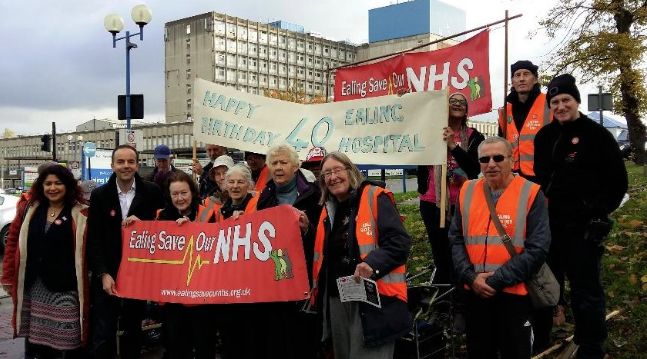
Ealing Hospital 40th Birthday Party Music Hall on 5th November 2019 at The Viaduct Pub Hanwell
Ealing Hospital formally opened its doors to patients on Bonfire Night 5th November 1979. Exactly 40 years to the day, local activists are throwing a birthday party for the hospital in the form of a ‘Music Hall’. In the best Victorian tradition, there will be popular Music Hall songs, comedy, verse, specialist acts and variety entertainment. All the artists are appearing for free and they include NHS staff and local professional and amateur performers. The local theatre company ‘A Wonderful Adventure’ (www.wonderfuladventure) is an active partner in mounting the event.
It’s £10/ticket which includes some finger food.
To book tickets go here:
Venue details at:
For more information text Eric Leach on 07836 275278 or email eric.alan.leach@gmail.com
Any profit will be given to Ealing Save Our NHS
Eric Leach