Home Blog Page 18

If You Want to Save the NHS – Don’t Vote Conservative – May 2017

0


Issue: 48

May 2017


This occasional newsletter is researched, written and edited by a group of concerned residents in Ealing, West London who want to preserve our NHS. We view the wholesale engagement of private, for-profit healthcare service suppliers as unnecessary, profligate and dangerous. Increased funding  is what is needed in our NHS – not financial cuts, closure of vital services service or privatisation.


If You Want to Save the NHS – Don’t Vote Conservative

I am not a ‘party’ political animal and I have never been a member of a political party. However I’m convinced that five more years of a Conservative Government will result in the destruction of the NHS as I’ve known it since I became an adult in the 1960s.


The current Government’s Sustainability and Transformation Plans (STPs) will mandate the creation of Accountable Care Organisations (ACOs). ACOs will be private consortia of NHS, Local Authority and possibly private companies which will determine how and where money is spent for healthcare and social care. NHS bodies and Local Authorities will no longer hold the purse strings or push the management levers in the delivery of care. ACOs will be the fixed price, 10/15 year contract vehicles for cutting the national annual care bill by £22 billion.


The North West London STP, along with its aberrant precursor the NHS NWL Shaping a Healthier Future (SaHF) plan, will deprive Ealing – a town with more residents than Leicester or Sunderland – of a Major Hospital. The NWL STP will deprive the 426,000+ patients registered at the 76 Ealing GP surgeries of hospital A&E and Intensive Care services in the town. The number of beds at Ealing Hospital currently stands at 288. Under the Conservative party-driven STP this will be slashed to just 50 beds.


Under a ‘hard’ Brexit our new Tory Government might eject all EU/European citizens from the UK. EU/European countries might reciprocate and eject British nationals from their countries. The net result of this will be the loss of tens of thousands of care workers and the influx of thousands of new patients needing care.


I do hope that all Political Parties will explicitly spell out in their manifestos what their plans are for funding and improving care services. On 2 May 2017 the Shadow Health Minister revealed some of Labour’s NHS manifesto intentions. He said Labour, if elected, would stop the planned closure of hospital A&E units. He also said that Labour would introduce a moritorium on implementing STPs. The former intention will be clear to most voters whilst the latter won’t mean that much to the majority of voters who won’t have a clue what STPs are all about. Labour wants to set up ‘NHS Excellence’ which will be a new body which will involve local people in reviewing STPs.


Locally the Conservatives have made it very clear that they agree with Government Shaping a Healthier Future (SaHF) and Sustainability and Transformation Plan (STP) intentions to decimate Ealing Hospital. They are unwilling to admit that by reducing beds from 288 to 50, closing A&E, Intensive Care and Surgery what we will be left with not qualify as a hospital in any meaningful sense. Ealing Labour Party has made it very clear that they support the retention of Ealing District General Hospital and oppose the SaHF and STP proposals.


‘999 call for the NHS’ and Public Law Firm Leigh Day Launch STP ACO Judicial Review Initiative

This initiative will select a Clinical Commissioning Group (CCG) and request a Judicial Review (JR) of the CCG’s STP plans for new local NHS and social care organisations to operate ‘fixed, pre-set population budgets’. These so called capitated budgets will force the NHS to behave like an insurance company. Crowd funding is being used to raise £25,000.


To contribute and to find out more go to:


www.crowdjustice.com//challenge-stp/


One of the issues with regard to a JR concerning ACO/MCP/ACP/LCO/PAC ‘models of care’ – which are the projected vehicles for implementing these fixed, pre-set population budgets  – is that there is scant information on any of these in any of the STPs that I have read.


What the STPs don’t spell out re ACOs and their variants include:

+ 10/15 year fixed price contracts

+ Specific service profiles for a specific population

+ Consortia made up of a variety of organisations including public, private, charity and voluntary organizations

+ Contract values in the £billions


Bids are In for a £6 Billion Accountable Care Organisation (ACO) Contract in Greater Manchester

This is the largest ever NHS services tender. A 10 year ACO contract is on offer for the provision of community health, social care, primary care, mental health and voluntary sector care services for 600,000 patients. The closing date for bids was 28 April 2017. The ACO was originally supposed to go live in April 2017 but now the projected start date is 1 April 2018.


The lucky contract winner will be referred to as a Local Care Organisation (LCO). Not included in the LCO services are so called ‘core’ GP services. The organisation ‘commissioning’ the LCO is Manchester Health and Care Commissioning – a non-statutory collection of the Manchester Clinical Commissioning Groups and the city Council. The commissioners are quoted as saying that the LCO is a strong part of Greater Manchester’s pioneering devolution arrangements. We all know how to identify pioneers don’t we – they are the folks with arrows in their backs.


One does wonder how much Manchester residents know or understand what this LCO is all about. One can only speculate how many residents were involved in the formative stages of conceiving the LCO Invitation To Tender – never mind in developing the concepts for the LCO. My guess is that no residents were involved.


At a national level it’s of great concern that the ACO/LCO concept has not been debated in Parliament and there is no Government legislation or regulations which legitimise this £6 billion undertaking.


Be Very Scared of Moves Towards PPPs and the ‘Alzira Model’

Hidden under the bonnet of many of the STP vehicles are some components with very chequered histories. Two of these are PPPs and the ‘Alzira Model’. The fact that both are being talked about by NHS England and their prime Accountable Care Organisation (ACO) NHS consultants PwC is worrying.


What is PPP?

PPP stands for Public-Private Partnership and is a funding model for public infrastructure and services. A PPP contract will be long term and will involve at least one public body and one private body. PPPs are used to conceal public borrowing while providing long term State guarantees for profits for private companies. In the NHS the most common PPP contracts are 30/60 year PFI contracts for hospitals. PFI interest payments are often so high that they threaten the financial viability of hospitals. The most spectacular PPP failure was the London Underground Metronet PPP. It failed in 2007 after just five years and cost the tax payer £410 million to bring the work back under public ownership.


What is the ‘Alzira Model’?

The Alzira Public Private Investment Partnership (APPIP) was created in 1997. Signatories to the partnership were the Spanish Valencia Government and RSUTE – a joint venture special purpose vehicle. The RSUTE shareholders were a medical insurance company and Spanish banks. The function of the APPIP was to construct a hospital and manage both the clinical and non-clinical facilities in the town of Alzira. Funding would be calculated by applying an annual ‘Capitation’ fee of 204 Euros per resident. This capitated budget approach is exactly the one favoured by all ACO undertakings. The hospital was built and began operating as La Ribero Hospital on 1 January 1999. As the first PPP hospital in Spain there was local hostility and initially few patients were referred to the hospital. High interest payments drove wages down and led to an unhappy workforce with union protests. Staff at the La Ribero Hospital had less job security, lower pay scales and longer working hours than staff at non PPP Spanish hospitals. One of the local banks involved became overstreched and went bust in 2001.


Following losses, the APPIP contract was terminated in March 2003. Clearly the capitation fees had been set too (optimistically) low. However nothing succeeds like failure and the Valencia Government had to pay RSUTE 69.3 million Euros on termination. RSUTE II sprang into life and paid the Government a premium of 72 million Euros for a new APPIP contract. The new contract was a bigger deal which served 245,000 inhabitants, offering primary and specialist care, managing 30 health centres and two outpatient clinics as well as the hospital. The annual capitation fee was initially 379 Euros/head (as opposed to the failed project’s 204 Euros/ head). There was even an annual capitation uplift every year! By 2012 the annual capitation had soared to 639 Euros.


Under RSUTE II there have been doctor shortages, staff dissatisfaction and a doctors’strike in 2007. There were also claims that RSUTE II ‘cherry picks’ the most profitable medical and surgical specialities, whilst referring HIV and other chronic disorders to other hospitals.


Much of this information has been extracted from two papers jointly authored by the University of Zaragoza and the University of Manchester/Manchester Business School. The authors found it extremely difficult to get hold of reliable and complete data on the financial performance of the PPP. However they conclude that the original RSUTE project was never going to be viable. As for the re-negotiated RSUTE II PPP, it has proved to be very costly to the Government.


The questions that must be asked include whether the PPP/Alzira Model approach is a viable way of achieving cost savings and or service improvement. The NHS paid for 20 Morcambe Bay clinicians to visit Alzira and study the functioning of the PPP in 2014. However there’s nothing in the NHS Morcambe Bay Vanguard that even vaguely resembles the Alzira Model. Maybe the clinicians weren’t impressed – and maybe that represents taxpayers’ money well spent on the trip.


Smoking Ban at Scottish Hospital Judged Unlawful by Supreme Court


On 11 April 2017, the Supreme Court overturned a decision by the Scottish Inner House of the Court of Sessions to implement a comprehensive smoking ban at Carstairs Hospital. Carstairs Hospital had previously implemented a truly draconian, comprehensive ban on smoking anywhere (inside or outside). The ban even extended to visitors being searched and having tobacco products confiscated.


Charles McCann, who suffered from a mental health disorder and who was detained in the hospital, applied for a Judicial Review to challenge the ban. The Supreme Court judged that Mr McCann’s rights under domestic law and Article 8 of the European Convention on Human Rights had been infringed. In effect the decision allows patients and their visitors to smoke in the hospital grounds.


Although this decision relates to a Scottish hospital let’s hope it encourages someone to challenge the idiotic no smoking anywhere ban implemented by the West London Mental Health NHS Trust.


CAN WE AFFORD TO CLOSE ANY MORE A&E DEPARTMENTS?

0
EVIDENCE FROM NORTH WEST LONDON.  By Dr Gurjinder Singh Sandhu
 
 
In this readable and alarming piece of work Dr Sandhu talks about the impact of cuts on North West London so far and the risks faced by even more.  He covers the fact that cuts are concentrated in the most deprived areas, the crisis in social care, the increasing population and proportion of elderly.
 
“Despite a sharp deterioration in A&E performance in North West London following the closures already made, the STP envisages closing the A&E at Ealing hospital by 2021 and closing the A&E at Charing Cross Hospital at some point after that. The STP also proposes to consolidate acute services from nine onto five sites in North West London….”
 
“In this respect North West London is further down the STP pathway than any other region in England and there are important lessons to learn….”
 
“Since the closure of Emergency Departments in North West London in
September 2014, each successive winter has seen deterioration in Type 1 A&E
Performance”
 
“Patients trapped in acute hospital beds due to shortages of social care provision
have an important impact on hospital capacity, patient flow and the ability of staff to
admit new patients, including emergency patients, further compounding the A&E
crisis.”
 
Dr Gurjinder Singh Sandhu is a Consultant Physician who currently works in Acute Medicine and is developing an interest in health inequalities in elderly care medicine. Dr Sandhu is an active member of Ealing Save Our NHS.
[pdf-embedder url=”https://ealingsaveournhs.org.uk/wp-content/uploads/2017/04/DrSandhu_AE-closures-NW-London_CHPI_FINAL_19Apr.pdf”]
 

Time to Abandon the Failing NHS NW London SaHF Healthcare Project – April 2017

0


Issue: 47

April 2017


This occasional newsletter is researched, written and edited by a group of concerned residents in Ealing, West London who want to preserve our NHS. We view the wholesale engagement of private, for-profit healthcare service suppliers as unnecessary, profligate and dangerous. Process improvement is what is needed in our NHS – not revolution.


Time to Abandon the Failing NHS NW London SaHF Healthcare Project

In the Summer of 2012 NHS North West London published proposals which were aimed at both improving healthcare services and cutting healthcare costs. These proposals were called ‘Shaping a Healthier Future’ (SaHF). The proposals noted that changes were already underway and that it would take ‘over three years’ to complete the changes. The SaHF proposals involved reducing the number of Major Hospitals from nine to five, closing four hospital A&E units, reducing the number of Acute hospital beds and replacing 30% of Acute hospital care with care outside hospitals.


Four and a half years later we have to ask these questions: have the proposals been implemented and have service improvements and cost cutting aims been met? This paper attempts to answer both questions.


+ SaHF Has Not Cut Costs

SaHF planned to cut costs by 4% each year. NHS NW London spent £3.4 billion in 2011/12. So three years of cost cutting should have cut costs by £408 million. However there have been no SaHF announcements or press release about cost saving. No doubt if any cost savings had been achieved SaHF would have proudly and loudly trumpeted them. On 22 February 2017, Ms Tessa Sandall, NHS NW London CCGs’ Managing Director was asked in a public meeting what the SaHF cost savings amounted to. She replied that she did not know. When asked for a ‘rough estimate’ she declined to answer.

Clearly SaHF implementation has resulted in zero cost savings.


+ Healthcare Services Have Not Improved During the SaHF Project

The healthcare services that are key to a seriously ill patient’s survival are Accident & Emergency (A&E) services. The 2012 plan specified closing four hospital A&E units. Only two however have been closed. They were closed in September 2014. Immediately after these closures, hospital A&E performance throughout NW London plummeted and has never recovered. North West London hospital A&E units are regularly some of the worst performing in England with Hillingdon Hospital often featuring as having the worst performing hospital A&E unit in the country.


+ Out–of-Hospital Care: When and Where?

SaHF promised seven day a week out-of-hospital care. This has not been delivered for either physical health or mental health. So called ‘Health Centres’ were to be provided to provide ‘networked’ GP services such as therapy, rehabilitation, diagnostics or specialist imaging. Where are these ‘Health Centres? They don’t seem to exist. SaHF promised improved access to GPs. Locally, regionally and nationally we are all having to wait longer to see our GPs. SaHF told us that our GP will co-ordinate care across all services and will have overall responsibility for our health. This is clearly not the case. In many parts of NW London so called Referral Facilitation Services determine whether your GP referral for you to see a specialist/consultant/hospital department is granted or not.


+ Mental Health Services Have Not Improved

The largest mental health NHS Trust in North West London is the West London Mental Health Trust (WLMHT). In 2015 and 2016 CQC carried out full inspections of WLMHT. Both inspections rated the WLMHT poorly. In fact the December 2016 inspection report rated 9 of the 11 mental health services as ‘Requiring Improvement’.With one in five adults suffering from mental health problems at any point in time this casts WLMHT and SaHF in a poor light. Incredibly the 2012 SaHF proposals made no explicit mention whatsoever about improving mental health services. For this reason alone the SaHF project was completely flawed from day one and should never have been begun.


+ The SaHF Business Case: Four Years Late, Incomplete and Unrealistic

In 2012 residents searched in vain for a detailed SaHF business case. It could not be found. It was only in December 2016 that a partial, detailed SaHF business case emerged. Amazingly the SaHF ‘over three years’ project was now a ten year project. I really can’t recall being consulted on that massive project extension!


Entitled ‘Strategic NHS NW London Outline Case Part 1’ the document contained a request for money for NHS building work in ‘outer’ North West London. Apparently SaHF wants H.M. Treasury to hand over £513 million for this building work. (Sometime in the future an additional £377 will be requested for ‘inner’ North West London NHS (Part 2) building work). To give some impression of just how unrealistic this request for capital funding actually is one only has to study Chancellor Hammond’s Budget proposals in March 2017. For NHS building work over the next three years across the whole of England the Chancellor has allocated just £325 million. Of this only £130 million will be spent this year.


+ Surely the NW London Sustainability and Transformation Plan (STP) and the SaHF Can’t Co-exist?

In December 2014 NHS England announced a Five Year Forward View on healthcare and social services. This required all regions to produce a five year plan to improve services and cut £22 billion off annual care costs by 2020/21. These regions were designated ‘footprints’ and there are 44 of them. NW London’s footprint published its STP in October 2016. The cost savings target was annual cost savings of £1.4 billion in 2020/21. Integrating healthcare and social care services, improving mental health services and illness prevention are key elements of STPs. The future delivery vehicle for the cuts and the changes for care delivery improvement will be Accountable Care Organisations (ACOs). ACO’s in NW London will be private consortia of Local Authorities, NHS CCGs, NHS Trusts and federations of GP surgeries. These ACOs will enter into 10 year, fixed price care delivery contracts to deliver specific services to specific populations.


The NHS SaHF project – unlike the STP – completely ignores social care, integrating healthcare and social care, mental health services and illness prevention. SaHF makes no reference to ACOs, which in future will be the sole care delivery vehicle. SaHF is run by CCGs with no formal management roles for Local Authorities, NHS Trusts and GP surgery federations. In fact SaHF follows the commissioner/supplier split laid down in the 2012 Health & Social Care Act. The STP requires Local Authorities, CCGs, Trusts, GP federations and other public and private bodies to all work together. In the STP all these bodies are peers in private ACO consortia and the commissioner/supplier requirements of the 2012 Health and Social Care Act are completely ignored.     


It is perverse, utterly confusing and unproductive for NHS NW London management to attempt to run SaHF and the STP in parallel. STP is part of a 2016 national initiative and hasn’t had a chance to succeed or fail as yet. However the SaHF is a 2012 regional initiative which has been failing for over four years.        


ACO Progress is Slow

Accountable Care Organisations (ACOs) are, apparently, the future delivery vehicles for all State funded care services. All 44 Sustainability and Transformation Plans (STPs) have ACO intentions ‘hidden’ inside them. ACOs will be private consortia of Local Authorities, NHS CCGs, NHS Trusts and federations of GP surgeries who will ‘enjoy’ long term, fixed price contracts to deliver specific care services to a well defined population. In North West London the contracts will be for ten years and the first ACO is likely to be for the care of the elderly.


On 31 March 2017, NHS England published a 75 page report entitled ‘Next Steps on the NHS Five Year Forward View’. In the May 2017 issue of this newsletter we’ll examine the GP and mental health aspects of this report. On the ACO front, new jargon appears in the report. It tells us that some STPs will become Accountable Care Systems (ACSs) in years 2017/18 and 2018/19. It’s clear that ACSs are just transition bodies prior to fully blown ACOs.      


However there are no STPs identified as certainties for ACS status. Eight STPs are listed as ‘likely candidates’. None of them are in London. Overall these ACS intentions are somewhat lack lustre. Where is the brave new world of 10/15 year fixed price ACO contracts? Management consultants and then NHE executives have been beavering away on  STPs and ACOs now for at least two years. The ACO Vanguards were announced just over two years ago. Just how long do these experts need to create the brave new ACO world? Realism however is alive and well in the report as terms like ‘complex transition’, ‘staged implementation’ and ‘working towards the ACS goal’ reveal the authors’ sensitivity about the scale of the ACO dream.


But all is not sweetness and light in the ACO firmament. Two recent stories catch the eye:


+ Torbay and South Devon Integrated Care Organisation Collapses

The Torbay and South Devon Integrated Care Organisation was set up in October 2015 as a Multi-Speciality Community Provider (MCP) flavour of an ACO. It used a system provided by US healthcare company Kaiser Permanente. Torbay and South Devon NHS Foundation Trust has pulled out of the MCP claiming its dislike of the ‘risk sharing’ element of the contract. Torbay Council has revealed a £12 million overspend by the MCP and has warned of substantial financial risk to the Council.


+ Northumbria Healthcare Falls At First Financial Hurdle

Due to go live on 1 April 2017, the launch of this ACO has now been postponed indefinitely. Northumberland CCG claims it is broke with a projected annual debt of £41 million. NHS England has also been caught telling the NCCG to refer only to an earlier estimated debt of just £5 million.


Only time will tell if the ACO will follow join the Rogues Gallery of NHS failures. At some future time will we add it to polyclinics, NPfIT, Mid-Staffordshire, care.data, Shaping a Healthier Future, the Better Care Fund and perhaps STPs themselves?


Lancashire County Council Planning to Annex 8 CCGs

Democratic accountability may well be alive and well in Lancashire where regional government is planning to run all care services in the future. According to Local Government Chronicle (23 February 2017) Lancashire County Council (LCC) commissioned PricewaterhouseCoopers (PwC) to propose a way forward for running care services. PwC proposed the creation of five integrated care providers, with LCC being the ultimate boss. The eight Lancashire CCGs would effectively be annexed. LCC seems keen on the proposals but NHS bosses are seemingly not impressed.


30,000 Excess Deaths in 2015: Researchers Conclude Cuts in Care Costs is the Main Cause

There was a significant increase in mortality across England and Wales in 2015. At 30,000 excess deaths this was the largest recorded increase in mortality since 1945. These deaths have been analysed by the London School of Hygiene and Tropical Medicine, the University of Oxford and Blackburn and Darwen Borough Council. The analysis was published in the ‘Journal of the Royal Society of Medicine.’


The excess deaths were largely in the older population who are the most dependent on health and social care services. The researchers found that NHS data revealed clear evidence of health systems failures. Almost all targets were missed including ambulance call-out times and A&E waiting times, despite unexceptional A&E attendances compared to previous years. Staff absence rates rose and more posts remained empty as staff had not been appointed.


The researchers say that there are already worrying signs of an increase in mortality in 2016. Without urgent intervention, they say, there must be a concern that this trend will continue.


It’s hard not to conclude that implementing STPs to cut £22 billion off the annual healthcare services bill by 2020/21 will lead to much greater increases in annual excess deaths.


WHAT’S GOING ON WITH OUR HOSPITALS?

0

It’s a Frightening Crisis


For some time the media has highlighted the crisis in our hospitals, especially in A&Es.  Ambulances that are needed elsewhere are stuck outside A&Es, sometimes for hours because there are no beds to put patients into.  In North West London we’re in one of the worst areas. Recently all local A&Es were in the bottom 12 for urgent cases, with Hillingdon Hospital the worst in England.  Obviously the closure of A&Es at Hammersmith and Central Middlesex Hospitals was the main contributing factor.  That is to say obvious except apparently to the senior health managers in charge.  


Unbelievably, they are pressing ahead with plans to close Ealing A&E. It’s a familiar story, they are seriously under resourcing Ealing Hospital.  Unless this process stops, the Hospital will become unviable, at which point will close the A&E.  Without A&E backup most other services can’t function, so almost 300 beds would go too.  


I’m not making this up, it’s in the “Delivery Plan” for the STP, recently uncovered by a Freedom of Information request.  The Plan includes


  • The loss of 3,658 NHS jobs in NW London next year 17/18 – rising to 7753 job losses by 20/21
  • A cut of almost 50,000 hospital admissions and 222,370 outpatient appointments cut by 20/21. Already patient waiting times for planned operations are at record levels.
  • The loss of 500 – 600 hospital beds with the closure of Charing Cross and Ealing as major acute hospitals
  • A reduction in A&E attendances by 64,175 in the next 5 years.


Ealing Hospital would end up as a collection of clinics with the Urgent Care Centre which, like many other NHS services has been tendered out and is now privately run – despite the Hospital location and use of the NHS logo. A year ago, a ‘fly on the wall’ TV documentary, exposed how badly it struggled to maintain standards.


Who Orders the Cuts and Privatisation NHS Services?


In Ealing, it’s the Clinical Commissioning Group, or CCG, who hold the purse strings.  They claim to be acting on ‘clinical’ advice, they are following instructions from the “Shaping a Healthier Future” tem, which is now morphing into the “Sustainability and Transformation Plan”.  Behind these bodies is NHS England, controlled by the Health Minister.  Their managers are appointed to follow nationally laid down directives.


The one multi-million pound growth area is the private management consultants and public relations advisors.  NHS budgets in North West London have millions to these people to organise NHS restructuring and ‘savings’.  You may have come across them as they have toured community meetings with documents and glossy leaflets explaining that health services will be much better after they implement more cuts.  According to these spin doctors, healthy living advice and community clinics will be a better replacement for expensive hospital treatment.


Sustainability and Transformation Plans


S.T.P.s are aimed to hugely cut health and adult social service spending.  There is no democracy or accountability, none of this has been through Parliament, local Councils have been bypassed, even though they are supposedly in charge of adult social care. England has been divided up into 44 great big areas for each of which handpicked senior managers have been appointed to draw up a plan to “meet the budget”.  Hospital Trusts, CCGs and local authorities have been told they must buy in to the process. Each of the STP areas is huge, covering several local authorities, CCGs and hospital trusts – far too big for local communities or local accountability even supposing there were any structures in place.  Staggeringly, most of them have been bullied and cajoled into signing up for the STP without even being given the full plans.


STPs are being sold as plans to integrate adult social care, health and hospitals.  But integration of services is totally undermined by the STPs having far smaller budgets.  It’s a nightmare.  Local authority budgets for social care, especially for the elderly, have been cuts so much that even the private companies now running most care homes on a shoestring are starting to go out of business.  As a result, people are stuck in hospital as there’s nowhere to go.  


Ealing Council Says No


In our area of North West London, the STP is continuing the existing cuts programme with the Orwellian title of ‘Shaping a Healthier Future’ run by a shadowy and unaccountable organisation of the same name, based in Marylebone.  As well as the closure of A&Es at Hammersmith and Central Middlesex, award winning and much needed Ealing Maternity Ward has been shut down, followed by the Charlie Chaplin children’s ward, which means children can’t go to Ealing A&E.


The whole project has been a disaster for our community and to its credit, Ealing Council has defied Government pressure and refused to endorse the STP, along with Hammersmith and Fulham Council.  They have gone public with their defiance and even organised a public meeting to highlight the problem.


Analysis shows that cuts and closures will hit the most deprived areas in North West London.  Many people will simply be unable to access services, as highlighted in the Delivery Plan.  They will be left attempting to rely on already overstretched GPs.


Look – the Emperor has No Clothes


Locally and nationally opposition to STPs is growing. Ealing and Hammersmith have been joined by other Councils.  Retired senior health managers have gone public, saying the STPs won’t work.  Dr Tracy Batten, recently resigned as the boss of 5 West London Hospitals.  Even the British Red Cross has said that we are facing a “humanitarian disaster.”

But the health bosses are still in denial because they are hired to carry out policy and to tell their superiors that all is well.  Everyone can see the problem except for the emperor’s courtiers – paid not to see it.

Stop Privatising the NHS!

0
While the focus is on the massive cuts and closures programme, another nasty process is taking place within the NHS – privatisation.  More and more parts of the NHS are now being run by private profit making companies.  These companies are allowed to use the NHS logo, so it’s not obvious what’s going on. For example,the Urgent Care Centre at Ealing Hospital is private, along with many other services.
£8.7 billion pounds of NHS money – our money is now given to private providers to operate services on behalf of the NHS.  That’s 7.6 % of the overall budget and it’s growing all the time.
Plans to cut and restructure the NHS are being drawn up at great cost – not by NHS staff, but by private consultancy firms.  This article shows the fat cats are getting so confident they think it’s THEIR RIGHT to make profit out of our NHS.  Just a few miles away from us in Surrey, Virgin are suing the local NHS!
Read this article to know more

It’s Time to Abandon the Failing NHS NW London SaHF Healthcare Project

0

“SHAPING A HEALTHIER FUTURE”


It’s Time to Abandon the Failing NHS NW London SaHF Healthcare Project


In the Summer of 2012 NHS North West London published proposals which they claimed would improve healthcare services and costs. These proposals were called ‘Shaping a Healthier Future’ (SaHF). The proposals noted that changes were already underway and that it would take ‘over three years’ to complete the changes, which involved reducing the number of Major Hospitals from nine to five, closing four hospital A&E units, reducing the number of Acute hospital beds and replacing 30% of Acute hospital care with care outside hospitals.


Four and a half years later we have to ask:


+ Have the proposals been implemented?

+ Have service improvements and cost cutting aims been met?


This paper attempts to answer both questions.


SaHF Has Not Cut Costs


SaHF planned to cut costs by 4% each year. NHS North West London spent £3.4 billion in 2011/12 which means that three years of cost cutting should have reduced spending by £408 million. However there have been no SaHF announcements or press release about cost saving. No doubt if any cost savings had been achieved SaHF would have proudly announced them.


On 22 February 2017, Ms Tessa Sandall, NHS NW London CCGs’ Managing Director was asked in a public meeting what the SaHF cost savings amounted to. She replied that she did not know. When asked for a ‘rough estimate’ she declined to answer and it appears that SaHF implementation has resulted in zero cost savings.


Healthcare Services Have Not Improved During the SaHF Project


Accident & Emergency (A&E) services are key to a seriously ill patient’s survival.  In the face of public opposition, the 2012 proposals specified the closure of four hospital A&E units. Only two however have been closed which were at Central Middlesex Hospital and Hammersmith Hospital. They were closed in September 2014. Despite claims in SaHF that these closures would somehow “improve” services, hospital A&E performance throughout NW London immediately plummeted and has never recovered. North West London hospital A&E units are regularly some of the worst delays for urgent cases in England with Hillingdon Hospital often featuring as having the worst performing A&E unit in the country.


“Out of Hospital” Care: When and Where?


SaHF promised seven day a week “Out of Hospital” care to replace cuts inside our hospitals, although the proposals were vague about exactly what it would consist of. Sadly, this promised care has simply not been delivered for either physical or mental health. So-called ‘Health Centres’ were supposed to be provided for ‘networked’ GP services such as therapy, rehabilitation, diagnostics or specialist imaging. But where are these ‘Health Centres’?  They don’t seem to exist!


SaHF also promised improved access to GPs, but locally, regionally and nationally we are all having to wait longer to see our GPs. SaHF told us that our GP will co-ordinate care across all services and will have overall responsibility for our health and this is clearly not the case. Instead, in many parts of NW London so called ‘Referral Facilitation Services’ determine whether your GP referral for you to see a specialist/consultant/hospital department is granted or not.


Mental Health Services Have Not Improved


The largest mental health NHS Trust in North West London is the West London Mental Health Trust (WLMHT). In 2015 and 2016 the Governments Care and Quality Commission carried out full inspections of thus Trust and both inspections rated the WLMHT poorly. In fact the December 2016 inspection report rated 9 of the 11 mental health services as ‘Requiring Improvement’.  With one in five adults suffering from mental health problems this casts WLMHT and SaHF in a very poor light, to say the least.


Incredibly the 2012 SaHF proposals made no explicit mention whatsoever about improving mental health services. If for no other this reason, the SaHF proposals were completely flawed from day one and should never have been begun.


The SaHF Business Case: Four Years Late – Unfinished, Unrealistic and Unprofessional


In 2012 residents searched in vain for a detailed SaHF business case. It could not be found. It was only in December 2016 that a partial, detailed SaHF business case emerged. Amazingly the SaHF ‘over three years’ project was mysteriously now a ten-year project. There has been no convincing explanation and no public consultation on that massive project extension!


Entitled ‘Strategic NHS NW London Outline Case Part 1’ the document contained a request for money for NHS building work in ‘outer’ North West London. Apparently SaHF wants H.M. Treasury to hand over £513 million for this building work. Sometime in the future an additional £377 will be requested for ‘inner’ North West London NHS (Part 2) building work. To give some impression of just how unrealistic this request for capital funding actually is one only has to study Chancellor Hammond’s Budget proposals in March 2017. For NHS building work over the next three years across the whole of England the Chancellor has allocated just £325 million.


Surely the NW London Sustainability and Transformation Plan (STP)

and the SaHF Can’t Co-exist?


In December 2015 NHS England announced a Five Year Forward View on healthcare and social services. This required all regions to produce a five-year plan to improve services and cut £22 billion off annual care costs by 2021/22. These regions were designated ‘footprints’ and there are 44 of them.


NW London’s footprint published its STP in October 2016 with an annual cost savings target of £1.4 billion in 2021/22. Integrating healthcare and social care services, improving mental health services and illness prevention are key elements of STPs. The future delivery vehicle for the cuts and the changes for care delivery improvement will be Accountable Care Organisations (ACOs). ACOs in NW London will be private consortia of Local Authorities, NHS CCGs, NHS Trusts and federations of GP surgeries. These ACOs will enter into 10 year, fixed price care delivery contracts to deliver specific services to specific populations.


The NHS SaHF project – unlike the STP – completely ignores social care, integrating healthcare and social care, mental health services and illness prevention. SaHF makes no reference to ACOs, which in future will be the sole care delivery vehicle. SaHF is run by Clinical Commissioning Groups with no formal management roles for Local Authorities, NHS Trusts and GP surgery federations. In fact SaHF follows the commissioner/supplier split laid down in the 2012 Health & Social Care Act. On the other hand, the STP requires Local Authorities, CCGs, Trusts, GP federations and other public and private bodies to all work together. These bodies will work together as peer partners in private ACO consortia and the commissioner/supplier requirements of the 2012 Health and Social Care Act will be completely ignored.     


The truth is that the STPs are also a vehicle for massive cuts to both the NHS and social care.  But on top of that, it is perverse, utterly confusing and unproductive for NHS NW London management to attempt to run SaHF and the STP in parallel. STP is part of a 2016 national initiative and hasn’t had a chance to succeed or fail as yet. However, the SaHF is a 2012 regional initiative which has been shown to be a failure over the last four years.  It’s time to bury SaHF so that NHS staff, GPs and Local Authorities can attempt to make the STP work – a daunting enough task in itself!


400 Turn Up to ‘Save Our NHS’ Public Meeting at Ealing Town Hall: NHS Bosses Refuse to Participate – -March 2017

0


Issue: 46

March 2017


This occasional newsletter is researched, written and edited by a group of concerned residents in Ealing, West London who want to preserve our NHS. We view the wholesale engagement of private, for-profit healthcare service suppliers as unnecessary, profligate and dangerous. Process improvement is what is needed in our NHS – not revolution.


400 Turn Up to ‘Save Our NHS’ Public Meeting at Ealing Town Hall: NHS Bosses Refuse to Participate

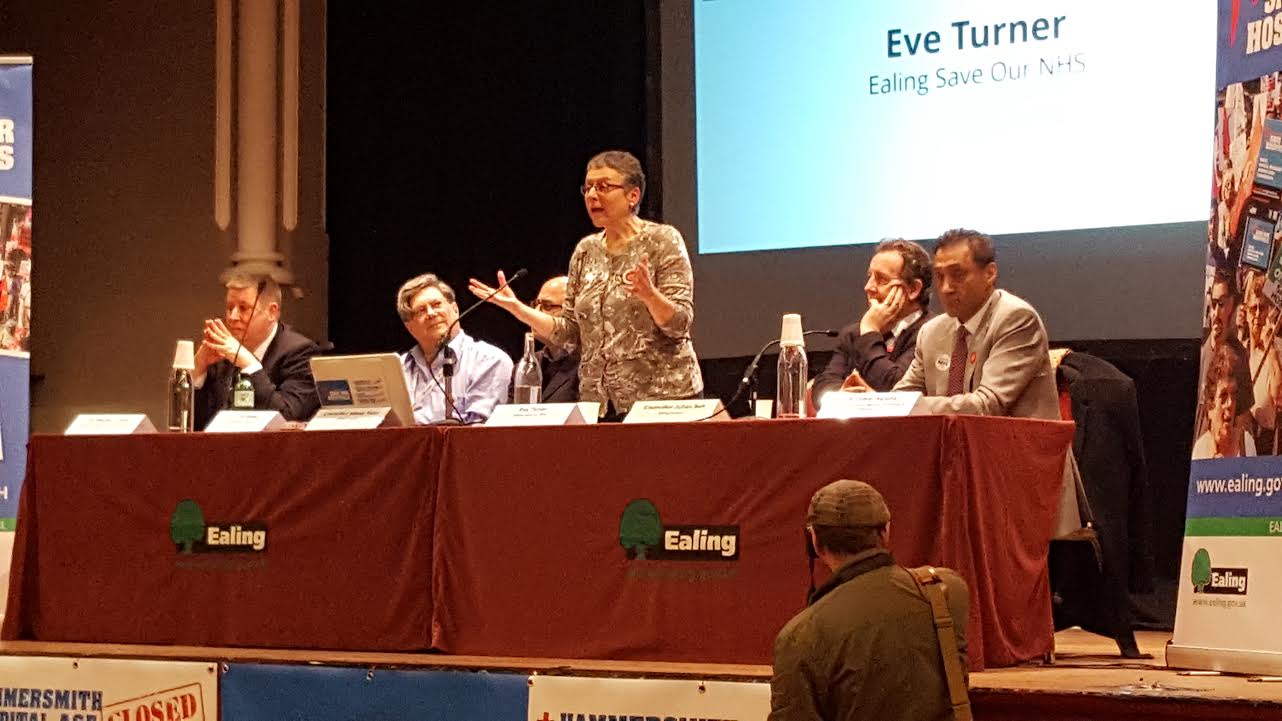
It was standing room only at the London Borough of Ealing’s (LBE) ‘Save Our NHS’ public meeting on 15th February 2017. NHS bosses were invited to attend the meeting – but declined LBE’s offer. As well as politicians, the platform speakers were James Guest, Chair of Healthwatch Ealing and Eve Turner, Secretary of Ealing Save Our NHS. James highlighted that in total 865 hospital beds are to be removed across north west London. Eve lit up the evening with her passion and commitment to continue to confront the lies NHS bosses have fed us all and to fight against the planned, massive cuts in finance, beds and staff.


What was revealed to the audience were details of planned cost savings, staff cuts, reduction in hospital beds, the downgrading of Ealing and Charing Cross Hospitals, and closure of A&E units. Facts and anecdotal evidence emerged about the current and future impact of savage cuts to social services. One patient had been discharged from hospital and sent for convalescence at Clayponds Hospital. Subsequent discharge from there was to the local Premier Inn Hotel – for four weeks!


Major issues raised at the meeting included delays in seeing GPs, waiting times at A&E, delayed elective surgery and inadequate mental health and social services. All residents were urged to quiz their GPs about future Primary Care arrangements. There was a general consensus that Ealing GPs had been consistently silent about any possibly negative aspects of planned cuts and changes.


It was pointed out that the latest healthcare and social care proposals  – the North West London Sustainability and Transformation Plan (STP) – followed the approach of the failing 2012 NHS NW London  ‘Shaping a Healthier Future’ (SaHF) plan. (One major difference however between SaHF and STP is that STP attempts to cut costs and improve healthcare and social care services. SaHF only tries to improve and cut costs for healthcare).    The Leaders of Ealing and Hammersmith & Fulham Councils confirmed that they had refused to sign up to the STP.


We heard horror stories from NHS staff about days when no carers and no A&E beds were available. Hillingdon Hospital A&E performance continues to be the worst in England. Councillor Aysha Raza pointed out that when Ealing hospital is downgraded many more patients and their loved ones will have to travel to Northwick Park Hospital in Harrow. She has researched the difficulties for Southall residents travelling to Northwick Park. It’s three buses and an overall journey time of 1 hour and 45 minutes!! She was not alone in criticising Dr Mohini Parmar, who seemingly runs Ealing Clinical Commissioning Group, SaHF and the STP. Aysha has noticed that Dr Parmar’s favourite technique when confronted in public with difficult questions or requests for evidence is to announce that ‘a piece of work is underway to provide/answer this’. However such work never seems to emerge as a report in the public domain.


North West London Councillors Quiz Care Planners

On 20 February 2017 I attended, as an observer, a meeting of the North West London Joint Health Overview & Scrutiny Committee. In theory two Councillors from each of the eight Local Authorities attend these six-monthly meetings. At any one time there were no more than ten Councillors attending. Claire Parker led the small team of NHS NW London bosses. On the agenda were big topics – the £513 million capital request for NHS SaHF building work in outer NW London, and the NW London STP.


Quite frankly some of the Councillors questions and observations were banal and irrelevant. However a few of them were brilliant. Councillor John Coombs from Richmond outlined that in Germany STP proposals had been implemented over the last two years. They were failing in spite of the fact that Germany has more doctors, nurses and hospital beds per 1,000 population than England.. Here in England the NHS  has cut hospital beds for years and plans to cut many more. One third of all our doctors are approaching retiring age. We have fewer trainee nurses. The Government is cutting back on immigration. Pharmacies (which could take some pressure off GPs) are being closed down. And we plan to reduce spending as a percentage of GDP on healthcare and social care over the next five years. Just how can these SaHF/STP proposals succeed? A spontaneous round of applause broke out from the spectators’ gallery. Ms Parker was clearly rattled by this and blurted out that there are problems but there’s plenty of waste in the care system and massive savings can be achieved by eliminating waste. I’d be surprised if anyone in the room found this a credible response.


The SaHF cash request, which might eventually find its way to H.M. Treasury, breaks down into £69 million for GP surgeries’ enhancements, £141 million for Out Of Hospital /Hubs and £303 million for Acute sites. The NHS expects to receive £9 million from selling off land on the Ealing Hospital site and £7 million from other land sales. No clues are provided as to where a new healthcare facility might be located on the Ealing Hospital site or when and where demolition will take place. Best estimate for when a new healthcare facility will open on the site is November 2022. The NHS bosses are keen to call the new facility a ‘Local Hospital’. What it will actually be is a Day Care Centre with some ‘Frail elderly beds’.


Painful statements which NHS bosses uttered include:


+ ‘ If we don’t get the £500 million – there is no plan B’


+  ‘We have more work to do on clinical models’

(Isn’t 4 years long enough to have sorted this out?)


+  ‘The ‘Evening Standard’ article about job cuts was wrong. We won’t be reducing staff numbers. The information came from draft documents’

(The fact is that the 7,753 jobs cuts by 2020/21 was contained in the formal response by the NHS to a Freedom Of  Information request)


+ ‘ The 2012 SaHF plans did not include any provision for illness prevention, mental health or social care services’


+  ‘We are not closing beds to save money’

(If this is true – why are they doing it?)


+  ‘The NHS NW London estate (i.e. its properties) is in worse condition than anywhere else in England’

(How can this have happened? Surely CCGs, Trusts, NHS England and now defunct PCTs should hang their heads in shame)


At the end of the meeting the Chair Councillor Mel Collins asked Ms Parker if the SaHF/STP proposals were either about residents’ health or cutting costs. She replied ‘residents’ health’. Just how refreshing would it have been if she had answered truthfully along these lines ‘They are about cutting costs. We have to reduce our annual spend by £1.4 billion by 2021. However we will do everything we can to provide the best care we can from 2021 with just 60% of the money we are currently spending each year’.


NHS NW London Clinical Commissioning Groups (CCGs) Argue With Themselves About Staff Cuts

Recently an activist with Brent Patient Voice submitted a Freedom of Information request to NHS bosses about future care staff STP cuts across NHS NW London. The detailed reply quoted 7,753 job losses by 2020/2021. The ‘Standard’ newspaper picked up and ran the story.


Incredibly the self styled ‘Combined CCGs of NW London’ responded to these reported cuts as follows:


‘We have no plans to reduce the overall number of health and care staff across NW London – in fact the total number is likely to increase to reflect increasing demand.’


Is this a case of the left hand not knowing what the right hand is doing? Or is someone simply lying?


New Health Centre on Ealing Hospital Site by November 2022?

Under the auspices of the failing 2012 ‘Shaping a Healthier Future’ (SaHF) project the NWL CCG supergroup now say that what they call ‘Ealing Local Hospital’ will be built on the Ealing Hospital site by November 2022. As SaHF has missed all previous deadlines we should take this date with a pinch of salt. More salt is needed to believe that H.M. Treasury will sign off ‘in principle’ £500 million of capital spending needed for this (and other building projects) by February 2018. However the so called ‘Full Business Case’ will not be created and submitted before September 2018 – with Treasury re-blessing expected by April 2019.


As for the new facility, it won’t contain a traditional A&E unit. No blue light ambulances will visit. There will be no Intensive Care beds or consultants, no Maternity unit, no Paediatrics unit. It will primarily feature lots of GPs, diagnostics, outpatients, an Urgent Care Centre and ‘extended services for frail elderly people’- whatever that might mean.  Apparently there will be 50 beds for the frail elderly.


There are no details on where this new, small facility will be built on the site or when the Major Hospital building that is Ealing Hospital will be demolished.


West London Mental Health Trust (WLMHT) Receives Poor CQC Ratings in Two Consecutive Years

The Care Quality Commission (CQC) carried out a full inspection of WLMHT in November 2016. Its report was published on 9 February 2017. The report does not make pleasant reading. CQC rated 9 of the Trust’s 11 services as ‘Requires Improvement’. Staff recruitment and retention, patients’ physical health needs, acute ward capacity, poor inpatient environments, and governance processes were cited as areas needing improvement. CQC did find some improvements since its inspection and critical report in 2015. These were in staff morale, better incident reporting, working with partners, creating a single point of access, enhanced assessment and treatment teams and a new Primary Care mental health service.


It’s not as though all London mental health Trusts are performing as badly as WLMHT. In December 2016, CQC rated South West London and St George’s Mental Health NHS Trust as ‘Good’ in 8 out of 10 services, and Barnet, Enfield and Haringey Mental Health Trust as ‘Good’ in 5 out of 10 services.

The NHS Better Care Fund – Yet Another Expensive, Cost-Cutting Failure

The NHS Better Care Fund (BCF) was first announced in June 2013. £5.3 billion was to be spent on transforming local health and social care services by pooling resources. Major goals were reducing the number of hospital admissions and making annual cost savings of £1 billion. In November 2014, the National Audit Office (NAO) branded the BCF plan a ‘shambles’. It could find no evidence as to how these cost savings were going to be achieved. The BCF went ‘live’ on 1 April 2015.


In November 2015 the Government froze the BCF at £3.8 billion.


So what has BCF achieved? According to the NAO very, very little:


+ The BCF target of reduced hospital admissions was 106,000. In fact over the BCF period hospital admissions have risen by 87,000!


+ The BCF has not achieved any cost savings. In fact the BCF has cost an additional £311 million!


+ Better co-operation between NHS healthcare bodies and Local Authorities social care organisations has been observed


+ There have been no announcements or measurements of ‘better care’.


BCF is another clear example of gross incompetence by Government, the Department of Health and NHS England. One hopes whoever was responsible for designing, goal setting and managing BCF will apologise, resign or be sacked. Norman Lamb MP when serving as a Government minister helped draw up these plans. He is quite obviously one of the culprits.


Massive demonstration to Save the NHS

0
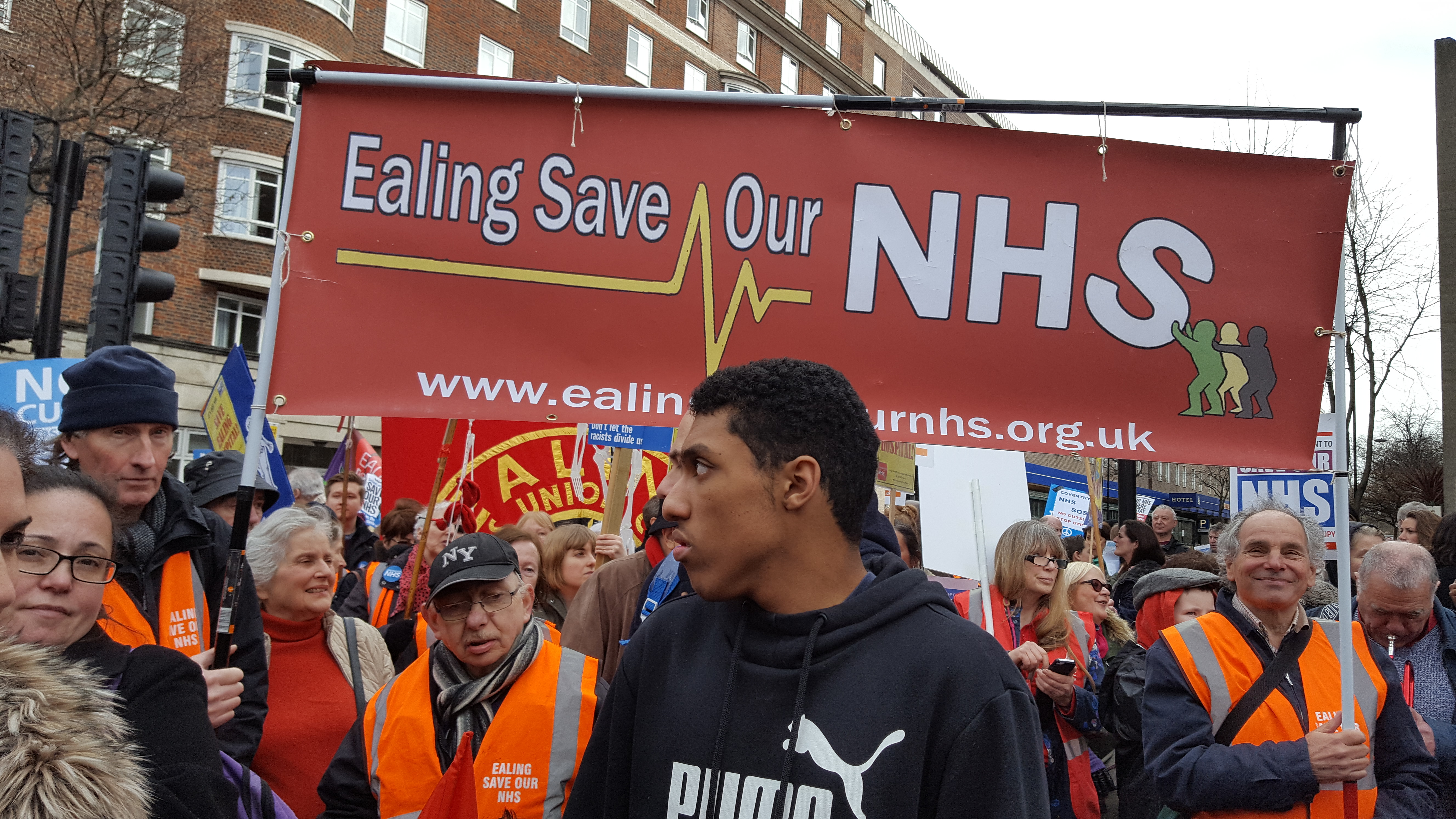
Health campaigners from Ealing Save Our NHS were joined by hundreds of other Ealing residents last Saturday for a nation march against NHS cuts.
150 people gathered at Ealing Broadway station to travel down together, while dozens more took different routes to join the protest in central London.  An estimated quarter of a million people took part, arriving from all over the country by coach and train.  They were from all ages and backgrounds.  Some were health staff; others had placards saying that the NHS had saved the lives of a family member.
People are getting desperately angry” said Oliver New, chair of Ealing Save Our NHS.  “The Government is making extreme budget cuts to Health and social care.  Here in North West London operations are beiFB_IMG_1488654681474ng cancelled and elderly people struggle more and more to access the most basic services.   They can’t keep trying to blame hospital staff or migrants who are the often very people trying to hold our NHS and care services together.  We are asking local health chiefs to drop their unsafe plans for massive cuts in hospital admissions and needed NHS staff here in North West London.”
Speakers at the protest included Labour Leader Jeremy Corbyn, Ealing Hospital consultant Gurjinder Sandhu, London GP Louise Irvine and Steve Cowan, the leader of Hammersmith and Fulham Council, which along with Ealing Council has publicly opposed plans to cut hundreds of beds and the blue light Accident and Emergency Departments at Ealing and Charing Cross Hospitals.
[gmedia id=23]

Huge Public Meeting in Ealing Town Hall

0
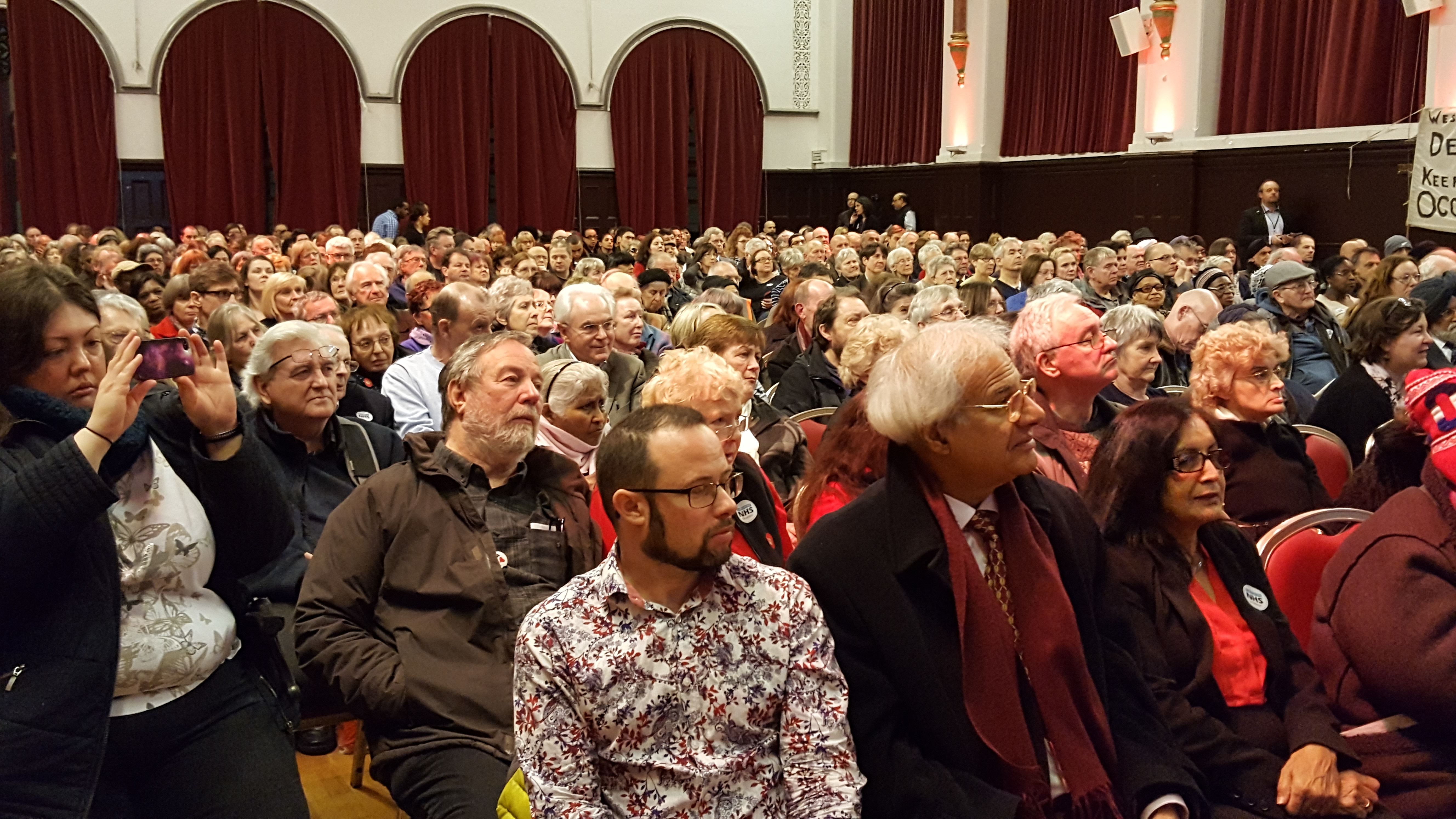
Victoria Hall in Ealing was packed to overflowing on Wednesday for a meeting about the future of local hospitals.  Hundreds of people turned up and some had to be turned away after the 450 capacity of the room was reached.
The audience heard that even with a national hospitals crisis, our North West London hospitals had the highest waiting times for extreme emergencies.  Staff had been urged to send patients home early to make more room.
20170215_195148ulian Bell, leader of Ealing Council, which organised the meeting, and Steve Cowan from Hammersmith and Fulham Council, stated that they were refusing to support plans to cut even more beds and the A&Es in Ealing and Charing Cross Hospital.  Mr Bell said that it would be the equivalent of a city the size of Leeds being left with no A&E.
Eve Turner, Secretary of Ealing Save Our NHS, was cheered when she called on people to get involved in campaigning and to support a national demonstration on March 4th.
Other speakers included GLA member and GP, Dr Onkar Sahota and James Guest from Healthwatch Ealing.  NHS chiefs declined the offer to attend the meeting.
 
20170215_202017Afterwards Eve Turner said:  “It’s beyond believe that even as they are sending people home early from overcrowded hospitals, the local health bosses are still defending their plans to cut hundreds of beds along with over 7,750 NHS staff, and reduce A&E capacity by 64,000.  But they have money for private spin doctors and management consultants – they paid one firm over &£30 million to advise them on cuts.  People are getting angrier all the time and I don’t blame them.”
20170215_195350

NHS North West London Healthcare Services – The Future Disaster in Numbers – February 2017

0


Issue: 45

February 2017


This occasional newsletter is researched, written and edited by a group of concerned residents in Ealing, West London who want to preserve our NHS. We view the wholesale engagement of private, for-profit healthcare service suppliers as unnecessary, profligate and dangerous. Process improvement is what is needed in our NHS – not revolution.


NHS North West London Healthcare Services – The Future Disaster in Numbers


Number of Staff, January 2017:  48,258

2017/2018    18/19 19/20      20/21

Staff Reductions (cumulative)

3,658             5,222 6,592    7,753

155 NHS STAFF WILL BE FIRED, ON AVERAGE, EVERY MONTH FOR THE NEXT 50 MONTHS


Outpatients

    Cut by 222,370 up to 2020/2021


Elective Admissions

    Cut by 34,437 up to 2020/20/21


Non Elective Admissions

    Cut by 64,175 up to 2020/20/21


Figures courtesy of an FOI response received by a Brent health campaigner.


Most of England Has Just One Massive Healthcare Care Cost Cutting Plan – But North West London Has Two!

In the summer of 2012 NHS North West London launched its ‘Shaping a Healthier Future’ (SaHF) project. It was an ‘..over three year’ programme of cuts and restructuring  which would achieve annual savings of 4% each year. SaHF involved downgrading four Major Hospitals (one of which is Ealing Hospital), closing four of the nine hospital A&E units, cutting the number of Acute hospital beds and replacing them with ‘Out-Of-Hospital’ (OOH) arrangements. However no annual cost savings have been achieved (by now they should exceed £400 million), just two of the A&E units were been closed (in September 2014) and A&E performance has been some of the worst in England ever since. Hospital Acute beds have been cut, but replacement OOH arrangements are nowhere to be seen.


Over a 10 month period in 2016 the NW London Sustainability and Transformation Plan (STP) was conceived in secret by over 200 civil servants. The STP is a five year cost cutting plan for care services. Its financial goal is to reduce the annual running costs for care services throughout the region by £1.3 billion by 2021. The STP’s mission is similar to SaHF but there are significant differences. STP covers both health care and social care services and the integration of the two. As such, Local Authorities are thrown together with NHS bodies to sort this out. SaHF however is just about healthcare; STP aims to mandate recent new strictures like seven day working and parity of esteem for the physically and mentally ill – neither of which were SaHF goals – in fact mental health is hardly mentioned at all in the SaHF. The STP also mandates  the creation of brand new, long term fixed private partnerships called (generically) Acountable Care Organisations (ACOs). ACOs do not feature in SaHF at all.


Many of us, watching the SaHF fail in 2015/16, presumed that it would be quietly retired and be replaced by its newer big brother the STP. But…no. December 2016 saw SaHF come roaring back with a 356 page business case. We had been waiting for this business case for some three years. Sadly this was only Part 1 of the business case – asking for just £513 million for building works in ‘outer’ NW London. Part 2 – aimed at building works in ‘inner’ NW London asking for £314 million – has yet to be published. To my astonishment Part 1 tells us all that SaHF has now become a 10 year project!


On 25 January 2017 Ealing Council Councillors met SaHF (and STP) bosses in public  for three hours to scrutinise Part 1 of the SaHF business case. The catchy title of the business case is ‘Shaping a Healthier Future: Strategic Outline Case (SOC) Part 1’. The publishers are a non-statutory body who call themselves ‘NHS North West London Collaboration of Clinical Commissioning Groups’.


A common complaint by Councillors was their struggle to understand much of the jargon and financial complexities. Some said that on the doorstep their constituents knew absolutely nothing about the proposed cuts and changes to local healthcare services. Councillors variously voiced their opposition to the downgrading of Ealing Hospital. Some could simply could not understand how this downgrade would improve healthcare for Ealing residents. Others worried about what would happen if H.M.Treasury refused to hand over the cash for building work. Others felt that Ealing residents would endure pain and worse travelling to remote hospitals after Ealing Hospital ceased to be a Major Hospital.


Councillors also wrestled with the concept of  ‘Hubs’. Hubs seem to be collections of GP surgeries (20,000 patients/hub). It’s possible that there will also be some social services and some mental health services residing in a Hub. Apparently Ealing will have three Hubs. One will be in/at Ealing Hospital site, with a new one in the north, probably on the GSK site in Greenford and a new one in the east probably on the site of Acton Health Centre. Each of the new Hubs will cost £20 million to build. SaHFers then referred to Hubs as Health and Wellbeing Centres. Councillors went nuts. One name or the other they cried. Let’s have Health & Wellbeing Centres they demanded. It was made clear that no more GP businesses were to be created. The SaHF business case described a future facility at Ealing Hospital as a ‘Local A&E’. Councillors struggled to get their mind around the idea that any hospital’s emergency unit with no Intensive Care and no arriving blue light ambulances could ever be labeled  ‘A&E’.


There were a number of instances when Councillors pressed for more evidence or risk assessment data and were fobbed off with promises to carry out further research /data gathering. Some Councillors understandably were dumbfounded by this. SaHF has had over three years and spent millions of pounds with management consultants designing and implementing these SaHF changes. Even though the SaHF business case (Part 1 only) is three years late, is it still incomplete?


SaHF stated that in 2025/26 there would be 22,000 fewer hospital admissions. Presumably this is an annual figure. No clues were provided as to how this figure for nine years hence had been calculated.


Healthwatch Ealing (HE) presented an update on its response to the business case. Chair James Guest reprised his oft stated reservations about the exclusive adoption of a ‘top down’ design approach. What was needed was a ‘bottom up’ approach to validate the ‘top down’ high level assumptions. This would begin with a detailed description and analysis of the current services and patient volumes at Ealing Hospital and grow into where these services and patient activities will be relocated. Other concerns highlighted included lack of evidence re ‘efficiency’ and Acute beds’ reduction proposals, patient access and transport issues, lack of overarching accountability, too few Hubs and Hubs in the wrong place, and lack of clarity and detail about the new provision of Frail Elderly Beds on the reconfigured Ealing Hospital site. The Councillors welcomed the HE report and SaHF agreed to respond in writing to it.


The most surreal part of the meeting was when the SaHF PR person did a sales pitch on ‘engagement’. The person also handed out copies of a questionnaire. SaHF wants to know how Ealing residents would like the £513 million to be spent. This is so insulting to Ealing residents. SaHF has published a 356 page business case to support the spending of this money on building works. It’s already decided how this money is to be spent.


NHS North West London Hospital A&E Performance Continues to be the Worst in England

Latest available A&E performance figures (November 2016) for the sickest patients (Type 1) reveal that four of the NHS NW London Hospital Trusts were amongst the ten worst performing in England. On one dreadful day (29 November 2016) Hillingdon Hospital managed to treat just 41% of Type-1 patients within four hours.


However NHS NW London top management continues to be in denial about this dreadful performance. On 11 January 2016 Dr Mark Spencer, Medical Director, on being confronted with these horrific performance figures said:


‘As ever, the NHS’s priority in NW London , as elsewhere, is on treating the sickest A&E patients first, whilst endeavouring to reach the 95% standard for all patients  whenever possible, even in winter’.


But…There Could be Much Worse to Come

The current A&E chaos still awaits the completion of the 2012 cost-cutting NHS NW London ‘Shaping a Healthier Future’ (SaHF) programme. SaHF promised us the closure of four hospital A&Es – but so far has closed just two, and both of those were in September 2014.


The NHS mantra underpinning SaHF is that 30% of those people occupying hospital beds should not be there. This percentage was first spouted by the NHS’s favourite management consultants McKinsey & Co in 2009. The way the logic goes is that if you have fewer people filling beds in hospital you can get rid of lots of those expensive hospital beds. Nationally 13,822 NHS hospital beds have been eliminated since 2010.  Our cost-cutting Sustainability and Transformation Plan (STP) wants to close another 500 Acute beds by April 2020.


Lies, Damned Lies and NHS Hospital A&E Attendance Data

Lying by politicians has reached unprecedented levels with regard to attendance levels  at NHS hospital A&E units. Secretary of State Jeremy Hunt MP told Parliament in December 2016 that A&E attendance levels were up 30%. Sarah Wollaston MP, Chair of the Health Committee, also said in December 2016 that there were ‘unprecedented levels of demand’ at NHS hospital A&E units.


But, these statements are completely untrue.


Colin Standfield has been collecting, collating and analysing NHS hospital A&E attendance figures for 3.5 years. For all attendances in London the uplift April 2013 to November 2016 is 6.15%, but the population rose by 3.69%. Throughout England for all attendances the uplift is 6.5%, but the population over the three years rose by 2.37%.


The actual increase across England in real terms is 4.13%.


As for NHS NW London generally and Northwick Park and Ealing Hospitals specifically, A&E attendance levels have reduced slightly over the three year period.


Are these politicians consciously lying? Maybe they are just spouting whatever NHS England and the Department of Health are telling them. So…is it NHSE and the DoH who are consciously lying?


Ealing Clinical Commissioning Board (ECCG) Governors’ Meeting 18 January 2017

I sat through almost three hours of this meeting. The meeting content variously astonished, depressed and surprised me. The NHS ECCG currently decides how our money is spent by the NHS to provide for secondary/hospital care for Ealing residents. However of the 20 Governors the three dominant members are part of the five person team which decides on how money is spent on secondary/hospital care for much of North West London. The fivesome run the consortium of five of the eight NHS NW London CCGs. They also run the NHS NW London 2012-2022 cost cutting project ‘Shaping a Healthier Future’ (SaHF) and the 2016-2021 NW London cost cutting project the Sustainability and Transition Plan (STP). SaHF and the STP are often presented as being the same but of course they aren’t. When any one of the three big bosses speak they may be speaking as ECCG, the NW London CCG consortium, SaHF or STP – or in fact as all four.


Engagement with the public is very poor at ECCG meetings. No hard copy of the documents to be reviewed/approved is provided. We were not even given an agenda. The ECCG had no interest in discovering who we were. No names or email addresses were collected, so even if answers were forthcoming at the meeting or afterwards there was no way the answers could be sent to any of us. Quite pathetic.


Ealing GPs apparently will soon be asked if they want to be controlled by NHS England or the ECCG. If they choose ECCG we will have the bizarre situation where the GP led ECCG will determine the finances and potentially the professional lives and deaths of 200+ GPs at 80 GP surgeries. This really cannot be right. It’s like giving your young children the right to determine how much pocket money they receive!


Apparently only 11% of those needing physiotherapy were receiving it within four weeks.


Local activists at the end of the meeting raised issues about the A&E crisis in Ealing and throughout NW London. The complacency which radiated from the ECCG Governors was appalling. ECGG would not accept that there was a local A&E crisis. ECCG said that each hospital collected A&E performance date in its own particular way. This made meaningful data aggregation across hospitals and across the country an impossibility. So according to the ECCG/CCG consortium/SaHF/STP measuring and comparing A&E performance data is a futile exercise. Unbelievable.


When questioned about bed blocking Clare Parker, one of the NHS bosses, said there were plenty of beds in North West London – 2.2 million in fact. I found this quite offensive. Some of these home beds would obviously be unsuitable from a clinical/medical perspective. For example the elderly, the mentally ill and substance abusers often live chaotic lives in unhygienic situations. Thousands of poor people are living in bed and breakfast accommodation throughout NW London. Also, more than 8,000 people slept rough in London during 2015/16. Ms Parker also blurted out that there were 4,000 acute beds in NW London. I found this surprising as the health emergency researcher John Lister counted just 3, 449 beds way back in 2012. However at 4,000 beds we have just over 2 beds per 1,000 (GP registered) population. The World Health Organisation recommends a minimum of 5 beds per 1,000. France has 6.4 beds and Germany 8.2 beds.


The issue of offering patients at Charing Cross Hospital the opportunity to have their operations at remote private hospitals was raised. One of the big issues was that these private clinics had no intensive care services on site and if an emergency arose delays in getting to an NHS acute hospital could prove fatal. . Incredibly what emerged was an amazing queue of 400 Charing Cross patients awaiting operations for over 52 weeks.


I tried in vain to ask my question, but was never invited to speak. The question I would have asked was one identified by eagle eyed Brent Patient Voice’s Robin Sharp:


‘Appearing for the first time in the 22 October 2016 version of the STP was £108 million savings from Local Authority Social Services. Can you please explain how these savings will be achieved?’


If I had asked the question I suspect the chances of my receiving a content bearing response would have been zero


Healthwatch Hounslow Annual General Meeting.

On 24 January 2017 I attended the Healthwatch Hounslow (HH) Annual General Meeting (AGM). We were told about many meaningful research activities. We also heard about extensive patient engagement. Staff and volunteers were thanked over and over again for their efforts. However, quite bizarrely, there was no written AGM report, no written financial report or any financial details, and no election of officers.


Hounslow CCG did a presentation on the NHS NW London Sustainability and Transformation Plan (STP). Two things not mentioned were the 900 hospital beds to be lost and annual savings of £1.3 billion to be achieved by April 2020 i.e. in just 38 month’s time.


Hounslow and Richmond Community Healthcare NHS Trust (HRCH) made a presentation. This was largely about how closely HH and HRCH worked together. Seemed a bit odd when the Healthwatch mission is to hold commissioners and suppliers to account.


Another presenter was a private company – LHM. LHM runs patience experience projects for HH – at what cost was never revealed. Maybe this is a good use of public money or maybe it isn’t.


None of the presentations mentioned the massive local A&E performance and bed blocking crisis. No mention was made of the ailing 2012 NHS NW London ‘Shaping a Healthier Future’ (SaHF) project. It is SaHF which has brought about the A&E crisis and has failed to make the promised aggregated annual savings of over £400 million.


Healthwatch Ealing asked from the floor what the impact on Hounslow residents might be when the implementation of the STP closes Ealing Hospital A&E. How would the STP deal with the inevitable increase in demand at West Middlesex Hospital? Sue Jeffers Managing Director of Hounslow CCG talked about various refurbishment and small expansions at West Middlesex Hospital. HCCG also referred to the future STP development of the six community healthcare hubs in Hounslow. As ever in such discussions NHS management failed miserably to explain how glorified GP surgeries (hubs) could in any way replace 24/7 hospital Acute care with co-located Intensive Care consultants. She didn’t even try the other approach which is to suggest that such care could be replaced by care at home. Her final throw away line was about the December 2016 NHS NW London SaHF business case (part one only) which stated that ‘outer’ NW London SaHF building work would need some £0.5 billion in capital from the Government. I am not alone in doubting that H.M. Treasury will agree to handing over this cash to the failed NHS NW London SaHF project.


In seven weeks time the same company which runs Healthwatch Hounslow will take over running Healthwatch Ealing for the next three years. Only time will tell whether they do a good job or not. There are many Healthwatch Ealing members who are very unhappy with how the STP will damage healthcare and social care services in Ealing. Let’s hope under the new administration these members remain active and help shape the local Healthwatch Ealing agenda for years to come.


Thanks for visiting us

Sign up to receive all the latest news from Ealing Save our NHS

We don’t spam! Read our privacy policy for more info.